Tom Lee: Why March Could Be an Up Month
Audio Brief
Show transcript
This episode explores market resilience amid geopolitical tension, featuring insights from Fundstrat's Tom Lee on why investors should look past headlines to underlying economic strength.
There are three critical takeaways for investors navigating current volatility. First, markets historically follow a sell the rumor, buy the news dynamic regarding geopolitical conflict. Second, a potential oil price shock may paradoxically lead to a more dovish Federal Reserve. And third, the recent pullback in technology and cryptocurrency sectors represents a buying opportunity rather than a systemic failure.
Regarding geopolitical risk, Tom Lee argues that while conflict headlines involving Iran and Israel cause immediate volatility spikes, they rarely alter US economic fundamentals. History suggests markets tend to sell off during the buildup to war but stabilize and recover once actual events unfold. Investors are advised to avoid panic selling, as the worst declines typically happen early before a rebound.
On the macroeconomic front, rising oil prices present a counterintuitive scenario. While traditionally viewed as inflationary, Lee suggests that in a fragile economy, an oil shock could act as a recessionary force. This would likely pressure the Federal Reserve to adopt a dovish stance rather than raising rates, shifting the narrative on monetary policy.
Finally, the conversation highlights tactical opportunities in tech and crypto. The recent sell-off in the Magnificent Seven and broader software stocks has reset valuations to attractive levels seen last April, signaling an overreaction. Similarly, while cryptocurrency prices face a winter period, the fundamental utility and development on networks like Ethereum suggest long-term value remains intact despite current price stagnation.
In short, investors should view the current geopolitical and sector-specific weakness as a mean-reversion opportunity rather than a signal to exit the market.
Episode Overview
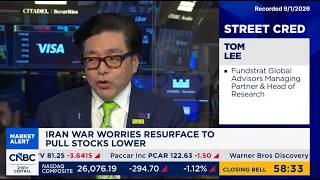
- This segment features Tom Lee, Head of Research at Fundstrat Global Advisors, discussing the market reaction to geopolitical tensions involving Iran and Israel.
- The conversation frames the current market volatility within a historical context, exploring how markets typically react to war headlines versus long-term economic fundamentals.
- Lee provides his outlook for the remainder of March, touching on oil prices, the "Magnificent Seven" tech stocks, and the current state of the cryptocurrency market.
Key Concepts
- Geopolitical Risk vs. Fundamentals: While headlines about war and conflict (like the Iran strikes) cause an immediate spike in the VIX (volatility index) and risk premiums, they rarely alter the underlying US economic fundamentals. Markets tend to sell off during the buildup to conflict but often recover once the actual events unfold ("sell the rumor, buy the news" dynamic).
- The Oil Price Shock Paradox: A spike in oil prices is traditionally seen as inflationary and hawkish for the Fed. However, Lee argues that in the current fragile economic climate, an oil shock might actually be deflationary or recessionary, potentially pushing the Fed to be more dovish rather than hawkish.
- Market Resilience and "Buying the Dip": Despite the initial sell-off and fear, Lee predicts that the worst of the decline will happen early in the week and that March will ultimately be a positive month for stocks. He views the recent pullback in tech and crypto as a buying opportunity rather than a sign of a deeper crash.
- Crypto Winter vs. Ethereum Utility: Lee distinguishes between the price action of cryptocurrencies (which is currently stagnant or "crypto winter") and the fundamental utility being built on networks like Ethereum. He suggests that while prices are down, the development activity indicates long-term value, even if current capital is fleeing to hard assets like gold.
Quotes
- At 0:48 - "In the past, markets kind of sell off into the build-up, and then they tend to do better once the battle begins. And I think this is going to be similar." - Explaining the historical pattern of market behavior surrounding geopolitical conflicts.
- At 2:29 - "In the past, you know, oil shocks are actually more at risk of maybe tipping a weak economy into recession... instead of thinking the Fed would be hawkish, I think the Fed might be dovish on a spike in oil." - Offering a contrarian view on how central banks might react to rising energy costs.
- At 3:59 - "At least in the case of the software stocks broadly, the entire complex kind of has fallen back to where they were last April. To me, that's clearly an overreaction." - Justifying why he believes the tech sector sell-off presents a mean-reversion opportunity.
Takeaways
- Investors should avoid panic selling during geopolitical headlines, as history suggests markets often stabilize and recover once the initial uncertainty of a conflict resolves.
- Monitor the "Magnificent Seven" and broader software stocks for potential entry points, as recent pullbacks may represent an overreaction that has brought valuations down to attractive levels.
- differentiate between asset price and network utility when evaluating cryptocurrencies; focus on development metrics (like tokenized funds on Ethereum) rather than just current trading prices to gauge long-term viability.