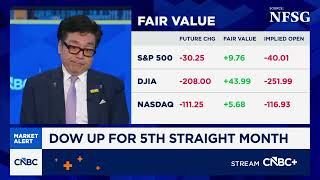
Tom Lee: Institutions Caught the Low. Retail Missed It.
Audio Brief
Show transcript
This episode covers Tom Lee's insights on the stock market with a focus on the tech sector and market breadth.
There are three key takeaways. First, the market is experiencing rolling bear markets rather than an impending crash. Second, retail investors are positioned to drive market broadening. Third, tech valuations remain reasonable compared to consumer staples.
Lee explains that narrowing market breadth is a sequential correction across sectors. While institutional investors caught the market bottom, retail investors still hold substantial capital. As they deploy these funds, expect a surge in small and mid cap stocks. Additionally, despite rapid gains, companies like Nvidia trade at lower price to earnings multiples than traditionally safe stocks like Walmart. Capital is simply shifting toward high growth areas.
In summary, investors should monitor retail capital flows and compare cross sector valuations to navigate this sequential recovery.
Episode Overview
- This episode features an interview with Tom Lee on CNBC, discussing the current state of the stock market, particularly focusing on the tech sector and market breadth.
- The discussion explores concerns about market breadth narrowing and whether the rapid rise in semiconductor and tech stocks is justified or a cause for worry.
- Lee provides insights into market dynamics, comparing current valuations of AI and tech stocks to other sectors, and suggests a "rolling bear market" perspective to understand recent market behavior.
Key Concepts
- Market Breadth and Rolling Bear Markets: The concept of market breadth refers to how many stocks are participating in a market move. Lee interprets recent narrowing breadth not as a sign of imminent crash, but as a series of "rolling bear markets." He suggests that while some sectors (like the "Magnificent 7") peaked earlier, others might follow, and broadening is expected as retail investors seek opportunities in smaller caps.
- Retail vs. Institutional Investors: The episode highlights a divergence in investor behavior. Institutional investors caught the market bottom, while retail investors largely missed it. However, retail investors still have significant capital to deploy, which Lee believes will drive broadening in the market, particularly in small and mid-cap stocks.
- Valuation and Multiples: When addressing concerns about the rapid rise of semiconductor and tech stocks, Lee points out that valuations, particularly for key players like Nvidia, are not excessively high compared to the broader market. He notes that Nvidia trades at a lower multiple than some consumer staples companies (like Costco or Walmart), which are often considered "safe" stocks but have much higher PE ratios. This suggests that the market is appropriately reallocating capital to high-growth areas where earnings estimates might still be too conservative.
Quotes
- At 0:36 - "I'm going to look at this as a series of rolling bear markets because we know the Mag 7 and the software stocks peaked a lot earlier than the broader market did." - This explains Lee's framework for understanding market movements, suggesting a sequential rather than simultaneous market correction and recovery.
- At 1:54 - "So I think it's going to be a retail driven buying of stocks and that's why I think broadening can take place because you know retail investors do like small and mid cap stocks as well." - This highlights the expected source of future market breadth and the specific areas likely to benefit.
- At 2:51 - "Nvidia is barely trading above a market multiple and still trades at a discount to what investors pay for quote safe stocks like Staples, Costco and Walmart, which traded almost 50 times earnings." - This provides a critical perspective on valuation, challenging the assumption that all tech stocks are overvalued by comparing them to traditionally stable, but expensively priced, companies.
Takeaways
- Consider the concept of "rolling bear markets" when evaluating portfolio risk; a downturn in one sector doesn't necessarily mean a broader market collapse is imminent.
- When assessing stock valuations, look beyond nominal price increases and compare price-to-earnings multiples across different sectors to identify where true value or overvaluation might lie.
- Keep an eye on retail investor sentiment and capital flows, as their participation can significantly influence market breadth and the performance of small to mid-cap stocks.