Tom Lee: “This Is What a Market Bottom Looks Like”
Audio Brief
Show transcript
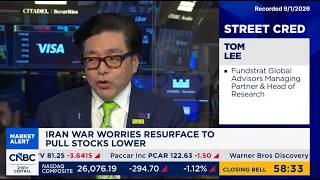
This episode explores market resilience amidst Middle East geopolitical tensions featuring insights from Fundstrat's Tom Lee BTIG's Jonathan Krinsky and Wharton Professor Jeremy Siegel.
There are three key takeaways for investors navigating this volatility. First history suggests geopolitical conflicts often create buying opportunities rather than long-term downturns. Second technical indicators like VIX inversion and sector capitulation signal a potential market bottom. Finally big tech and software stocks are increasingly acting as defensive safe havens during global instability.
Let's look at the details. Despite alarming headlines the market reaction has been better than expected aligning with the historical adage that geopolitical shock is often a contrarian buy signal. Experts highlight specific indicators of a wash-out bottom including a VIX curve inversion where near-term fear spikes above future expectations. Additionally they note that lagging sectors like memory chips are finally showing signs of capitulation which often marks the final stage of a correction.
Crucially there is a divergence between oil prices and energy stocks. While crude prices spiked on conflict fears energy equities failed to reach new highs suggesting the market views the oil shock as temporary. In this environment mega-cap tech stocks and software companies are emerging as the new defensive play offering strong balance sheets and growth that serve as a buffer against broader economic headwinds.
Investors should monitor these technical signals closely while considering high-quality growth assets as modern safe havens.
Episode Overview
- This episode features a market discussion between Fundstrat's Tom Lee, BTIG's Jonathan Krinsky, and Wharton Professor Jeremy Siegel regarding the stock market's resilience amidst geopolitical tensions in the Middle East.
- The experts analyze current market indicators—specifically oil prices, the VIX volatility index, and sector performance—to determine if the recent pullback represents a buying opportunity or the start of a deeper correction.
- A core theme is the historical tendency for markets to overreact initially to geopolitical events, followed by a recovery, suggesting that the current dip may be a strategic entry point for investors.
- The conversation shifts to specific sectors, highlighting the strength of "Mag 7" stocks and software as early leaders in a potential recovery, while noting that lagging sectors like memory chips are finally showing signs of capitulation.
Key Concepts
- Market Resilience to Geopolitics: Despite scary headlines regarding conflict in the Middle East, the market's reaction has been better than expected. Historical data suggests that geopolitical events often cause short-term volatility but rarely result in long-term negative market trends. The initial "fright" is often a contrarian signal to buy.
- Indicators of a Market Bottom:
- VIX Curve Inversion: When the spot VIX (current volatility) trades higher than future VIX contracts, it indicates extreme near-term fear, which often signals a market bottom is near.
- Capitulation in Lagging Sectors: A market bottom is often confirmed when the last holding-out sectors finally sell off. In this case, memory stocks and Korean markets—which had held up well—finally dropped, suggesting the selling pressure is washing out.
- Oil Price vs. Energy Stocks Divergence: If oil prices spike but energy stocks fail to make new highs (or even trade lower), it indicates that the market views the oil spike as temporary or geopolitical rather than fundamental demand-driven.
- The "Escort" Strategy as a stabilizer: The potential for the US Navy to escort tankers through the Strait of Hormuz is viewed as a critical stabilizing factor. Successful escorts would likely prevent a runaway spike in oil prices, which is the primary economic risk factor stemming from the conflict.
- Defensive Nature of Big Tech: In times of uncertainty, mega-cap tech stocks (Mag 7) and software are increasingly acting as defensive assets. Their strong balance sheets and earnings growth make them attractive "safe havens" when the broader economy or cyclical sectors face geopolitical headwinds.
Quotes
- At 3:24 - "When missiles fly, time to buy... throughout history, geopolitical conflicts are rarely a long-lasting negative catalyst for markets." - highlighting the historical precedent that war-induced sell-offs are usually buying opportunities.
- At 7:12 - "When World War I started... they closed the New York Stock Exchange for six months... when they reopened it stocks were rising and then they just absolutely soared up to new highs." - illustrating that even during massive global conflicts, market closures and fear often precede significant bull runs.
- At 4:13 - "This morning crude oil was up about 8%, but the energy stocks... [were] unable to take out yesterday's high and in fact it traded red... those were two signals we were watching." - explaining how technical divergence between a commodity and its related equities can signal that a fear-based rally is unsustainable.
Takeaways
- Monitor the VIX for entry points: Watch for a spike in the VIX (potentially above 40) or an inversion where spot VIX exceeds futures as a strong signal that fear has peaked and a tradeable bottom is forming.
- Look for the "washout" in leadership: Do not try to catch a falling knife until the strongest sectors (like memory chips in this context) finally succumb to selling pressure, as this often marks the final stage of a correction.
- Focus on structural winners during turmoil: Instead of fleeing to cash, rotate into high-quality growth areas like software and the "Mag 7," which are showing relative strength and acting as modern defensive assets during geopolitical instability.