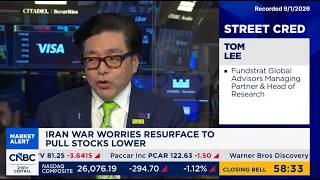
Tom Lee: S&P 7,300 Is Still Coming — Here's What Changed
Audio Brief
Show transcript
This episode covers Tom Lee providing a macro update on stock market performance during periods of geopolitical conflict. There are three key takeaways. Markets usually establish their bottom during the anticipation of conflict rather than the actual fighting. Historical recoveries following macro shocks are typically rapid and V shaped. Investors should use historical analogs rather than reacting to daily headlines.
The phenomenon known as selling the build up and buying the invasion shows that equities price in maximum fear before military action officially begins. Markets act as forward looking mechanisms. For example during World War Two the stock market bottomed years before the conflict was resolved and even before the United States committed troops. Once the initial shock is absorbed the vast majority of major market lows since 1900 have resulted in sharp rebounds.
Investors should position their portfolios to capitalize on these rapid recoveries instead of waiting on the sidelines for certainty.
Episode Overview
- This episode features Tom Lee providing a macro update on stock market performance during periods of geopolitical conflict and wartime.
- The narrative traces the initial market panic caused by war fears and surging oil prices, then uses historical analogs like World War II to show how markets typically react to these events.
- This content is highly relevant for investors seeking to understand how historical market patterns can provide a roadmap for navigating current geopolitical volatility and "fog of war" uncertainty.
Key Concepts
- Geopolitical conflicts often trigger early market bottoms. Counterintuitively, the stock market usually suffers its worst declines during the anticipation of a conflict rather than during the actual fighting.
- "Sell the build-up, buy the invasion" is a historical market phenomenon where equities price in the maximum fear before military action officially begins, leading to rapid recoveries once the uncertainty of the start date is removed.
- Markets act as forward-looking mechanisms. Using World War II as an analog, markets can find their absolute bottom years before a conflict is resolved, or even before major powers fully commit troops, because the initial shock has already been absorbed.
- V-shaped recoveries are the historical norm. When examining major market bottoms resulting from significant macro shocks since 1900, the vast majority result in rapid, V-shaped rebounds rather than slow, prolonged U-shaped recoveries.
Quotes
- At 0:30 - "You sell the build-up, buy the bullets." - This highlights the core contrarian framework investors should understand regarding how markets historically price in geopolitical threats versus actual conflicts.
- At 0:43 - "The stock market bottomed five years into World War II, even before the US committed any troops." - This historical example proves how markets look past immediate devastation to price in future outcomes long before fundamental news improves.
- At 2:03 - "That is more the norm because of all the major lows since 1900, the vast majority are V-shaped." - This clarifies a common misconception, teaching investors that sharp, rapid recoveries following major market drawdowns are actually the historical standard.
Takeaways
- Avoid liquidating portfolios based purely on escalating "fog of war" news headlines, as the market typically establishes its bottom during peak uncertainty.
- Position your investments to capitalize on rapid V-shaped recoveries following macro shocks, rather than waiting on the sidelines for a slow, confirmed consolidation period.
- Utilize historical market analogs (like past conflicts) to build your investment roadmap, rather than relying on unpredictable day-to-day political or military developments.