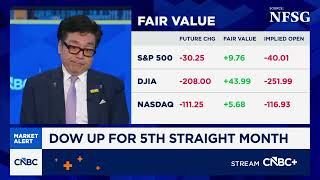
Tom Lee: Could Nvidia Earnings Set the Market Bottom?
Audio Brief
Show transcript
This episode of Closing Bell analyzes whether recent stock market volatility is merely a pause before a rally to 5300 on the S&P 500, featuring insights from Fundstrat's Tom Lee.
There are three key takeaways from the discussion. First, experts are closely watching the rotation of capital away from the Magnificent Seven tech stocks and into broader sectors. Second, the relative performance of consumer discretionary stocks versus staples is flashing potential warning signals. Third, the market is drawing a sharp distinction between AI infrastructure builders and software application companies.
Regarding the capital rotation, Tom Lee suggests that three specific areas are bottoming and poised for a rebound. He points to a potential resurgence in the Magnificent Seven due to relative undervaluation, a bottoming in software stocks, and a recovery in cryptocurrency. However, other panelists argue this broadening market might actually represent a defensive shift into value and safety amidst high interest rates, rather than pure bullish momentum.
The debate over the consumer is particularly critical. While discretionary stocks like restaurants and airlines are showing absolute strength, they are underperforming consumer staples on a relative basis. This specific ratio is often viewed as a leading indicator for risk appetite. If discretionary stocks continue to lag staples, it serves as a defensive signal that typically precedes broader economic caution.
Finally, investors must distinguish between AI infrastructure and application. Infrastructure stocks like semiconductors and data centers have rallied, but software stocks have lagged due to fears that AI will disrupt their business models. Nvidia's upcoming earnings report is viewed as a pivotal moment. It is expected to either validate the entire AI trade or exacerbate concerns if growth metrics fail to impress.
In summary, investors should monitor the consumer discretionary-to-staples ratio for economic health signals while awaiting Nvidia's earnings to clarify the trajectory of the software sector.
Episode Overview
- This episode of CNBC's Closing Bell features a discussion with Tom Lee of Fundstrat regarding the current state of the stock market, specifically addressing whether the recent volatility is a pause before a rally to 5,300 on the S&P 500.
- The conversation explores the rotation of capital away from the "Magnificent 7" tech stocks into other sectors, particularly consumer discretionary, industrials, and crypto, debating whether this broadening market is a bullish signal.
- A panel of experts, including technical analyst Jonathan Krinsky, Stephanie Link, and Cameron Dawson, provides contrasting views on the strength of the consumer, the impact of rising interest rates, and the critical importance of Nvidia's upcoming earnings report.
Key Concepts
- The "Three Key Trades" Thesis: Tom Lee outlines three specific areas he believes are bottoming and poised for a rebound: a rotation back into the "Magnificent 7" tech stocks (which have become undervalued relative to the broader market), a bottoming in software stocks (specifically the IGV ETF), and a resurgence in cryptocurrency after a significant drawdown.
- Consumer Discretionary Resilience vs. Fragility: There is a sharp debate regarding consumer stocks. One perspective argues that the consumer discretionary sector (e.g., restaurants, airlines) is breaking out technically due to a strong labor market and stabilizing interest rates. The counter-argument suggests that while discretionary stocks are performing well on an absolute basis, they are underperforming consumer staples on a relative basis—a classic defensive signal that often precedes economic caution.
- AI Infrastructure vs. Application: A distinction is drawn between companies building AI infrastructure (semiconductors, data centers, power generation) and those building AI software applications. While infrastructure stocks have rallied, software stocks have lagged significantly due to fears that AI will disrupt their business models ("eat their lunch"). Nvidia's upcoming earnings are seen as a pivotal moment that could either validate the entire AI trade or exacerbate fears if they don't show massive growth.
- Market Broadening as a Health Signal: The panel discusses the "mean reversion" trade, where sectors that lagged over the last few years (like energy and materials) are now outperforming. Some view this rotation as healthy market behavior indicating a sustainable rally, while others see it as a defensive shift into value and safety amidst high interest rates and inflation concerns.
Quotes
- At 1:22 - "There's this old adage that it takes a whole lot of 'E' to offset 'PE'... earnings have been good but things that have affected multiples are what's causing the market to come in." - explaining that while corporate earnings are strong, external factors like the Fed, geopolitics, and AI fears are compressing stock valuations (PE ratios).
- At 8:58 - "If you put [consumer discretionary] next to consumer staples, you actually see that it's really underperformed to start the year. And this has been the most important ratio we think for the bull market over the course of the last three years." - highlighting a specific technical ratio that serves as a leading indicator for risk appetite and economic health.
- At 11:11 - "It's really important to differentiate infrastructure versus the application... The infrastructure side of things has been very good... but the application of the AI is what certainly has dinged the software names." - clarifying why different parts of the tech sector are moving in opposite directions despite the general "AI boom" narrative.
Takeaways
- Monitor the relative performance of Consumer Discretionary (XLY) versus Consumer Staples (XLP); if discretionary stocks begin to lag staples significantly, treat it as a "yellow flag" for the broader economy and risk assets.
- Watch the upcoming Nvidia earnings report not just for its own numbers, but as a bellwether for the software sector; a strong report is needed to prove that AI spending is translating into broader tech growth rather than just infrastructure build-out.
- Consider looking for opportunities in "mean reversion" sectors that have underperformed over the last 3-5 years, such as energy, materials, and specific consumer services like airlines and restaurants, which are currently showing technical breakout signals.