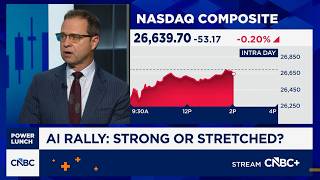
The Two Things Fundstrat's Mark Newton Needs to See Peak
Audio Brief
Show transcript
This episode covers the underlying resilience of the current stock market rally with Fundstrat Head of Technical Strategy Mark Newton. There are three key takeaways. First, equal weight indices reveal a healthier, broader market than cap weighted giants suggest. Second, rising moving averages signal powerful short term momentum. Third, technical analysis helps investors filter out geopolitical noise to focus on price action.
Looking at equal weighted metrics shows broad sector participation, proving that the market recovery is sustainable. Additionally, the rapid doubling of stocks trading above their twenty day moving averages indicates a strong shift from oversold conditions. By prioritizing these technical trends and earnings over volatile headlines, investors can build a more reliable strategy.
Ultimately, tracking market breadth and price momentum provides a clearer roadmap for navigating volatile trading environments.
Episode Overview
- This episode features an interview with Mark Newton, Head of Technical Strategy at Fundstrat, discussing the underlying resilience of the current stock market rally.
- Newton explains why the broader market looks stronger under the surface than major indices like the S&P 500 and Nasdaq 100 suggest, pointing to equal-weight indicators and moving averages.
- The discussion highlights how technical analysts filter out geopolitical noise and exogenous headlines to focus on raw market data and sector performance.
- This content is highly relevant for investors seeking to understand market breadth, technical analysis frameworks, and how to navigate volatile trading environments amid geopolitical tensions.
Key Concepts
- Market Breadth and Equal-Weight Metrics: While mega-cap tech stocks often dominate headline indices, tracking the equal-weighted S&P 500 provides a clearer picture of broader market participation. A rising equal-weight index indicates a healthier, more sustainable rally across multiple sectors.
- Moving Average Penetration: The percentage of stocks trading above their short-term moving averages (such as the 20-day moving average) serves as a critical gauge for market momentum and stabilization. A rapid doubling of this metric suggests a powerful underlying shift from oversold conditions.
- Technical Analysis vs. Exogenous Noise: Technical analysis operates on the premise that price action and market structures discount all available information. While geopolitical headlines cause near-term volatility, focusing on earnings, sector rotation, and technical structures provides a more reliable path for long-term strategy.
Quotes
- At 0:20 - "You've seen the equal-weighted S&P just in the last month rise to the highest level since early September... It's been a great comeback in the broader market." - Explaining why looking beyond cap-weighted indices reveals hidden strength in the market.
- At 0:35 - "The percentage of stocks above their 20-day moving averages has actually doubled in the last two and a half weeks... That is very encouraging." - Demonstrating the quantitative momentum shift that signals a stabilizing broader market.
- At 2:00 - "As a technical analyst, we're taught really to ignore a lot of the exogenous events and the news... It really pays to concentrate on earnings, concentrate on technical strength." - Clarifying the core philosophy of technical trading during periods of geopolitical uncertainty.
Takeaways
- Look at equal-weighted ETFs (like the RSP) alongside cap-weighted indices (like the SPY) to accurately assess whether a market rally has broad participation or is being driven by only a few mega-cap stocks.
- Monitor the percentage of stocks trading above their 20-day moving averages as a reliable metric to identify short-term market bottoms and turning points in momentum.
- Avoid making impulsive portfolio adjustments based solely on breaking geopolitical news; instead, let technical trend lines, sector strength, and earnings reports guide your trading execution.