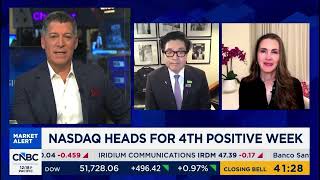
New Highs in October. What Do the Cycles Say Now?
Audio Brief
Show transcript
This episode covers technical analyst Mark Newton's insights on the stock market's return to record highs and the sustainability of the rally.
There are three key takeaways. First, market gains are highly concentrated in technology, creating a sharp divergence with lagging equal-weighted indexes. Second, dynamic sector rotations have kept the broader market resilient. Third, reliable technical analysis requires aligning price targets with cyclical time factors.
While narrow breadth poses a risk, the rally remains intact unless technology leaders begin to break down. Monitoring crude oil trends provides another key signal, as falling oil prices serve as a catalyst for risk assets. Investors should use repeatable, multi-indicator frameworks and strict stop-losses to manage risk.
Understanding these technical dynamics helps investors navigate rotations and protect capital in a highly concentrated market.
Episode Overview
- This episode features Mark Newton, CMT, analyzing the stock market's return to record highs and examining whether this upward trend is sustainable.
- It details how technology and the "AI renaissance" are driving the market's gains while other sectors like the Dow and equal-weighted S&P are lagging.
- Newton explains his technical analysis toolkit, showcasing how he overlays trend-following indicators, DeMark signals, and Fibonacci cycles to predict market movements.
- This content is ideal for investors and traders looking to understand market breadth, sector rotations, and structured risk-management frameworks.
Key Concepts
- Market Resilience vs. Breadth: While major indexes are pushing into new high territory, the rally is highly concentrated. The tech sector and the AI boom are carrying the market, whereas the equal-weighted S&P 500 and the Dow Jones are lagging, revealing a stark divergence in market breadth.
- Sector Rotation: The market has experienced healthy rotations rather than a flat sell-off. Capital has cycled dynamically—first through energy, then into tech, and later into healthcare—allowing the broader market to remain resilient.
- The Intersection of Price and Time: Fibonacci analysis is most effective when price targets align with time cycles. Newton notes that the market's recent pullback hit an exact 38.2% retracement in both price and time before staging its recovery.
- Repeatable Analytical Frameworks: No single technical indicator is a magic bullet. Instead, the goal is to stack non-correlated tools (such as combining trend-following indicators with counter-trend DeMark signals) to build a repeatable framework that mitigates risk.
Quotes
- At 0:23 - "You almost always need to have time line up for price to be truly successful." - This explains why analyzing price levels in a vacuum is insufficient without factoring in cyclical time constraints.
- At 2:59 - "If breadth deterioration would start to affect technology, I would take it a lot more seriously, like it did in 2021." - This clarifies the critical threshold where broad market weakness could finally drag down the leading technology sector.
- At 4:58 - "It's not the Holy Grail. It's more about establishing a repeatable framework of something that works... to minimize your chances of loss." - This teaches a realistic approach to technical trading, emphasizing risk mitigation over perfect prediction.
Takeaways
- When evaluating overall market health, compare cap-weighted indexes against equal-weighted indexes and the Dow to monitor for dangerous divergences in market breadth.
- Monitor crude oil price trends closely; a breakdown in crude oil's uptrend serves as a highly positive catalyst for risk assets and equities.
- Avoid the emotional trap of holding onto underperforming stocks; establish strict, quick rules to cut losses and re-evaluate assets that are failing to perform.