The Physics of Euler's Formula | Laplace Transform Prelude

Audio Brief
Show transcript
This episode unpacks the foundational concepts behind the Laplace transform, focusing on complex exponentials.
There are four key takeaways from this discussion. First, understanding complex exponentials, expressed as E to the power of S T, is crucial for advanced differential equation methods. Second, the complex exponent 'S' directly determines the exponential function's behavior: its real part controls growth or decay, while the imaginary part governs oscillation. Third, a powerful strategy for solving linear differential equations involves assuming an exponential solution, simplifying calculus problems into algebra. Finally, visualizing derivatives as velocity vectors, rather than merely slopes, offers a deeper mathematical intuition.
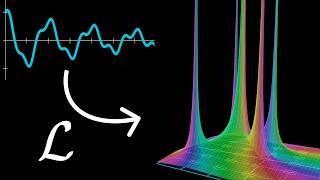
The Laplace transform is introduced as a powerful tool, converting time-domain functions into a complex variable F of S, with e to the s t as its central character. The core property that the derivative of e to the s t equals 'S' times e to the s t holds true even when 'S' is a complex number. This makes these functions fundamental atoms for describing systems governed by linear differential equations.
The S-plane visually represents the complex variable 'S'. Here, the real part of 'S' on the horizontal axis dictates exponential growth or decay. Conversely, the imaginary part on the vertical axis dictates the rate of oscillation or rotation. This connection provides a clear visual guide to system behavior.
By guessing an exponential solution like X of T equals e to the s t for a linear differential equation, such as a damped harmonic oscillator, the problem transforms from complex calculus into straightforward algebra. This method significantly streamlines solving these complex equations.
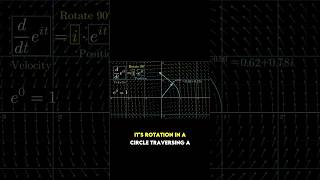
Instead of only conceptualizing a derivative as a graph's slope, visualizing it as a velocity vector provides a richer understanding. For e to the s t, this velocity vector is always 'S' times the position vector, offering a dynamic perspective on change.
These foundational insights into complex exponentials equip listeners to better understand and apply advanced mathematical tools for analyzing dynamic systems.
Episode Overview
- This episode serves as the first part of a trilogy aimed at demystifying the Laplace transform, focusing on the foundational concepts required for understanding it.
- It provides a deep, visual intuition for complex exponentials (e^st), explaining what it means to have a complex number in an exponent.
- The video connects the properties of exponential functions to solving linear differential equations, using the damped harmonic oscillator as a core example.
- The host establishes that exponential functions can be thought of as the fundamental "atoms" for describing systems governed by linear differential equations.
Key Concepts
- Laplace Transform: Introduced as a powerful tool for studying differential equations, which transforms a function of time, f(t), into a function of a complex variable, F(s).
- Exponential Functions (e^st): These are the central characters of the series. The variable 's' can be a real or complex number, determining the function's behavior (growth, decay, or oscillation).
- Complex Exponents: The video provides a visual and intuitive explanation for
eraised to a complex power by connecting it to differential equations. The core idea is that the derivatived/dt(e^st) = s * e^stholds true even when 's' is complex. - Visualizing Derivatives: Instead of just thinking of a derivative as the slope of a graph, it can be visualized as a velocity vector. For
e^st, the velocity vector is alwaysstimes the position vector. - The S-Plane: This is the complex plane where the variable 's' lives. The real part of 's' corresponds to exponential growth or decay, while the imaginary part corresponds to oscillation (rotation).
- Solving Differential Equations: The episode demonstrates how guessing an exponential solution
x(t) = e^stfor linear differential equations (like the damped harmonic oscillator) transforms the calculus problem into a simpler algebra problem.
Quotes
- At 00:05 - "a powerful tool for studying differential equations." - The narrator introduces the Laplace transform and its primary application, setting the context for the entire series.
- At 01:03 - "Wait, what does this even mean? to shove a complex number into an exponent." - The narrator voices a common point of confusion for students, which the video directly aims to address and clarify.
- At 24:50 - "You can kind of think about these functions e to the s t as being like the atoms of calculus." - This quote provides a powerful analogy for why exponential functions are so fundamental to solving a wide range of differential equations.
Takeaways
- Understanding complex exponentials (
e^st) is crucial for grasping advanced methods for solving differential equations, including the Laplace transform. - Visualizing mathematical concepts, such as interpreting derivatives as velocity vectors in the complex plane, can build a much deeper and more flexible intuition.
- The behavior of an exponential function
e^stis directly determined by its complex exponent 's': the real part controls decay/growth, and the imaginary part controls oscillation. - A common strategy for solving linear differential equations is to assume the solution is an exponential function, which simplifies the problem from calculus to algebra.
- Many complex physical systems, like a damped mass on a spring, can be modeled and solved by breaking them down into combinations of these fundamental exponential functions.