The dynamics of e^(πi)

Audio Brief
Show transcript
This episode explores the exponential function from a dynamic perspective, revealing how imaginary exponents lead to circular motion and Euler's identity. There are three key insights.
First, e to the power of t is defined as a function where its rate of change always equals its current value, starting at one. Real constants in the exponent accelerate growth or cause decay.
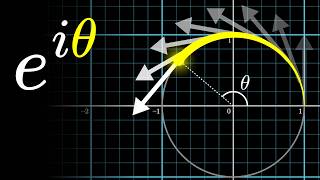
Next, using an imaginary exponent transforms this, making the velocity always rotated 90 degrees from the position. This unique dynamic relationship describes constant-speed circular motion on the complex plane.
Finally, following this circular path for a distance of pi visually derives Euler's identity: e to the power of i pi equals minus one.
This illustrates the profound connection between exponents, imaginary numbers, and geometry.
Episode Overview
- The video explains the function e^t from the perspective of dynamics, defining it as a function whose rate of change (velocity) is always equal to its current value (position).
- It demonstrates how real-valued constants in the exponent either accelerate this growth (e^2t) or cause exponential decay (e^-0.5t).
- The core insight is introduced: using an imaginary exponent (e^it) means the velocity is always rotated 90 degrees from the position.
- This dynamic relationship is shown to uniquely describe constant-speed circular motion on the complex plane.
- By following this circular path for a distance of π, the video visually derives Euler's identity: e^(iπ) = -1.
Key Concepts
- Dynamics of e^t: The exponential function e^t describes a value whose rate of change is equal to its current value. It starts at 1 (when t=0) and grows at an ever-increasing rate.
- Exponential Growth and Decay: Modifying the exponent with a constant (k) in e^kt changes the dynamic so that the rate of change is k times the current value, leading to faster growth (k > 0) or decay (k < 0).
- Imaginary Numbers as Rotations: Multiplying a number by the imaginary unit 'i' is geometrically equivalent to rotating it 90 degrees counter-clockwise on the complex plane.
- Circular Motion from e^it: The function e^it describes motion where the velocity vector is always 'i' times the position vector. This means the velocity is always perpendicular to the position, resulting in motion around a unit circle.
- Euler's Identity: The equation e^(iπ) = -1 is explained as the result of starting at position 1 and traveling for π seconds (or π units of arc length) around the unit circle, which lands you at the position -1.
Quotes
- At 00:07 - "From the perspective of dynamics, this is the unique function, which is its own derivative, and also which equals one when you plug in zero." - Explaining the fundamental definition of the function e^t used in the video.
- At 01:15 - "Geometrically multiplying by I looks like rotating by 90 degrees." - Highlighting the key insight that connects imaginary numbers to rotational motion.
Takeaways
- Understand the exponential function
e^tas a dynamic process where the rate of growth is always proportional to the current amount. - Visualize multiplication by the imaginary unit 'i' as a 90-degree counter-clockwise rotation in the complex plane.
- The function
e^itelegantly describes uniform circular motion, connecting exponents, imaginary numbers, and trigonometry. - Euler's identity,
e^(iπ) = -1, is a direct geometric consequence of starting at 1 and moving halfway around a unit circle.