Parameter Estimation and Fitting Distributions

Audio Brief
Show transcript
This episode covers parameter estimation and fitting distributions, a central idea in statistics and a foundational element of modern machine learning.
Here are four key takeaways from this discussion.
First, fitting distributions to data is a fundamental process for modeling systems, applicable to both classical statistical models and modern machine learning techniques.
Second, the classic approach is powerful when prior knowledge allows assuming a specific distribution type, simplifying the problem to estimating a few parameters.
Third, the modern machine learning approach is necessary for high-dimensional, complex data where a simple, predefined distribution is inadequate.
Fourth, the overarching goal involves finding parameters that maximize the probability of having observed the collected data, primarily through Maximum Likelihood Estimation and the Method of Moments.
Parameter estimation involves using sample data to estimate unknown parameters of a chosen probability distribution. This process, known as fitting distributions, aims to find a model that best describes observed data. It is crucial for understanding underlying data patterns and making predictions.
The classic approach assumes a known parametric model for the data, such as a Normal or Poisson distribution, often based on domain knowledge. The challenge then becomes estimating the specific parameters of that model from the data, for instance, determining a rate parameter for a Poisson process.
In contrast, the modern machine learning approach addresses complex, high-dimensional datasets where the underlying distribution is unknown or non-standard. Here, flexible models like neural networks are employed, with their internal parameters optimized to effectively fit the intricate data patterns.
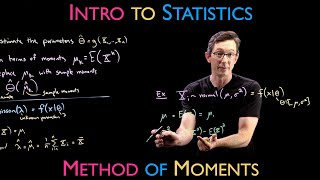
Maximum Likelihood Estimation, or MLE, is a core principle for parameter estimation. It identifies the parameter values that maximize the probability, or likelihood, of the observed data having occurred. The Method of Moments offers an alternative, equating sample moments from data to theoretical moments of the distribution to solve for parameters.
Ultimately, both classical and modern methods strive to find a set of model parameters that best explains the likelihood of observed data.
Episode Overview
- This episode introduces the concept of parameter estimation and fitting distributions, explaining its central role in statistics and as a foundational element of modern machine learning.
- The lecture contrasts the "classic" statistical approach, which assumes a known distribution type, with the "modern" machine learning approach, which handles complex, unknown distributions.
- A concrete example of radioactive decay is presented to illustrate the classic approach, where a Poisson distribution is fitted to observed data.
- The episode outlines key methods that will be covered in the series, including Maximum Likelihood Estimation (MLE) and the Method of Moments, setting the stage for a deeper dive into these techniques.
Key Concepts
- Parameter Estimation: The process of using sample data to estimate the unknown parameters (e.g., mean, variance) of a chosen probability distribution.
- Fitting Distributions: The task of finding a probability distribution that best describes or "fits" a set of observed data.
- Classic Approach: Assumes a known parametric model for the data (e.g., Normal, Poisson) based on domain knowledge. The goal is to estimate the specific parameters of that model from the data. For example, estimating the rate parameter (λ) for a Poisson process.
- Modern (Machine Learning) Approach: Used for complex, high-dimensional data where the underlying distribution is not known or does not fit a simple, named distribution. In this case, a flexible model like a neural network is used, and its parameters (weights) are optimized to fit the data.
- Maximum Likelihood Estimation (MLE): A core principle for parameter estimation where one finds the parameter values that maximize the probability (likelihood) of the observed data having occurred.
- Method of Moments: An alternative estimation technique that involves equating the sample moments (e.g., sample mean, sample variance) calculated from the data to the theoretical moments of the distribution, and then solving for the distribution's parameters.
Quotes
- At 00:09 - "This is a really, really central idea in data analysis and statistics and is especially relevant today because it's the basis of much of modern machine learning." - The speaker emphasizes the importance and broad applicability of the topic at the beginning of the lecture.
- At 01:04 - "The classic approach, I'll just write it here, kind of the classic approach is you start with a model of what you think your data is probably described by..." - The speaker begins to explain the traditional, model-based paradigm for fitting distributions.
- At 03:35 - "The modern thing we would do, and by modern of course I mean machine learning... we collect data and it probably doesn't fit a nice named distribution." - This quote introduces the machine learning paradigm, which is designed for complex data where the underlying distribution isn't assumed to be simple.
Takeaways
- Fitting distributions to data is a fundamental process for modeling systems, whether using classical statistical models or modern machine learning techniques.
- The classic approach is powerful when you have prior knowledge to assume a specific distribution type (e.g., Normal, Poisson), simplifying the problem to estimating a few parameters.
- The modern machine learning approach is necessary for high-dimensional, complex data (like images or natural language) where a simple, predefined distribution is inadequate.
- The overarching goal is to find a set of parameters (θ) for a model that maximizes the probability of having observed the collected data (X).
- Key techniques for parameter estimation include the Method of Moments and, more prominently, Maximum Likelihood Estimation (MLE).