Method of Moments to Fit Distributions from Data

Audio Brief
Show transcript
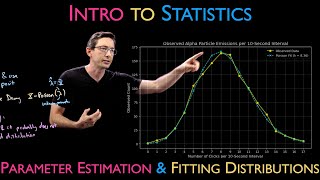
This episode introduces the Method of Moments, an intuitive technique for estimating probability distribution parameters from observed data.
There are four key takeaways from this conversation. First, the Method of Moments provides a straightforward way to estimate distribution parameters by matching theoretical moments to observed sample moments. Second, for a Poisson distribution, the estimated parameter lambda is simply the sample mean of the data. Third, for a Normal distribution, the estimated mean is the sample mean, and the estimated variance is derived using the sample's first and second moments. Fourth, this method assumes prior knowledge of the distribution family being fitted.
The core principle involves expressing unknown parameters as functions of a distribution's theoretical moments. These theoretical moments, like the mean or variance, are then replaced with their corresponding sample moments calculated directly from the data. This substitution yields the estimated parameter values.
For instance, when estimating the parameter for a Poisson distribution, which is equal to its mean, the Method of Moments simply uses the sample mean as the estimate for lambda. Similarly, for a Normal distribution, the sample mean estimates the population mean, and the sample's first and second moments are used to derive the estimated variance. The method's effectiveness relies on assuming the underlying probability distribution is already known.
The Method of Moments offers an accessible and powerful tool for parameter estimation when the distribution family is identified.
Episode Overview
- An introduction to the Method of Moments, an intuitive technique for estimating the parameters of a probability distribution from data.
- The core principle is explained: relating the unknown parameters to the theoretical moments of the distribution and then substituting sample moments calculated from the data.
- The method is demonstrated with two clear examples: estimating the parameter λ for a Poisson distribution.
- The technique is further applied to a two-parameter case: estimating the mean (μ) and variance (σ²) for a Normal distribution.
Key Concepts
- Parameter Estimation: The goal is to find the unknown parameters (θ) of an assumed probability distribution, f(x|θ), using a set of observed, independent, and identically distributed (i.i.d.) data points (X₁, ..., Xₙ).
- Method of Moments: This method works by equating the theoretical moments of a probability distribution (which are functions of its parameters) with the corresponding sample moments calculated from the data.
- Theoretical vs. Sample Moments:
- The k-th theoretical moment is μₖ = E[Xᵏ], the expected value of the random variable X raised to the k-th power.
- The k-th sample moment is μ̂ₖ, which is the average of the k-th power of the observed data points.
- The Process:
- Express the unknown parameters (e.g., λ, μ, σ²) as a function of the theoretical moments (μ₁, μ₂, etc.).
- Calculate the sample moments (μ̂₁, μ̂₂, etc.) from the data.
- Substitute the sample moments into the expressions from step 1 to obtain the estimated parameters (λ̂, μ̂, σ̂²).
Quotes
- At 02:03 - "You write θ in terms of the moments... then we replace the μₖ with sample moments to get θ̂." - This quote succinctly summarizes the entire two-step process of the Method of Moments.
- At 03:32 - "This is really, really, really simple... I think if I show you a couple of examples, you're totally going to understand how this works." - The speaker emphasizes the intuitive and straightforward nature of the method, which is best understood through application.
- At 05:43 - "Lambda is equal to the mean value of the PDF, the expectation value of X... And so what we're going to do is we're going to replace μ₁ with the sample moment." - This explains the direct application of the method to the Poisson distribution, where the parameter is equal to the first moment.
Takeaways
- The Method of Moments is a straightforward approach to estimate distribution parameters by matching theoretical moments to observed sample moments.
- For a Poisson distribution, the estimated parameter λ̂ is simply the sample mean of the data.
- For a Normal distribution, the estimated mean μ̂ is the sample mean, and the estimated variance σ̂² is calculated using the sample's first and second moments.
- This method assumes you know the family of the distribution (e.g., Normal, Poisson) you are trying to fit to the data.