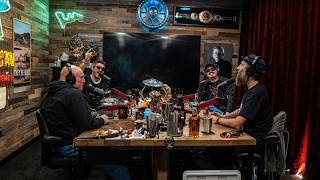
JRE MMA Show #188 with Paddy Pimblett
Audio Brief
Show transcript
Six weeks before facing Benoit Saint Denis, a DEXA scan, a medical body composition test, showed Paddy Pimblett had accidentally gained 6 kilos of solid muscle. He was still 30 pounds over the limit three weeks out, forcing his nutritionist to design a diet to intentionally burn that muscle away. On this November 11, 2026 episode of the Joe Rogan Experience, host Joe Rogan talks with mixed martial arts fighter Paddy Pimblett and producer Jamie Vernon. By the end, you will understand the extreme science of weight cutting, what cage damage really feels like, and how combat sports rules are changing.
How fighters shed massive weight in weeks by targeting muscle, water, and glycogen.
Four weeks before a Cage Warriors title defense, Pimblett was at a cave rave drinking ale and eating crisps at nearly 192 pounds. To make the 145 pound limit in under 26 days, he ate 1,500 calories daily and cut about 18 pounds of water overnight.
Why modern mixed martial arts demands total fluency and split second improvisation.
Pimblett choked out Benoit Saint Denis with a modified Peruvian necktie he calls the Pad Thai, claiming it is the second fastest D'Arce choke variation in Ultimate Fighting Championship, or UFC, history. Yet he had never hit the move in his life, having only drilled it once with coach Paul Rimmer four weeks earlier.
That constant evolution inside the cage also exposes the surprising truth about physical damage and hidden injuries.
Against Justin Gaethje, a chest punch hurt worse than any clean head strike, though Pimblett alleges Gaethje poked his eyes twice, faked a low blow, and kneed his groin. Worse happens beneath the surface: tearing his ankle one minute into his fight with Jared Gordon required three surgeries in one, leaving Pimblett couch bound on Tramadol and battling severe depression for months.
How misunderstandings, flying hand sanitizer, and flawed stats drive lightweight rivalries.
While microwaving eggs in London, Pimblett was confronted by rival Ilia Topuria and roughly 14 people, leading Topuria to miss a punch and Pimblett to throw a hand sanitizer bottle. Looking at division metrics, Pimblett argues that Merab Dvalishvili landing 18 takedowns in three rounds is actually a bad stat, because it means his opponent stood back up 17 times.
The push to ban knee strikes while bringing back grounded kicks.
Nearly two hours into the episode, Rogan breaks the news that the UFC is making oblique kicks to the knee joint illegal. Pimblett disagrees with the ban and wants grounded knees and soccer kicks legalized, provided head stomps remain banned since the head is trapped against the canvas.
Why elite combat and endurance athletes refuse to quit even when half blind.
Referencing a fight where Topuria had broken orbital bones and could not see against Gaethje, Pimblett vows he would never let his coaches stop a fight on the stool. Rogan points to similar grit in ultramarathoner Courtney Dauwalter, who beat all the men by up to eight hours in a 250 mile race fueled by beer and candy, and finished another race half blind after cracking her head.
Elite fighting is a game of extreme bodily manipulation and unbreakable psychological grit, where raw numbers rarely tell the whole story. Martial arts have evolved more in the last 33 years since the UFC emerged than in the last 33,000 years.
Episode Overview
- Paddy Pimblett tells Joe Rogan how he manages extreme weight cuts, breaks down his recent fights and rivalries, and debates the evolution of MMA rules and training.
- The conversation explores the physiology of weight manipulation, detailing how Pimblett balloons up to 205 or 210 lbs out of camp, rehydrates from 156 lbs to 190 lbs in the cage, and once had to intentionally burn off 6 kg of accidental muscle mass to make lightweight.
- Pimblett traces his career from starting at Next Generation MMA in Liverpool in 2010 to fighting through the Cage Warriors pipeline, analyzing his improvised submission over Benoit Saint Denis, his foul-marred bout with Justin Gaethje, and a severe ankle injury against Jared Gordon.
- Rogan and Pimblett examine the broader landscape of combat sports, including the origins of Pimblett's feud with Ilia Topuria, the new signing of Usman Nurmagomedov, and why high takedown totals without top control are a flawed metric.
- They also cover proposed rule changes, including Rogan's announcement that the UFC is banning oblique kicks to the knee and their shared desire to legalize knees and kicks to grounded opponents.
Key Concepts
- The Physiology of Extreme Weight Cutting and Rehydration: Weight management in elite MMA relies on distinguishing between water, glycogen, and dense tissue. Pimblett's heaviest weight is 210 lbs in America, and he reached 205 lbs after fighting Justin Gaethje (where he clarifies he only ate a handful of sweets from a 1-kilo bag backstage), though a week of dieting drops him to 195 lbs by shedding excess salt and sugar. For his last fight, he weighed in at 156 lbs, rehydrated to 169 to 170 lbs within two hours, woke up at 185 to 190 lbs, and weighed 193 to 194 lbs in his tracksuit at the venue (190 lbs actual weight). Four weeks before defending his Cage Warriors featherweight (145 lbs / 65.8 kg) title against Julian Erosa, Pimblett was at a rave in a cave drinking ale and eating crisps at 87 kg (~191.8 lbs); he had 25 to 26 days to lose 21 kg (~46.3 lbs; Rogan estimates 45 to 49 lbs) by eating 1,500 calories a day and cutting 8.4 kg (17 to 18 lbs) overnight. Furthermore, between the Gaethje fight and six weeks before facing Benoit Saint Denis (BSD), a DEXA scan revealed Pimblett had accidentally gained 6 kilos of muscle mass from lifting twice a week, taking creatine, and doing a dirty bulk. Still weighing 84 kg (183 to 185 lbs), or 30 lbs over the limit, three weeks out, his nutritionist Paul Reed had to invert his diet to less protein and more carbs to intentionally burn off muscle mass.
- Technical Evolution and Improvisation Inside the Cage: Modern MMA requires complete multi-disciplinary fluency rather than single-sport specialization, alongside the ability to improvise under extreme fatigue. Pimblett started training in 2010 at age 15 at Next Generation MMA in Liverpool under coach Paul Rimmer, won his first amateur bout two months after turning 16 on one week's notice against a 24-year-old under rules allowing standing knees to the head and ground-and-pound (banning only elbows and twisting leg locks), and went 9-0 as an amateur and 4-0 as a pro before his first loss. He credits Cage Warriors for developing real talent, claiming 80% of its fighters signed to the UFC stay signed. Against BSD, Pimblett hit a modified Peruvian necktie he calls the "Pad Thai" (having named his submission of Jordan Leavitt the "Padlock"), which he claims is the second-fastest D'Arce/choke variation in UFC history (two seconds slower than the fastest, though he argues BSD was already unconscious earlier), despite never having hit the move in his life and only drilling it once with Rimmer four weeks prior. As sports evolve, fighters also debate the history of techniques: Rogan hedges on whether Benson Henderson or Cub Swanson threw the first calf kick in MMA, while Pimblett and Rogan hedge on whether Renato Moicano or Brian Ortega won their fight (Ortega beat Moicano), and Rogan struggles to recall José Aldo's last opponent before Pimblett and Jamie Vernon confirm it was Aiemann Zahabi.
- The Reality of Damage, Fouls, and Fighter Durability: Perceived knockout power and fight damage often differ wildly from what athletes experience inside the cage. Pimblett claims pound-for-pound the hardest he was ever hit was in sparring during COVID by 52 to 55 kg boxer Brandon Daord, that teammate Luke Riley hits harder in 4 oz gloves than Justin Gaethje did, and that his UFC debut opponent Luigi Vendramini landed the best punch on him in the UFC. Against Gaethje, Pimblett says a chest punch during ground-and-pound hurt more than any clean head strike, alleging that Gaethje poked him in the eye in Round 1 and Round 2 (causing the knockdown), faked a low blow off a body shot in Round 3 for a two-minute breather, and kneed him in the groin in Round 4 with no stoppage. By contrast, Rogan cites Robert Whittaker saying Yoel Romero felt like "hitting steel" and was the only opponent where throwing a calf kick hurt Whittaker's own leg worse (though Pimblett hedges on who won the recent BKFC match between Romero and Darren Till). Pimblett also details the hidden toll of injuries: tearing his ankle one minute into his December 2022 fight with Jared Gordon required three surgeries in one (inner ligament, outer ligament, and LCL repair), leaving him couch-bound for two weeks, on Tramadol, battling severe depression, and unable to train for six to seven months until July 2023.
- Rivalries, Divisional Politics, and Judging Criteria: Navigating the UFC lightweight division involves managing personal feuds, new roster additions, and flawed statistical narratives. Pimblett explains his feud with Ilia Topuria began on Twitter with Guram Kutateladze (whom Pimblett initially misremembers as Giga Chikadze), when Pimblett called him a "fake Russian" and tweeted about getting "terrorized by Russians," explaining he was never taught about the Russia-Georgia war in school and used "terrorized" as Liverpool slang for bullied. In London, Topuria confronted Pimblett with roughly 14 people while Pimblett was microwaving eggs; Topuria swung and missed, and Pimblett threw a hand sanitizer bottle at him. Pimblett criticizes Topuria for claiming three nationalities (Georgian, Spanish, born in Germany), claims Spanish fans are turning on him, and says Topuria wears 2-inch heels at press conferences because he is too small for 155 lbs. Looking at the wider division, Jamie confirms PFL/Bellator lightweight Usman Nurmagomedov officially signed with the UFC on the day of recording. Evaluating grappling metrics, Pimblett argues that Merab Dvalishvili shooting 25 to 50 takedowns or landing 18 takedowns in three rounds is a bad stat because it means the opponent stood back up 17 times, contrasting it with Islam Makhachev taking Jack Della Maddalena down five times in five rounds and holding him down.
- MMA Rule Reform and the Future of Fight Venues: Both speakers argue that current unified rules artificially protect stalling fighters while banning legitimate weapons. At 1:59:50, Rogan announces that oblique kicks to the knee are going to be made illegal in the UFC, a move Pimblett disagrees with, arguing both oblique kicks and 12-to-6 elbows should be legal. Pimblett favors allowing knees and soccer kicks to the head of a grounded opponent (without stomps, since the head is trapped against the canvas), while Rogan hedges on whether ONE Championship still allows soccer kicks and proposes a single 30-minute round with no stand-ups and a 4-foot red line inside the cage where grounded kicks and knees are banned, keeping them legal in the center. They also recall the dangers of PRIDE rules, with Pimblett hedging on who Shogun Rua broke his arm against when posting on a takedown (guessing Kevin Randleman or Sokoudjou) before Jamie confirms it was Mark Coleman. Discussing massive global venues for future fights, Pimblett notes Liverpool's Anfield holds 60,000+ for football and at least 70,000 for MMA with floor seats, while they review footage of Real Madrid's Santiago Bernabéu stadium, which uses a retractable roof and a 6-layer underground hydraulic greenhouse system to lower, water, and treat its grass pitches.
- Mental Toughness, Sparring Philosophy, and Athletic Outliers: Combat sports and endurance athletics demand extreme psychological resilience, though athletes differ on how much gym trauma to absorb. Pimblett spars twice a week year-round and stops 10 days before a fight, whereas Rogan hedges on a rumor that Michael Chandler wasn't sparring much anymore, and the trio hedges on what is hanging out of heavyweight Josh Hokit's mouth in sparring footage (debating whether it is a football mouthpiece tab, chewed guard, gum, or a toothpick). Inside the cage, Pimblett refuses to ever quit; referencing Justin Gaethje vs. Ilia Topuria (where Topuria's orbital bones were broken and he couldn't see), Pimblett vows he would never let his coaches Paul or Ellis stop a fight on the stool. Rogan highlights similar grit in other athletes, claiming welterweight Carlos Prates lived in Thailand for five to six years fighting over 100 times (roughly weekly) to make a living, and that ultramarathoner Courtney Dauwalter won a 250-mile race by beating all the men by seven to eight hours on beer and candy, and finished another race after cracking her head and going half-blind. Away from the cage, fighters also deal with bizarre distractions and business ventures: Rogan recounts how Rory MacDonald changed his phone number without telling the UFC, allowing a fan who inherited the number to text producer Joe Silva random walkout song requests like MC Hammer's "Can't Touch This," and hedges on world news when asking if there is a ceasefire with Iran (Jamie says "No," and Rogan replies, "Depends on whose tweets you're reading").
- Commercial Ventures, Sponsors, and Recovery Products: Throughout the conversation, the speakers discuss and display several commercial products and sponsorships. Pimblett wears a PUNT.com t-shirt and a Roley's Super Natural Lager hat, bringing cans of Roley's onto the set and disclosing that he recently invested in the company. He claims a 330 ml (11.16 fl oz) can of Roley's has 89 calories, 4.4% ABV, prevents hangovers, and contains magnesium, potassium, and vitamins B3, B5, B6, and B9 (which Rogan initially misreads as B8). Additionally, Rogan reads episode sponsorships for DraftKings and Perplexity (Perplexity Computer), while Jamie brings out cans of Willie's (a THC/hemp drink) that Rogan praises as "legit."
Quotes
- At 0:00:33 - "It had Song Yadong talking, no subtitles, English is his second language, and then it cuts to me and I'm talking, it's got subtitles underneath, I'm like, English is my first language." - Pimblett laughs about the UFC Embedded series subtitling his thick Liverpool Scouse accent before the Justin Gaethje fight.
- At 0:02:24 - "I think the highest I got after I fought Justin was like 205. I think that's the highest I get to now, like 205, but if I diet for a week, I'm right back down to 195." - Pimblett explains how quickly he sheds his initial post-fight weight gain because it consists mostly of salt and sugar.
- At 0:06:16 - "I get taxed obviously in America and then get taxed again when I get back to the UK. Killer. Thieving bastards, taking me money, innit?" - Pimblett complains about the financial frustration of double taxation when fighting in the United States as a British citizen.
- At 0:12:57 - "And I've never done that submission before. Never done it, I just done it on the fly. I've never really done a Peruvian necktie before." - Pimblett reveals that his "Pad Thai" choke against Benoit Saint Denis was improvised in the cage after only drilling it once four weeks prior.
- At 0:17:30 - "Martial arts have evolved more in the last 33 years since the UFC emerged than it has in the last 33,000 years." - Rogan summarizes the rapid technical progression of unarmed combat since the inception of modern mixed martial arts.
- At 0:17:43 - "When I first started watching it, you could just be a world-class kickboxer, or a world-class wrestler, or a world-class jiu-jitsu practitioner, you didn't have to be good at anything else. You could be one-dimensional and still become a world champion. Now you can't." - Pimblett contrasts the early specialist era of the UFC with the well-rounded skill sets required today.
- At 0:25:46 - "People get to like 10, 11, 12 and 0, but they're fighting taxi drivers. They're fighting absolute crabs who don't deserve to be in the cage, where Cage Warriors, you don't fight people like that." - Pimblett defends the high level of matchmaking in Europe's Cage Warriors promotion compared to padded regional records.
- At 0:29:20 - "We don't get taught in our schools about Georgia and Russia going to war, you know. I had no idea that they'd been to war, no idea in the slightest, and he still says to this day that that's what I was talking about." - Pimblett explains the Twitter misunderstanding with Guram Kutateladze that sparked his ongoing feud with Ilia Topuria.
- At 0:34:08 - "Pick one. You can't be all three, lad. Are you Georgian, are you Spanish, or are you German? Because I reckon you've got a German passport because you were born in Germany. So stop trying to get a fan base from three different countries." - Pimblett criticizes rival Ilia Topuria for claiming multiple national identities to market himself.
- At 0:37:01 - "The way I look at it when I get in the Octagon is there's only two people in the world what matter, and it's him, because he's trying to kill me, and the ref, because he decides when this fight's finished." - Pimblett shares his mindset inside the cage.
- At 0:46:20 - "I spar twice a week. I love sparring. I love punching people in the face and getting punched in the face. I love—I don't understand the way Holloway says he doesn't spar." - Pimblett details his year-round training schedule and contrasts his approach with fighters who avoid hard sparring.
- At 0:48:14 - "I think you should be able to knee on the floor. And I think you should be able to kick on the floor, just not stomp." - Pimblett lays out which grounded strikes he believes should be legalized in MMA while drawing the line at head stomps.
- At 1:00:32 - "The last one I weighed in at 156, was drinking all me liquids, two hours later I was 170 again, 169, 170." - Pimblett illustrates how rapidly his body absorbs fluids immediately following an official lightweight weigh-in before reaching 190 lbs on fight night.
- At 1:01:26 - "It was a fucking kilo of sweets, lad. Think I'm eating a kilo of sweets in the back, you silly bastards? I had a handful of them." - Pimblett debunks a viral video from the Justin Gaethje fight where fans claimed he ate an entire 1-kilo bag of candy backstage.
- At 1:25:51 - "You'd never see me catching—catch me fighting any of my teammates. I consider them family. They're all like me brothers." - Pimblett emphasizes loyalty to his gym mates at Next Generation MMA over pursuing fights against friends.
- At 1:29:57 - "I reserve my judgment on who a man is until I roll with him." - Rogan quotes jiu-jitsu practitioner Kron Gracie to explain how grappling exposes a person's true character and ego.
- At 1:38:04 - "Jiu-jitsu is like chess if you're drowning. It's like playing chess while you're drowning." - Pimblett quotes his head coach Paul Rimmer to describe the combination of strategic thinking and physical suffocation in grappling.
- At 1:59:50 - "It is going to be made illegal. I know. I think we're announcing it right now. I don't think people know, but it's going to be made illegal." - Rogan breaks the news that the UFC plans to ban oblique kicks targeting an opponent's knee joint.
- At 2:35:06 - "I'm just never not stopping. That's the pussy's way out. That's the bitch's way out. I'm not having it. I'm never going to say 'no más' on me stool. It's not going to happen." - Pimblett states he would never allow his coaches Paul or Ellis to stop a fight between rounds, referencing Ilia Topuria's broken orbitals against Justin Gaethje.
- At 2:37:20 - "When it's like these stats like, 'Oh, he took him down like 18 times in three rounds,' I'm sitting there thinking, that means he got up 17 times. That's not a good stat." - Pimblett critiques high takedown totals, such as Merab Dvalishvili's, as evidence of poor top control rather than grappling dominance.
Takeaways
- Use DEXA scans to diagnose the exact composition of weight gain before starting a cut, ensuring you know whether excess mass is water, fat, or dense muscle tissue.
- Adjust macronutrient ratios to target specific body composition goals, such as lowering protein and increasing carbohydrates when an athlete needs to shed accidental muscle mass to make a weight class.
- Eliminate excess salt and sugar immediately after a dietary binge to shed 10 to 15 lbs of water retention within a single week.
- Utilize hot baths with Epsom salts instead of saunas for heat stress, magnesium absorption, and rapid water weight manipulation, a method Pimblett has used for 12 years to cut 14 to 15 lbs in a single bath without using Sweet Sweat.
- Drill unconventional submissions and positional transitions at least once in training camp so you can recognize and execute them instinctively during live scrambles.
- Evaluate grappling performance by total top control time and damage inflicted rather than raw takedown totals, recognizing that repeated takedowns mean the opponent is repeatedly escaping.
- Limit hard sparring to twice a week and cut off all sparring 10 days before a competition to preserve reaction time and allow the brain and body to recover.
- Vet regional fight records by strength of competition rather than undefeated numbers, testing prospects in high-level feeder leagues like Cage Warriors before moving to the UFC.
- Protect your vision and defense after absorbing an eye poke or uncalled foul in the cage rather than waiting for the referee to pause the action.
- Update your contact information immediately with event producers and management when changing phone numbers to avoid security lapses or unauthorized fight-night changes.
- Verify the historical and geopolitical context of foreign slang before posting trash talk online to avoid turning a sporting rivalry into an international incident.
- Maintain strict weight discipline between fight camps so you are never forced into an emergency 1,500-calorie-a-day crash diet to shed 21 kg in under four weeks.