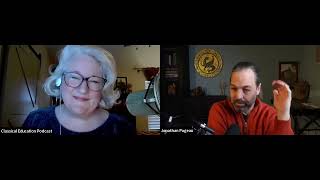
Jonathan Pageau on The Symbolic World of Fairy Tales
Audio Brief
Show transcript
This episode explores the journey of a liturgical artist from cynical contemporary art to traditional iconography, discussing the profound role of symbolic beauty and fairy tales in forming the mind and soul.
There are three key takeaways from this discussion. First, beauty is essential for shaping the mind and soul, helping individuals perceive order and meaning. Second, ancient stories and art are a rich symbolic language, offering patterns that give meaning to our experiences. Third, symbolic language, like the role of monsters, offers a powerful framework for interpreting culture, stories, and life.
Jonathan Pageau, a liturgical artist, emphasizes beauty's role beyond mere aesthetics. It is a foundational tool for education and formation, helping us discern reality's underlying patterns. This aligns with classical education's focus on truth, goodness, and beauty as interconnected principles.
Traditional stories and art offer a beautiful web of references, forming a symbolic language that structures our understanding. Fairy tales are especially powerful examples, described as "scalable stories." They contain profound, multi-layered truths accessible to both children and adults, condensed through oral tradition into potent wisdom.
Pageau's new publishing venture, Symbolic World Press, aims to create beautifully illustrated books rooted in this traditional storytelling. Their first project is a retelling of Snow White, using ancient themes to address modern issues like vanity and technology. Within this symbolic framework, monsters represent the chaotic or unknown elements at the margins of our identity and world, often guarding a central order.
Ultimately, this conversation highlights the enduring power of symbolic narratives to provide meaning and guidance in navigating contemporary challenges.
Episode Overview
- Guest Jonathan Pageau, a liturgical artist and expert in symbolism, discusses his journey from cynical contemporary art to traditional iconography in a search for beauty and meaning.
- The conversation explores the importance of symbolic patterns and beauty as essential tools for forming the mind and soul, connecting these ideas to the core tenets of classical education.
- Pageau introduces his new publishing venture, Symbolic World Press, and its first project: a beautifully illustrated retelling of Snow White funded through a Kickstarter campaign.
- The discussion delves into the profound, multi-layered nature of fairy tales, explaining how these "scalable stories" use concepts like monsters to reveal deep truths about reality and human identity.
Key Concepts
- Beauty in Formation: The central theme that beauty is not merely aesthetic but is fundamental to shaping the mind and soul, helping individuals perceive order and meaning in a chaotic world.
- Symbolism as a Language: Traditional stories and art function as a rich symbolic language, providing a "beautiful web of references" and patterns that help give meaning to our experiences.
- Symbolic World Press: A new publishing company founded by Pageau to create high-quality, beautifully illustrated books rooted in wonder and traditional storytelling, beginning with a series of fairy tales.
- Scalable Stories: Fairy tales and scripture are described as "scalable," meaning they are simple enough for a child to grasp while containing profound, multi-layered truths that can be explored by adults.
- Monsters and the Margin: Monsters in stories symbolically represent the chaotic, hybrid, or unknown things that exist at the margins of our identity and world, often acting as guardians of a central order.
Quotes
- At 1:43 - "I wanted to make something that was connected to community but also spoke of something real and not was a comment on a comment on a comment on something, which is what most contemporary art is." - Pageau explains his motivation for leaving contemporary art for traditional iconography.
- At 5:50 - "The biggest slogan in the classical education world is, we educate children in truth, goodness, and beauty, but half of the people in the movement don't know how to answer what that means." - The host connects Pageau's work directly to a core, yet often misunderstood, tenet of classical education.
- At 26:28 - "A monster is a mixture of things that don't fit together." - Pageau offers a concise definition of what monsters represent symbolically at the margins of our understanding.
- At 32:23 - "[Fairy tales] are highly condensed iterations of memory... they get refined and condensed until they're like pure gold." - Pageau describes how oral tradition has distilled fairy tales into potent, meaningful stories.
- At 33:47 - "I'm not talking directly about these, these cell phones, but I am alluding to the problem of vanity and the problem of the black mirror." - Pageau explains how he is retelling Snow White to make its ancient themes relevant to modern technology.
Takeaways
- Beauty is not a subjective luxury but an essential component of education and formation that helps us perceive the underlying patterns of reality.
- Ancient stories like fairy tales are condensed sources of wisdom, offering "scalable" insights into human nature that are just as relevant today as they were centuries ago.
- Understanding symbolic language, such as the role of "monsters" at the margins of identity, provides a powerful framework for interpreting culture, stories, and our own lives.
More from Classical Education Podcast
Jonathan Pageau: A Deep Dive Into Teaching Fairy Tales
Mar 18, 2025

Is Charlotte Mason Classical? Panel: Dr. Louis Markos, Dr. Patrick Egan, and Jason Barney
Jan 15, 2025
Creating a Book of Century in Art Class to Support History and Music with Anna-Marie Carter
Aug 07, 2024
An Interview with David V. Hicks, Author of Norms & Nobility
Jun 11, 2024