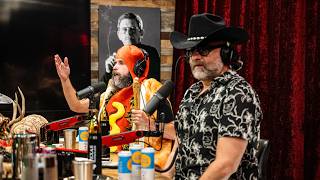
Joe Rogan Experience #2564 - Chuck Lorre
Audio Brief
Show transcript
Television creator Chuck Lorre jokes that the perfect murder of a malicious, destructive actress is simply to make her famous, because massive success removes every excuse for being unhappy. On this episode of his podcast, comedian and former NewsRadio actor Joe Rogan sits down with Lorre, the creator behind Two and a Half Men and The Big Bang Theory. By the end, you will learn how a creator survives decades of star meltdowns, cult manipulation, and shifting television trends while finding sobriety and creative collaboration.
How the sixties counterculture shaped a generation.
For two dollars, a teenager could bribe a guard and stand right at the stage for Jimi Hendrix. Lorre and Rogan attribute the radical shift between the nineteen fifties and late sixties to a reaction against fifties conformity, the Vietnam War, psychedelic drugs, and the birth control pill. Lorre experienced it firsthand at the Singer Bowl, where he saw a Doors concert end after twenty minutes when police on horses shut it down because Jim Morrison tried to expose himself.
Why the live television sitcom vanished.
When a joke fails on the Warner Brothers lot in Burbank, the silence is so complete you can hear the freeway outside. Although Lorre admits he does not know the deep history of early sitcoms, he explains that multi camera sitcoms are filmed like a play with a live audience, and he has never used a laugh track in forty years of production. When Lorre started, forty or fifty sitcoms aired a week, whereas today maybe two are filmed before a live audience.
Surviving star meltdowns and turning cancellations into hits.
In the early nineties, when Roseanne drew roughly forty million weekly viewers, massive viewership amplified pressure on troubled stars. Lorre recalls having Charlie Sheen's manager call during season eight of Two and a Half Men to say Sheen could not rehearse because his lighter blew up and burned off his eyebrows. Even when CBS canceled Lorre's earlier show Frannie's Turn after airing five episodes, producer Tom Werner called it a noble failure and had him develop Grace Under Fire.
How a massive hit buys creative freedom.
The success of Two and a Half Men gave Lorre the rare leeway at CBS to completely redo the failed first pilot of The Big Bang Theory. That success also let him bring in comedy legend Bob Newhart, who agreed to guest star under three demands: a live audience, a multi episode arc, and winning an Emmy after never winning one for his own shows. Lorre delivered on all three and Newhart won Best Guest Actor.
Why external fame cannot heal internal brokenness.
Lorre explains that massive wealth and fame devastate damaged performers because external validation cannot heal an internal void. Seeking meaning in his early twenties after totaling his car at seventy miles per hour, Lorre joined Scientology and had an out of body experience during a silent staring drill called Training Routine Zero, though he refuses to speculate on how it happened. Lorre spent ten years in Scientology before he and his then wife realized it was not working, left, and were excommunicated by their friends.
Finding sobriety and the power of saying I don't know.
After twenty seven and a half years without alcohol, Lorre declines to name Alcoholics Anonymous to protect the principle of anonymity. Though he worries it might sound like New Age nonsense, he views a higher power not as a static noun that limits it, but as a verb and an ongoing action. In writers' rooms, this humility meant saying I don't know to invite collaboration, and he learned from television legend Norman Lear to eventually step out of his own rooms so his presence would not suffocate younger writers.
External achievements, wealth, and fame will never resolve internal emotional wounds, because as Chuck Lorre puts it, nothing on the outside is going to heal the inside.
Episode Overview
- Podcast host, stand-up comedian, and former NewsRadio sitcom actor Joe Rogan interviews veteran television writer, producer, and author Chuck Lorre (creator/producer of Grace Under Fire, Cybill, Two and a Half Men, The Big Bang Theory, Young Sheldon, The Kominsky Method, and Leanne) to explore how a creator navigates decades of intense industry pressure, ego clashes, and shifting cultural landscapes while finding personal fulfillment and sobriety.
- The conversation traces the mechanics and decline of the traditional multi-camera sitcom, detailing how television evolved from an era of 40 to 50 sitcoms airing per week across four broadcast networks to the fragmented modern streaming ecosystem.
- Lorre shares behind-the-scenes history from his biggest shows—including managing severe star turbulence with Roseanne Barr, Cybill Shepherd, Brett Butler, and Charlie Sheen, alongside heartwarming collaborations with Bob Newhart and Billy Bob Thornton.
- The narrative shifts into Lorre's personal evolution, covering his teenage experiences at 1960s rock concerts, his 10-year involvement in Scientology during his twenties, his 27.5 years of sobriety, and his spiritual shift toward humility and collaborative ego-surrender.
- Business ties and disclosures include Lorre promoting his new memoir (and its audiobook, which he narrates) and his current Netflix multi-cam sitcom Leanne with comedian Leanne Morgan (which just finished its second season), alongside episode sponsors The Terminal List Season 2 on Amazon Prime (starring Chris Pratt, premiering October 21) and Call of Duty: Modern Warfare 4 (launching October 23; digital pre-orders available at callofduty.com).
Key Concepts
- The 1960s Cultural Rupture and Rock Counterculture: Lorre and Rogan attribute the radical shift between the 1950s and late 1960s to a reaction against 1950s conformity, the Vietnam War, psychedelic drugs, and the invention of the birth control pill. Lorre experienced this firsthand in 1969 at age 15 or 16 when he and his friends bribed a security guard $2 a piece at the Singer Bowl to stand right up at the stage for Jimi Hendrix (headlining right after Monterey) with Big Brother and the Holding Company featuring Janis Joplin as the warm-up act. At age 16 at the Singer Bowl, Lorre also saw The Doors (with The Who warming up just prior to releasing Tommy), a concert that lasted only 20 minutes because Jim Morrison tried to pull his penis out during the opening song ("Light My Fire") and police on horses shut it down. Rogan adds that his late NewsRadio co-star Phil Hartman worked as a stagehand at the Whisky a Go Go when Hendrix performed, where Hartman's job was to stand 2 feet away with his hands on an unstable speaker ("I guess it was just not very stable...") so Hendrix wouldn't knock it into the crowd. While Rogan notes that Hendrix, Joplin, and Morrison all died at age 27—mentioning a book by Hendrix's former bodyguard alleging Hendrix's manager had him murdered for royalties and that Hendrix's girlfriend was later thrown off a roof—Lorre remains skeptical of the murder conspiracy ("He probably contractually would have had them anyway...").
- The Mechanics and Decline of the Multi-Camera Sitcom: Although Lorre admits he does not know the exact historical chronology of the first TV sitcoms ("I don't know the deep history of it..."), he explains that multi-cam sitcoms are filmed like a play with 4 cameras rolling before a live studio audience, requiring writers and actors to make 200 people laugh every week for 22 weeks. Lorre has never used a laugh track in 40 years of production; yet, a reporter once sat in the stands with 200 laughing people for a 3 to 3.5-hour taping of The Big Bang Theory and still wrote an article complaining about the "annoying laugh track." When a joke fails on the Warner Bros. lot in Burbank, the silence is so complete you can hear the 134 Freeway. Audience attachment to sitcoms (Cheers, Seinfeld, Friends) is driven by characters and casting rather than plot, which helped The Big Bang Theory become a massive international hit in Germany, Mexico, and Brazil, where early on at Comic-Con, thousands camped out overnight and a young fan shook and cried out of sheer joy just getting Jim Parsons' autograph. When Lorre started in TV, 40 or 50 sitcoms aired a week (4 sitcoms on every network, 4 or 5 nights a week, totaling 16 a night, followed by 10:00 PM hour-long dramas influenced by figures like Steven Bochco and a New York City cop turned author whose name Lorre cannot recall: "Starts with an M... I'll remember it tonight when we're done."). Today, there are maybe 3 sitcoms total and maybe 2 filmed before a live audience (including Lorre's Netflix show with Leanne Morgan), and a whole generation of kids watched Young Sheldon on Netflix without ever seeing The Big Bang Theory or knowing what CBS is. While Lorre hedges on why multi-cams vanished ("I don't understand it either. Tastes change, the culture changes, I don't know...") and suggests laughing out loud is frowned upon in culture because it requires vulnerability (citing The White Lotus as brilliant comedy that doesn't cause out-loud laughter), Rogan disagrees, arguing that is just a Los Angeles bubble phenomenon, to which Lorre concedes ("Maybe I am a victim of Los Angeles... I live in a bubble.").
- Navigating Star Turbulence and "Noble Failures" in Network TV: In the early 1990s, when there were only 4 broadcast channels and maybe "100 famous people on Earth," massive viewership amplified pressure on troubled stars. When Lorre worked on Roseanne, roughly 40 million people watched every week in real time. Rogan notes that Roseanne Barr's erratic behavior and personality changes stemmed from a severe brain injury when she was hit by a car at age 15, putting her in a mental health institute for 9 months and leaving her unable to count despite previously being a grade-A math student. On Roseanne, Lorre was forced to put Tom Arnold's name as a writer on scripts even when he didn't write—a lucrative "no-show" job. After Roseanne, Carsey-Werner (owners of The Cosby Show and Roseanne) hired Lorre to create Frannie's Turn starring British actress Miriam Margolyes as a Staten Island housewife; CBS ordered 6 episodes, put it in a terrible time slot (Saturday nights at 8:00 PM), and canceled it after airing only 5 episodes. While Lorre admits he cannot objectively judge if the show was good ("You don't have perspective... I don't know that I really had a clean perspective on whether it was quality television..."), producer Tom Werner called it a "noble failure" and had Lorre develop an ABC show about a single mom. Lorre researched it by visiting women's shelters, the YWCA, and hospitals in Elgin, Illinois, creating Grace Under Fire starring Brett Butler (airing right after Home Improvement in 1993). Both Rogan and Lorre hedge on rumors that Butler later became homeless after the show ended ("I think she...", "I'd heard those stories too. I don't know."). Later, on Cybill, Cybill Shepherd forced Lorre to change a joke and got mad at him when it failed, while co-star Christine Baranski got huge laughs. On Two and a Half Men, Lorre had 6 or 7 years "in the clear" (150 to 160 episodes) before Charlie Sheen's drug addiction derailed Season 8—though Lorre hedges on whether Sheen used drugs earlier ("Not to my knowledge. If he was, he was managing it and keeping it to himself... I was determined to stay in denial."). During Season 8, Sheen's manager called to say Sheen couldn't attend rehearsal because his Bic lighter blew up and burned off his eyebrows.
- Earned Creative Leeway and Honoring Comedy Legends: The massive success of Two and a Half Men gave Lorre the rare network leeway at CBS to do a complete "do-over" on the failed first pilot of The Big Bang Theory. That success also allowed Lorre to feature iconic guest stars. Billy Bob Thornton guest-starred on The Big Bang Theory playing a 50-year-old version of the main characters living in his mother's basement, purely as a gift to his mother who loved the show. Similarly, Bob Newhart agreed to guest star under three demands: 1) it had to be filmed in front of a live audience, 2) his character had to have a multi-episode arc, and 3) he wanted to win an Emmy (having never won one for his own shows). Lorre delivered on all three, and Newhart won the Emmy for Best Guest Actor in a Comedy. By contrast, Rogan recalls attending the Emmys once after his NewsRadio co-star Phil Hartman was murdered; when Hartman lost the posthumous Emmy nomination, co-star Dave Foley joked, "What the fuck does a guy have to do to win?"
- The Destruction of External Validation vs. The Mystery of Cult Manipulation: Lorre explains that achieving massive fame and wealth is devastating for damaged performers trying to fill an internal void because success removes their excuse for being unhappy, forcing them to realize that external rewards cannot heal internal brokenness. Seeking meaning in his own youth, Lorre joined Scientology at age 21 or 22 while touring in a cover band in Columbus, Ohio, after flipping and totaling his car at 70 mph down an embankment in Iowa. He bought a "communications course" and practiced "TR 0" (Training Routine 0), sitting motionless opposite a pretty girl. During his first TR 0 session, he had an out-of-body experience where he felt he was up in the corner of the ceiling looking down at himself—the instructor yelled, "Chuck has gone exterior!"—an experience that only ever happened to him one other time during his 70 mph Iowa car crash. Lorre refuses to speculate on the mechanism behind it ("I don't think it had anything to do with her... It remains a mystery and I'm okay with it being a mystery."), while Rogan compares it to the documentary Holy Hell, about a cult leader/hypnotist/yoga teacher/gay porn star in Austin who performed a ceremony called "The Knowing," touching followers' heads to induce a hypnotic, psychedelic experience of seeing God. Lorre notes that L. Ron Hubbard—who Rogan points out wrote more fiction than any human being who ever lived because he never wrote a second draft—built the Scientology Celebrity Centre on Franklin Avenue in Los Angeles specifically as a PR positioning strategy to attract the general public via celebrities. Citing Yuval Noah Harari's books on how humanity's superpower is mobilizing millions around shared fictions, Lorre explains he spent 10 years in Scientology before he and his then-wife realized it wasn't working, left, and were excommunicated by all their friends (nobody chased him because he had no money), after which he worked for 10 years before breaking into TV on Roseanne. Rogan cites Lawrence Wright's book Going Clear as the work that exposed Scientology, noting that in 1996 his next-door neighbor delayed buying land because his wife was "going clear" at a cost of $50,000 (which Lorre notes takes place at Flag in Clearwater, Florida), and adds that director Paul Haggis left Scientology after reading the secret higher-level Hubbard sci-fi stories.
- Sobriety, Spirituality as a Verb, and Creative Collaboration: Lorre stopped drinking alcohol 27.5 years ago, though he explicitly declines to confirm or discuss Alcoholics Anonymous by name to preserve the principle of anonymity ("Let's not talk about that... Let's focus on the word anonymous. I got sober."). Hedging before discussing spirituality ("I'm going to say it and then regret it... because it might seem like flaky and airy-fairy and woo-woo New Age bullshit."), Lorre rejects the word "worship" and proposes that a higher power cannot be a static noun because naming it limits it; instead, he views it as a "verb"—an ongoing process and action. In his career, this humility translated into embracing the power of saying "I don't know" to invite collaboration. Having spent 25 years in writers' rooms, when Lorre wrote The Kominsky Method (starring Michael Douglas) entirely alone, he realized the voices of his past co-writers were still in his head critiquing his work (which Rogan compares to comedian Doug Stanhope writing comedy by imagining himself as a defense attorney defending a bit on trial, and writer/director Taylor Sheridan writing and directing massive hits like Sicario, Hell or High Water, 1883, 1923, Lioness, and Landman—pitched as "Bad Santa on an oil rig"—entirely by himself). However, Lorre learned from Norman Lear—who visited Lorre's set 35 to 40 years after Lear's 1970s heyday while preparing a remake of One Day at a Time—that once a creator becomes a legend, their mere presence in a writers' room suffocates younger writers who are too intimidated to challenge their jokes, which is why Lear refused to write the pilot himself. Earlier, when Lorre was working 60 hours a week on Two and a Half Men while starting The Big Bang Theory, he cold-called Lear (who once had 7 shows on TV simultaneously) for advice on managing the workload, learning to triage by focusing wherever the crisis is most urgent.
Quotes
- At 0:05:44 - "For me, it was characters. Nobody remembers the plot of a sitcom." - Chuck Lorre explaining why audience attachment to shows like Cheers, Seinfeld, and Friends relies on casting and characters rather than storyline.
- At 0:08:25 - "If it stinks in front of the audience, if you put it on TV, it's going to stink forever." - Chuck Lorre describing the immediate, unforgiving feedback loop of filming a multi-camera sitcom in front of a live studio audience.
- At 0:09:48 - "He sat in the stands with 200 people laughing, and he wrote about the annoying laugh track." - Chuck Lorre recounting how a reporter attended a 3 to 3.5-hour live taping of The Big Bang Theory and still falsely claimed the show used a canned laugh track.
- At 0:14:09 - "I think laughing out loud is frowned upon. I think there's a vulnerability to laughing when you let yourself laugh." - Chuck Lorre theorizing on why modern television culture favors dark, quiet comedies like The White Lotus over traditional laugh-out-loud sitcoms.
- At 0:16:04 - "There's a percentage of people that come there with a hole in their soul that they're trying to fill that will never get filled." - Joe Rogan discussing why damaged performers are drawn to Los Angeles and the entertainment industry.
- At 0:18:31 - "When a joke fails at the Burbank Warner Brothers lot, and the audience doesn't respond, you can hear the 134 Freeway." - Chuck Lorre illustrating the painful silence on a soundstage when a sitcom joke bombs in front of 200 people.
- At 0:22:36 - "They're losers in a life raft, you know what I mean? And they hold each other up." - Chuck Lorre describing the core character dynamic that made audiences love the ensemble cast of The Big Bang Theory.
- At 0:27:40 - "He said, 'Chuck, you got to let them fuck you a few times so they know they love you.'" - Chuck Lorre sharing cynical advice he received early in his career about tolerating abuse from powerful television stars and executives.
- At 0:29:34 - "He goes, 'I'm not the funny guy in the show. I react to the funny guys.'" - Chuck Lorre quoting comedy legend Bob Newhart on his philosophy of playing the deadpan straight man ahead of his Emmy-winning guest arc on The Big Bang Theory.
- At 0:36:10 - "When his manager calls me and says, 'Charlie can't come to run-through today, rehearsal, his Bic lighter blew up and he has no eyebrows.'" - Chuck Lorre detailing the absurdity of Charlie Sheen's Season 8 spiral on Two and a Half Men.
- At 0:37:28 - "I liken a bad show on television to going to a restaurant and having a cockroach come across your table. You don't go back to that restaurant ever again." - Chuck Lorre explaining why airing even a single subpar episode can permanently destroy viewer trust.
- At 0:47:37 - "And said, 'It's a noble failure. Let's try again.' I had never put 'noble' and 'failure' together in the same sentence." - Chuck Lorre recalling how producer Tom Werner encouraged him after CBS canceled Frannie's Turn after airing only 5 episodes, leading directly to Grace Under Fire.
- At 0:53:05 - "And then you learn that horrible truth, only can happen with success, which is, 'Oh shit, I'm still a miserable fuck.'" - Chuck Lorre explaining the psychological crisis performers face when massive fame and wealth fail to cure their internal unhappiness.
- At 0:53:46 - "Nothing on the outside's going to heal the inside." - Chuck Lorre summarizing the core life lesson regarding fame, money, and emotional recovery.
- At 0:55:24 - "The perfect murder of an actress who is malicious and destructive is to make her famous. It'll ruin her." - Chuck Lorre joking about how achieving stardom amplifies self-destruction in troubled performers.
- At 1:13:13 - "And she yelled out, 'Chuck has gone exterior!' I didn't know what that meant, but it was an extraordinary experience." - Chuck Lorre describing his out-of-body experience during his first Scientology TR 0 drill in Columbus, Ohio.
- At 1:32:41 - "The very act of putting a word on it limits it. The very act of saying this is a thing, a noun—I don't know if this is going to sound strange, but I think it's a verb." - Chuck Lorre explaining his spiritual perspective that a higher power is an ongoing action rather than a static noun.
- At 1:42:55 - "It was simply the power of saying, 'I don't know.' What a relief to not pretend I know." - Chuck Lorre revealing how dropping his ego in writers' rooms relieved his anxiety and unlocked true creative collaboration.
- At 1:52:44 - "So my very presence suffocates the process. I am the plastic bag from the dry cleaners, right? I kill small children." - Chuck Lorre explaining why he eventually had to step out of his own writers' rooms so younger writers wouldn't be too intimidated to pitch ideas.
- At 1:57:02 - "You go where the fire's burning the brightest and you try and put it out." - Chuck Lorre quoting the advice Norman Lear gave him when Lorre cold-called him about managing a 60-hour workweek on Two and a Half Men while launching The Big Bang Theory.
Takeaways
- Prioritize character and casting over plot mechanics when building long-form creative projects, as audiences return week after week to spend time with people they care about rather than to follow intricate storylines.
- Test creative work in front of a live audience whenever possible and trust their immediate visceral reaction; if material fails in the room, rewrite it immediately rather than hoping it will somehow work upon release.
- Protect quality control relentlessly, recognizing that releasing subpar work acts like a "cockroach on a restaurant table" that can permanently alienate your audience.
- Reframe creative cancellations or setbacks as "noble failures," using the support of trusted partners and grounded field research (as Lorre did in Elgin, Illinois, for Grace Under Fire) to pivot immediately into your next project.
- Do not rely on external achievements, wealth, or fame to resolve internal emotional wounds; recognize early that external validation merely removes your excuses for being unhappy without healing the inside.
- Guard your creative environment against substance abuse and destructive behavior; even a massively successful multi-year run will eventually collapse when addiction compromises basic reliability and safety.
- Separate anomalous psychological or meditative experiences from the manipulative organizations that host them; you can acknowledge the mystery of an altered state of consciousness without surrendering years of your life or finances to a cult.
- Protect your sobriety and personal recovery boundaries in public forums by focusing on the principles of recovery in your daily life rather than using organizational affiliations for publicity.
- Shift your mindset around spirituality and personal growth from static labels ("nouns") to ongoing daily actions and processes ("verbs").
- Practice saying "I don't know, help me" when facing a creative or professional block; dropping the ego-driven pretense of having all the answers immediately reduces anxiety and invites your team to contribute their best ideas.
- Internalize the constructive critiques of your best collaborators over time so that when you must work solo, you can rigorously stress-test and "defend" your ideas from multiple angles in your own head.
- Step back from day-to-day micromanagement once you achieve senior leadership status so your authority doesn't intimidate junior team members, and manage overlapping responsibilities by going "where the fire's burning the brightest."