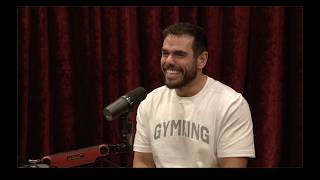
Joe Rogan Experience #2569 - Bill Thompson

Audio Brief
Show transcript
What happens when you evade trackers across the Appalachian Mountains for four days without food or water, only to realize the hikers you slept beside all night left zero footprints in the dirt? On his show, Joe Rogan sits down with Bill, a retired US military intelligence professional and founder of the hunting app Spartan Forge. You will learn how humans perform under extreme pressure and navigate the unconscious mind.
How extreme physics and rally mechanics push performance driving to the limit. The one-seater McMurtry Spéirling uses an underbody fan to generate two thousand kilograms of downforce, holding its roughly two thousand pound body weight upside down.
How to stop flinching under pressure by controlling your mind. Conventional archery wisdom says to use a surprise shot to avoid panic, yet elite archers like James Lutz, who recently shot a seven hundred nineteen out of seven hundred twenty, succeed using command shooting.
Why your ancient DNA craves voluntary hardship and finished work. Because software engineering never feels finished, Bill used to take two weeks of vacation annually to drive North Dakota sugar beet harvest trucks for twelve hours a day just to see three finished fields.
How mapping invisible air currents reveals a buck's hiding spot. Spartan Forge maps thermal air currents using topography, sun incidence, and canopy cover, which helped Bill harvest a twelve-year-old buck at thirty-five yards after three years of pursuit.
What extreme deprivation does to the waking brain. During a military Survive, Evade, Resist, Escape course, Bill escaped a car trunk and evaded trackers for about twelve miles over four days without food or water. Bill is eighty percent sure he talked to hikers by a cabin and slept by their fire, though he woke up to zero footprints or logs, and a debrief doctor had heard of students hallucinating people about fifteen times.
How your dreams balance a rigid waking ego. While Rogan and Bill agree Carl Jung's dream analysis is a personal heuristic or potential self-fulfilling prophecy rather than peer-reviewed science, Jung outlines how dreams balance an arrogant waking mind. These archetypes fill stories like The Shawshank Redemption, which mirrors the Christ story as an innocent man passes through a tunnel like a womb to be reborn.
Why staying in your unconscious mind unlocks athletic and creative mastery. In sports, Calgary Flames goalie Devin Cooley explained after a thirty-four save game that smiling and talking during timeouts shifts him into his slow conscious brain, causing him to give up seven goals.
Why the obsessive focus that creates champions can also turn fatal. Rogan watched a pool player named Water Dog shoot heroin, nod out for twenty minutes, and flawlessly beat a gambler for ten thousand dollars, yet he played terribly sober.
How continuous small improvements revolutionized modern martial arts. Coach John Danaher applies the Japanese philosophy of Kaizen, meaning continuous incremental improvement like upgrading the Nissan GT-R platform over decades, to Brazilian Jiu-Jitsu.
How creatures pass learned fears directly to their offspring. Rogan cites a Chinese researcher's study where caterpillars conditioned to avoid lavender scent paired with vibration retained the memory after becoming moths and passed it to their offspring.
Why artificial intelligence will make everyday life cheap and handmade goods priceless. Rogan predicts artificial intelligence will make the world unrecognizable within ten years maximum, while Bill forecasts massive deflation that drops Amazon coffee tables to three dollars and lets people live very well on ten thousand dollars a year.
Remember that mastering high pressure and modern chaos requires deliberate mental control and voluntary hardship. As Rogan puts it, treat your daily attention as a strict budget of one hundred units, and refuse to waste thirty precious units concentrating on nonsense.
Episode Overview
- Joe Rogan sits down with Bill, a retired US military intelligence professional and founder/CEO of the hunting technology app Spartan Forge, to explore how humans perform under extreme pressure and navigate the unconscious mind.
- The conversation progresses from the mechanics of high-stakes execution—such as elite archery, military SERE school survival, and martial arts—into deep explorations of Jungian dream analysis, addiction, and flow states.
- Both speakers examine how evolutionary wiring dictates human behavior, contrasting ancient survival mechanisms like hunting and fasting with modern traps like social media algorithms, substance abuse, and tribal politics.
- The episode concludes with a forward-looking discussion on epigenetics, political transparency, and how rapid AI automation will reshape the economy while sparking a renaissance in authentic, human-centric experiences.
Key Concepts
- Performance Driving & Physics: Extreme engineering continues to push physical limits, exemplified by the 1-seater all-electric McMurtry Spéirling race car (driven by co-founder Thomas Yates at Bettisfield House, McMurtry HQ England), which uses an underbody fan to generate 2000kg of Downforce-On-Demand from 0mph, holding its estimated ~2,000 lb body weight upside down. Similarly, a former engineer (whom Rogan thinks worked at Bugatti) stripped a 1969 Porsche down to fiberglass panels weighing ~1,800 lbs, contrasting sharply with Rogan's ~4,000 lb Tesla Model S or the 7,000 to 8,000 lb Cybertruck. The upcoming Tesla Roadster (which many paid $250,000 for in 2017) features Lamborghini-style doors, flies, hits 0 to 60 mph in under 1 second (0.9 seconds in a test), and exceeds 300 mph (approaching half the speed of sound at 360–380 mph). In the military's "high-risk officer pipeline," Bill spent 1.5 weeks learning rally car mechanics in Interceptor Impalas—using trail turns and braking through corners to front-load weight—to navigate serpentine courses in reverse under blank gunfire.
- Open-Loop vs. Closed-Loop Execution Under Pressure: Conventional archery wisdom dictates using a hinge release or thumb button with back pressure for a "surprise shot" to avoid target panic. However, elite tournament archers like James Lutz (who recently shot a 719 out of 720—72 arrows, hitting a 9 only once—in a Vegas round shooting at 3 targets at 20 meters to hit a dime 30 times for a 300 score), Kyle Douglas, Tim Gillingham, and bowhunter Cam Hanes (who runs 300-mile races and has hunted for 30 to 40+ years) succeed using "command shooting." Former SWAT member Joel Turner explains that flinching (which causes 6-inch misses at 20 yards) happens when shooting becomes an "open-loop" process (like swinging a baseball bat, which cannot be stopped mid-action) rather than a "closed-loop" process (like writing, which is continuously controlled). Even elite professionals can lose to amateurs under unique conditions, as seen when Spartan Forge engineer Evan Freed beat world-class archer Levi Morgan (who consults for and acts as an ambassador for Spartan Forge) in the finals of a ~20-person company competition, though Bill hedges that Levi would win the next 9 out of 10 times.
- Evolutionary Wiring & The Need for Difficulty: Human DNA rewards survival behaviors like hunting and fishing with endorphins (which Rogan saw when his 5-year-old daughter caught her first fish), whereas group protesting activates ancient tribal warfare circuitry and mob mentality. Without voluntary hardship, modern comfort degrades the psyche; as the ancient wrestler Plato ("broad" or "broad shoulders") noted, it is a tragedy to go through life without understanding the body's full physical potential. Because software engineering never feels "finished," Bill used to take 2 weeks of vacation annually to drive North Dakota sugar beet harvest trucks for 12 hours a day (donating the pay to his church) just to see 3 finished fields.
- High-Resolution Thermal Mapping: Whitetail bucks possess extraordinary olfactory capabilities; a late friend of Bill's (who died in 2017) had a deer pen in New York where wild bucks gathered at a fence 3/4 of a mile away at the base of a mountain when does went into heat, and mature bucks use mountain spots where thermals funnel from ~320 degrees. To maximize "bandwidth" between the brain, thumbs, and phone, Spartan Forge is releasing an update that maps thermals using high-resolution topography, sun incidence, historical weather, temperature, wind speed, and canopy cover. Bill used thermal awareness in north-central Pennsylvania (east of the Allegheny) to harvest "The Monarch," a 12-year-old, ~170-inch public land buck at 35 yards from the ground after 3 years of pursuit, resulting in a 25-minute adrenaline drop.
- Extreme Deprivation & The Hallucinatory Mind: During a ~3 to 6 week graduate-level SERE (Survive, Evade, Resist, Escape) course, Bill spent 2 weeks in classroom training (learning to pick handcuffs, escape car trunks, improvise shotguns, dress squirrels, and use "conduct polish" to alter his appearance) before being locked in a trunk handcuffed and zip-tied in a white painting outfit. Evading trackers and police for 12–13 miles across the Appalachian Mountains over 3–4 days without food or water, Bill met hikers by a cabin at ~2:00 AM on day 3 or 4, talked to them using his cover story, and slept by a fire until 5:00–5:30 AM—only to wake up to zero footprints or logs in the dirt (Bill hedges he is 80% sure it happened, though the medical debrief doctor had heard of students hallucinating people ~15 times). Later, locked for ~8 hours in a narrow, ~5.5-foot-tall dark cement box with discordant violin music playing, Bill hallucinated worms and snakes.
- Jungian Psychology, Archetypes, & Dream Functions: Inspired by a Jordan Peterson lecture on Chaos and Order while trying to impress his mathematician wife, Bill studied Carl Jung, Erich Neumann, Freud, and Adler, hiring a Jungian psychologist. While Rogan and Bill agree Jungian dream analysis is a personal heuristic or potential self-fulfilling prophecy rather than peer-reviewed science, Jung (Man and His Symbols / The Red Book) outlines four dream functions: 1) Compensatory Function (balancing a rigid or arrogant waking mind), 2) Self-Portrayal of the Psyche (unfiltered psychological state), 3) The Process of Individuation (bridging conscious ego and unconscious, leading to fewer but denser dreams), and 4) Prospective and Guidance Role. These archetypes pervade storytelling: The Shawshank Redemption (#1 on IMDb/Rotten Tomatoes) mirrors the Christ story (an innocent man with disciples passes through a tunnel/"woman's womb" to be reborn as a fisher of men), and Logan (which Bill notes grossed over $1 billion) depicts Logan integrating his mute female clone (his anima lacking logos/speech) and being crucified on a tree by his animalistic clone (his shadow self) while traveling from a chaotic desert to an Edenic North Dakota/Canada.
- Altered States in Creative & Athletic Mastery: Accessing the unconscious often bypasses waking blocks: Salvador Dalí used the hypnagogic "slumber with a key" method (50 Secrets of Magic Craftsmanship) to wake himself as a heavy key dropped onto a plate; NewsRadio writers stayed up until 3:00 AM to write scripts in a delirious state until 6:00–7:00 AM; and Stephen King (On Writing) wrote Cujo blackout drunk and wrote It (1981–1985), The Shining, Pet Sematary, and The Tommyknockers on alcohol, cocaine, Valium, Xanax, marijuana, and mouthwash with cotton swabs in his nose for nosebleeds. In sports, mastery represents the fourth tier of the Four Stages of Competence: 1) Unconscious Incompetence (Ignorance), 2) Conscious Incompetence (Awareness), 3) Conscious Competence (Learning), and 4) Unconscious Competence (Mastery). Calgary Flames goalie Devin Cooley (after a 34-save game) explained that smiling and talking during TV timeouts shifts him into his slow "conscious brain" (giving up 7 goals), whereas staying in an "unconscious" flow state allows rapid reaction before feeling dopamine, serotonin, and adrenaline after the final buzzer.
- The Dual Edge of Obsession & Addiction: The same obsessive focus that drives mastery can fuel fatal addiction. Rogan recalls a world-class pool player who never drank or smoked, injured his back in a car crash, applied his obsessive focus to pain pills, and died young of an overdose. In White Plains, NY (Executive Billiards), Rogan watched a player named "Buffalo Bill" / "Water Dog" shoot heroin, nod out for 20 minutes, and flawlessly beat gambler George the Greek for $10,000 on Table 1 (with tight pockets just shy of 4 inches); yet when Rogan paid his $20–$25 entry fee at Hard Times in Bellflower, CA in 1995/1996 and refused to drive him in his Toyota Supra Turbo to buy heroin, Water Dog played terribly sober. Similarly, Hall of Fame goalie Grant Fuhr admitted in 1990 (and a 1996 Sports Illustrated report) to using cocaine for ~7 years, which Bill heard as an 8-year-old in Plum Coulee, Manitoba (population 300) made the puck look like a beach ball. Bill avoids drugs and alcohol completely (having only tried psilocybin mushrooms once at age 16 before holding a military security clearance) because he is the only immediate family member never to go to jail or rehab, having lost a brother to suicide and two sisters (Janie, 3–4 years ago, and Heather) to overdoses—Heather having died of a meth overdose at a Canadian "safe supply" rehab facility in Alberta that gave patients meth once a week after she spent 7 years in Fort McMurray following antidepressant withdrawal.
- Kaizen & The Evolution of Martial Arts: Since the UFC began in 1993 (preceded by Hélio Gracie's 1940s–1950s Vale Tudo matches and Rickson Gracie becoming family champion at age 18, and hitting a ratings watershed in 2005 with Stephan Bonnar vs. Forrest Griffin on Spike TV), martial arts have evolved more in 33 years than in the prior 30,000 years. Coach John Danaher (a 6th-degree black belt under Renzo Gracie who came to the US in 1991 to pursue a Columbia PhD in epistemology, earning a Master's while working as a Manhattan bouncer) applies the Japanese philosophy of Kaizen (continuous incremental improvement, which Rogan compares to the Nissan GT-R platform from the early 2000s to 2025/2026) to Brazilian Jiu-Jitsu. This produces fighters like Gordon Ryan and Georges St-Pierre (whom Bill bear-hunted with for a week, marveling at his grappling pressure; GSP weighed in the high 190s lbs in his prime to cut to 170 lbs before beating middleweight Michael Bisping in 2017). Modern extremes include Merab Dvalishvili's 5-round takedown cardio against Umar Nurmagomedov (whereas even Khabib Nurmagomedov took a round off against Conor McGregor) and welterweight Michael Morales cutting from well over 220 lbs down to 170 lbs.
- Epigenetics & Inherited Memory: As Terence McKenna (or his brother Dennis McKenna) noted, "As the bonfires of knowledge grow brighter, the more the darkness is revealed to our startled eyes." Science is beginning to validate inherited intuition ("the ick"): Rogan cites a Chinese researcher's study where caterpillars conditioned to avoid lavender scent paired with vibration retained the memory after pupating into moths and passed it to their offspring; Bill cites B.F. Skinner's experiments on rats inheriting fear of cat scent; and Rogan cites Rupert Sheldrake's "morphic resonance," where rats on the West Coast solved mazes faster after East Coast rats learned them.
- AI Deflation & The Renaissance of the Real: While multibillion-dollar bot farms and micro-targeted algorithms currently manipulate politics (highlighting only the 10% of a platform a voter agrees with), Rogan predicts AI will make the world unrecognizable within 10 years maximum. Bill forecasts that AI will trigger massive deflation—dropping Amazon coffee tables to $1–$3, eliminating the $30,000 to $100,000 in red tape to start an LLC, and allowing people to live very well on $10,000 a year. As synthetic 2-hour AI movies flood the market, humans will crave authenticity, driving a renaissance in handmade goods, classic cars, live comedy, and regional theater houses, while open-weighted AI models run locally on basement GPUs like water heaters to handle personal admin privately.
Quotes
- At 0:09:54 - "Like everything in life, you think you have a conception of how these things will be before you get into them." - Bill explaining how the reality of high-stress military performance driving under gunfire differed from his expectations.
- At 0:15:46 - "So I think the strategy might be just have a bunch of big moments. Have more big moments in your life, more instances in your life where you have to deal with pressure." - Joe Rogan discussing how elite archers and fighters inoculate themselves against choking in high-stakes competitions.
- At 0:18:15 - "And a lot of times people invent rules to sort of, to kind of rationalize or deal with their own struggles, right? So they invent rules of like what you can and can't do, what you can and can't get away with, what works and what doesn't work. You only know what works if you try it and it works." - Joe Rogan debunking rigid orthodoxy in archery and martial arts mechanics.
- At 0:22:40 - "When you're protesting and everyone's walking down the street chanting and cheering, that's too much like war. That excites the part of the brain that thinks we're supposed to smash Starbucks to crush the patriarchy." - Joe Rogan explaining why he avoids protests due to their activation of ancient tribal warfare circuitry.
- At 0:26:37 - "We—I had this acronym I learned in the military which was STAB: steady position, trigger squeeze, aiming, and breathing." - Bill sharing the mental checklist he recites at full draw to block out buck fever and target panic.
- At 0:28:40 - "And so what you're doing is instigating closed-loop thinking by talking to yourself the entire time. So by having every moment controlled and every moment calm and you have a system and you're actually saying that system through your head, that's what keeps you in the present, in the moment, instead of just panicking." - Joe Rogan explaining Joel Turner's sniper and archery method for preventing flinching.
- At 0:31:42 - "I would say that's one of my superpowers is if I can't affect something, I don't worry about it." - Bill reflecting on learning the Serenity Prayer at age ~9 while attending AA meetings with his alcoholic mother.
- At 0:33:21 - "I think you need a certain amount of very high-pressure situations in your life in order to kind of galvanize your character." - Joe Rogan emphasizing why voluntary hardship is necessary for psychological resilience.
- At 0:38:11 - "If you don't choose something—like choose to eat well, choose to train, choose to hunt, or choose to do jiu-jitsu, or choose just to get a degree in something really difficult—if you don't adopt those things, then like nature, reality will judge you and you're going to get fat and old or have no meaning." - Bill explaining the consequences of avoiding physical and mental challenges.
- At 0:38:33 - "The people that I know that freak out the most about things don't do anything difficult." - Joe Rogan connecting a lack of real-world struggle to heightened everyday anxiety.
- At 0:40:53 - "There's a bandwidth between the brain, the thumbs, and a phone. And the amount of—I'm always trying to maximize that bandwidth. So the less time that I have to interact with an app in order to get more information, I've increased bandwidth." - Bill describing his design philosophy for Spartan Forge's thermal and mapping features.
- At 1:01:10 - "Like you see a person, you just get the ick. You're like, 'I don't know what I like—this guy, I don't like this guy.' That lesson's probably happened to your ancestors 10 million times." - Bill discussing how evolutionary survival mechanisms and epigenetics manifest as gut intuition.
- At 1:05:45 - "So I'll tell people that story and I'll be like, 'What story am I telling you?' And they're like, 'Well, you're telling me the story of Christ.' I was like, 'No, I'm telling you The Shawshank Redemption.'" - Bill illustrating how deeply Jungian and Biblical archetypes are embedded in popular culture.
- At 1:24:12 - "I think people want to define things that are undefinable because it gives them comfort that there's a structure to things that, you know, they can say, 'Oh, I get it now.' I don't know if you're ever going to get it." - Joe Rogan reflecting on the mysteries of consciousness, dreams, and human behavior.
- At 1:30:24 - "I called him up and I said, 'Hey man,' I go, 'You're high.' I go, 'You're getting high. This is—you're not sober. Like this is not a sober thing. I'm high as fuck right now.'" - Joe Rogan recounting what happened after he tested taking 10 Kratom pills after a formerly opiate-addicted friend claimed they were just a workout stimulant.
- At 1:35:19 - "And my friend Tommy said this best, he said, 'The same thing that made him great at pool made him addicted to those fucking pills.'" - Joe Rogan explaining how obsessive focus can pivot from skill mastery to fatal substance abuse.
- At 1:49:24 - "Martial arts have evolved more in the last 33 years than they have in the last 30,000 years, and that is true." - Joe Rogan highlighting the rapid advancement of combat sports since the inception of the UFC in 1993.
- At 2:11:14 - "It makes me into, from an unconscious goalie to a conscious goalie, and my conscious brain is really bad at playing goalie. So I have to like let my unconscious brain do the work because it reacts a lot quicker." - Calgary Flames goaltender Devin Cooley (via video clip) explaining why he avoids socializing during TV timeouts to protect his flow state.
- At 2:26:06 - "I still want those people talking for three hours because you can't sit for three hours and talk and not reveal yourself." - Bill arguing that all major political candidates should do unedited 3-hour podcasts so voters can see past curated talking points.
- At 2:35:50 - "I always try to explain it to people in terms of, I try to look at my attention and my energy of the day as units. I have 100 units, and if I spend 30 of those units concentrating on nonsense and horseshit, I've wasted 30 units—very precious units." - Joe Rogan sharing his mental framework for avoiding toxic social media engagement.
Takeaways
- Use the "STAB" Protocol for High-Pressure Execution: When executing a precise physical skill under heavy adrenaline, occupy your conscious mind with a closed-loop procedural mantra—Steady position, Trigger squeeze, Aiming, and Breathing (firing at the perigee of your breath after exhaling completely)—to prevent your brain from anticipating the outcome and flinching.
- Inoculate Against Pressure Early: Before pursuing a high-stakes goal (like hunting a mature trophy buck after a 6 to 9 month off-season), intentionally put yourself through lower-stakes repetitions (like harvesting 2 or 3 does first) and seek out frequent high-pressure moments in life to manage adrenaline drops.
- Practice Voluntary Hardship and Fasting: Schedule regular physical and mental challenges—such as jiu-jitsu, difficult academic degrees, quarterly 2-to-7-day fasts, or group "fasted hunts" (locking food in a cooler for 36 hours to 4 days on salt water until a goal is achieved)—to build resilience and prevent everyday anxieties from overwhelming you.
- Balance Digital Work with Tangible Labor: If you work in software, tech, or an industry where projects never feel truly "finished," periodically engage in manual or agricultural labor where you can visually witness the completion of a concrete task from start to finish.
- Audit Your Unconscious Through Dream Journaling: Write down your dreams immediately upon waking (even at 4:00 AM) and analyze the symbols as reflections of your internal psyche—looking for where your waking ego might be overly rigid, ignoring your relating function (anima), or refusing to accept resolution in a destructive conflict (as Bill realized during a 2-year legal battle).
- Protect Your Unconscious Flow State: Once you have achieved "Unconscious Competence" (mastery) in a fast-paced skill, avoid shifting back into your slow, analytical "conscious brain" during brief pauses in the action; save emotional celebration and overthinking until after the final buzzer.
- Cycle Nootropics and Beware of Gas Station "Stimulants": If you use nicotine pouches for cognitive focus, cycle off them every few weeks for 2 to 3 weeks (using nicotine-free alternatives like Ultras) to prevent dependency, and avoid Kratom or "Feel Free" / "Live Free" tonics, which act like opiates at higher doses (e.g., 10 pills or multiple bottles a day) and can trigger severe addiction.
- Channel Obsessive Focus Carefully: Recognize if you have an obsessive personality—like Bill dropping his golf handicap to a 6 (shooting 1 or 2 over par) just to prove his father-in-law wrong before quitting—and strictly guard against directing that hyper-focus toward substances or destructive habits.
- Apply the Serenity Prayer to Uncontrollable Stressors: Actively separate problems into what you can and cannot control; refuse to expend emotional energy worrying about outcomes outside your agency.
- Practice Anonymous Generosity: Perform good deeds without seeking recognition—such as paying for the vehicle behind you in a drive-thru (even when it turns out to be a $170 bill for a van full of kids)—and avoid telling people around you so your ego doesn't hijack the act.
- Budget Your Daily Attention as 100 Units & Value Your Time: Treat your daily mental energy as a strict budget of 100 units and your personal time at a set dollar value (e.g., $100/hour); refuse to waste 30 units of energy scrolling outrage algorithms or throwing away hours of your life on frivolous losses.
- Demand Long-Form Transparency from Leaders: Evaluate political candidates (whether JD Vance, Donald Trump, Bernie Sanders, or Kamala Harris) by watching them speak unscripted for 3 hours rather than relying on micro-targeted social media clips designed to show you only the 10% of their platform you already agree with.