How to lie using visual proofs
Audio Brief
Show transcript
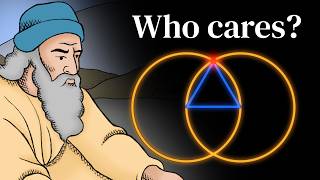
This episode explores three famous mathematical 'fake proofs' to highlight common pitfalls in reasoning and the crucial importance of rigor.
There are three key takeaways from this discussion. First, visual intuition often masks subtle flaws, emphasizing the need for rigorous proof. Second, understanding limits is crucial, as the limit of a property is not always the property of the limit object. Third, always question underlying assumptions, particularly in geometry, where a single error can invalidate an entire argument.
The episode reveals how compelling visuals can deceptively hide fundamental errors. What appears correct in a diagram is not a substitute for a stringent, logical proof. Visual arguments are powerful tools, but they require critical thinking to avoid significant flaws.
The examples illustrating sphere surface area and pi equals four highlight crucial nuances of limits and convergence. A property of a sequence, like perimeter, does not necessarily converge to the same property of the limit object. The limit of lengths is not always the length of the limit.
The proof for all triangles being isosceles showcases how seemingly rigorous steps can fail due to flawed assumptions. Diagrams can mislead by suggesting configurations that are not universally true. Moreover, the inability to flatten a curved surface like a sphere into a plane without distortion underpins many geometric errors.
Ultimately, these 'fake proofs' underscore the indispensable role of rigor and critical thinking in all mathematical reasoning.
Episode Overview
- The episode presents three famous "fake proofs" in mathematics to illustrate common pitfalls in mathematical reasoning and the importance of rigor.
- The proofs are presented in increasing order of subtlety: one for the surface area of a sphere, one "proving" π = 4, and one "proving" all triangles are isosceles.
- Each fake proof is deconstructed to reveal the specific error, teaching valuable lessons about limits, geometric assumptions, and the dangers of relying solely on visual intuition.
- The video emphasizes that while visual arguments are powerful tools for understanding, they must be backed by careful, critical thinking to avoid subtle but significant flaws.
Key Concepts
- Visual Intuition vs. Rigor: The central theme is the tension between what seems intuitively correct from a diagram and what is logically sound. The video shows how compelling visuals can mask fundamental errors.
- Limits and Convergence: The proofs for the sphere's surface area and π=4 highlight a crucial subtlety of limits: a property of a sequence of objects (like their perimeter) does not necessarily converge to the same property of the limit object. The limit of the lengths is not always the length of the limit.
- Hidden Assumptions: The proof that all triangles are isosceles demonstrates how a seemingly rigorous, step-by-step geometric proof can fail due to a single flawed assumption based on an inaccurate diagram. The error lies in assuming a particular configuration of points that isn't universally true.
- Spherical Geometry vs. Euclidean Geometry: The first proof fails because it attempts to flatten a curved surface (a sphere) into a 2D plane without distortion. This is impossible, as the geometry of curved surfaces is fundamentally different from the flat, Euclidean geometry of a plane. This distortion (or "Gaussian curvature") is what makes the area calculation incorrect.
Quotes
- At 01:15 - "The proof is elegant...It's only fault, really, is that it's completely wrong!" - Describing the deceptive appeal of the first fake proof for the surface area of a sphere, which arrives at the incorrect formula π²R².
- At 03:09 - "The claim of the example is not that any one of these approximations equals the curve, it's that the limit of all of the approximations equals our circle." - Clarifying the specific mathematical claim being made in the π = 4 proof, which helps pinpoint the error in assuming the limit of the perimeters equals the perimeter of the limit.
- At 05:20 - "It's just not enough for things to look the same. This is why we need rigor! It's why we need proofs!" - The narrator's conclusion after demonstrating how visual intuition fails in the first two proofs, setting the stage for the third, more formally deceptive geometric proof.
Takeaways
- Be wary of seemingly straightforward visual arguments, as they can hide subtle flaws. What looks correct in a diagram is not a substitute for a rigorous proof.
- When dealing with limits, understand that the limit of a property (e.g., length, area) is not always the same as the property of the limit shape.
- Always identify and question the underlying assumptions in a proof, especially in geometry, as a single incorrect assumption can invalidate the entire argument.
- You cannot flatten a curved surface, like a sphere, into a flat plane without distorting its geometric properties, such as area and length.