But what is a Fourier series? From heat flow to drawing with circles | DE4

Audio Brief
Show transcript
This episode explores the complex Fourier series, demonstrating how any periodic drawing can be approximated by summing rotating vectors.
This discussion highlights three key takeaways: first, complex periodic motions can be decomposed into simple circular movements; second, the integral formula for Fourier coefficients measures specific frequencies; and third, complex numbers simplify rotation and oscillation mathematics.
The visual representation, often called epicycles, adds vectors tip-to-tail, each rotating at an integer frequency. By adjusting each vector's initial size and phase, intricate shapes can be traced. This connects rotational views to traditional real-valued Fourier series, where sums of sines and cosines are a special case.
The Fourier coefficients determine the specific properties of each rotating vector. The integral formula calculates these coefficients by effectively unwinding the function at a certain rate. This makes the target frequency stationary, allowing an average over time to isolate its precise contribution, measuring the amount of that frequency.
Using complex numbers and exponentials like e to the power of i t is the most natural and efficient way to describe rotations and oscillations. This approach streamlines calculations, replacing complex trigonometric manipulations with simpler algebraic operations. It offers a more elegant and efficient mathematical framework for such phenomena.
This elegant framework offers a powerful mental model for analyzing systems involving cycles or waves, from signal processing to drawing intricate shapes.
Episode Overview
- The episode provides a visual introduction to the complex Fourier series, demonstrating how any periodic drawing can be approximated by summing up rotating vectors, often called epicycles.
- It explains that each vector rotates at a constant integer frequency, and by adjusting their initial size and phase, the tip of the final vector can trace out intricate shapes.
- The video connects this complex, rotational view to the more traditional real-valued Fourier series, showing how sums of sines and cosines are a special case of this more general idea.
- It derives the integral formula used to calculate the Fourier coefficients, which determine the specific properties of each rotating vector needed to construct a given shape.
Key Concepts
- Complex Fourier Series: The representation of a periodic function or closed-loop drawing as an infinite sum of rotating complex numbers (vectors). The general form is
f(t) = Σ c_n * e^(n*2πit). - Epicycles: The visual representation of the complex Fourier series, where vectors are added tip-to-tail. Each vector rotates at a constant integer frequency (
n), with its length and starting angle determined by a coefficient (c_n). The tip of the final vector traces the desired path. - Frequencies (n): Each term in the series corresponds to an integer frequency. Positive frequencies represent counter-clockwise rotation, negative frequencies represent clockwise rotation, and the zero frequency (
n=0) term is a stationary vector representing the center of mass of the drawing. - Fourier Coefficients (c_n): These are complex numbers that define the initial size (magnitude) and starting angle (phase) for each rotating vector. They are calculated using an integral that essentially isolates the contribution of each frequency component from the original function.
- Complex Exponentials: The function
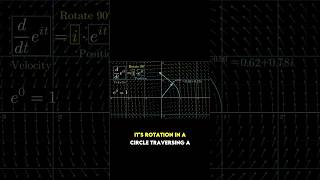
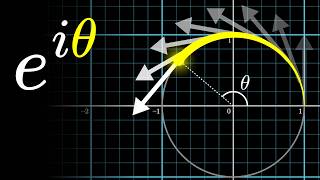
e^(it)is used to represent rotation in the complex plane. This simplifies the mathematics, as combining rotations becomes a matter of adding exponents, which is much cleaner than using trigonometric identities for sines and cosines.
Quotes
- At 00:21 - "By tweaking the initial size and angle of each vector, we can make it draw pretty much anything that we want." - The narrator explains the power and versatility of the Fourier series visualization, showing how adjusting the initial conditions of the rotating vectors can generate almost any shape.
- At 01:43 - "What's even crazier, is that the ultimate formula for all of this is incredibly short." - This quote introduces the compact integral formula for calculating the Fourier coefficients, highlighting the mathematical elegance behind the complex visual output.
- At 04:18 - "It's at this point that Fourier gains immortality." - The narrator emphasizes the historical significance of Joseph Fourier's bold and initially counterintuitive claim that any function, even discontinuous ones, could be represented as a sum of sine waves.
- At 18:48 - "This integral is a sort of clever way to kill all of the terms that aren't c2, and leave you only with the still part." - The video provides an intuitive explanation for how the integral formula for Fourier coefficients works: it modifies the original function to make the desired frequency component stationary, so that when averaged, all other rotating components cancel out, isolating the target coefficient.
Takeaways
- Complex, periodic motions or shapes can be understood by decomposing them into a sum of simple, constant-speed circular motions. This is a powerful mental model for analyzing any system that involves cycles or waves.
- The integral formula for calculating Fourier coefficients (
c_n) is a mathematical tool for measuring the "amount" of a specific frequency within a function. It works by "unwinding" the function at a certain rate to make the target frequency stationary, then averaging over time to isolate its contribution. - Using complex numbers and exponentials is the most natural and efficient way to describe rotations and oscillations. This approach simplifies the math, turning complex trigonometric manipulations into simpler algebraic operations on exponents.