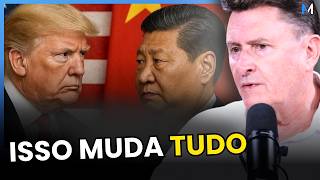
TRUMP ESTÁ DANDO UM TIRO NO PÉ (E PODE QUEBRAR OS EUA)
Audio Brief
Show transcript
This episode covers the escalating geopolitical tension between the United States and China, analyzing whether their relationship is destined for conflict or uneasy coexistence.
There are three key takeaways from this discussion. First, protectionist trade policies may be fundamentally flawed due to macroeconomic realities. Second, modern China seeks coexistence rather than the ideological dominance pursued by the Soviet Union. And third, investors must prepare for a fractured global order where political alliances increasingly dictate economic viability.
To expand on the first point, the conversation highlights a critical contradiction in current US economic strategy. While tariffs and dollar devaluation aim to boost exports, simultaneous increases in fiscal spending mathematically necessitate larger trade deficits. This creates an accounting identity problem where high government spending forces the country to import more capital and goods, effectively negating the goal of revitalizing domestic manufacturing. Furthermore, tariffs on intermediate goods like steel often backfire by raising production costs for downstream industries, ultimately fueling inflation.
Regarding China, the analysis suggests a distinct shift from Cold War dynamics. Unlike the USSR, which exported ideology, China focuses on securing its economic interests and internal stability. However, this pragmatic approach is complicated by Xi Jinping's aggressive posture and the lack of internal checks and balances. This creates a volatile environment where countries like Brazil find themselves caught in the middle, facing risks from over-dependence on Chinese exports while trying to maintain political alignment with the West.
Finally, the discussion outlines a new "triangle of instability" involving the US, China, and Russia. As isolationist policies alienate traditional Western allies, opposing powers are pushed closer together. For investors, this signals a need to monitor inflation risks driven by tariffs and to diversify supply chains away from a single-market reliance. Capital allocation strategies must now account for "friend-shoring," where geopolitical alignment is just as critical as economic fundamentals.
This has been a briefing on the macroeconomic and geopolitical risks shaping the US-China relationship.
Episode Overview
- This episode features an in-depth geopolitical analysis of the tension between the United States and China, exploring whether their relationship is a competition for global dominance or a negotiation for coexistence.
- The discussion centers heavily on the economic policies of Donald Trump, specifically how his tariff strategies and fiscal spending may backfire on the US economy by increasing trade deficits and inflation.
- The conversation also examines Brazil's precarious position in this global landscape, highlighting the risks of economic over-dependence on China while navigating political alignment with the West.
Key Concepts
- The Macroeconomic Flaw in Protectionism: A central theme is the "accounting identity" error in Trump's economic strategy. While he aims to boost exports by devaluing the dollar and imposing tariffs, his simultaneous increase in fiscal deficits (spending more than earning) mathematically necessitates a larger current account deficit. Essentially, if a country spends too much, it must import capital and goods from abroad, negating the goal of becoming a manufacturing powerhouse again.
- China's Strategic Goals vs. The USSR: Unlike the Soviet Union, which sought to export its ideology and political model globally, modern China is characterized as seeking coexistence rather than ideological hegemony. However, this view is nuanced by Xi Jinping's more aggressive posture and the lack of internal checks and balances compared to previous Chinese administrations.
- The "Shot in the Foot" of Tariffs: imposing high tariffs on intermediate goods (like semi-finished steel) hurts domestic manufacturing rather than helping it. If raw materials become more expensive due to tariffs, American finished goods (like cars) become more expensive to produce, fueling inflation and reducing competitiveness.
- The Triangle of Instability: The speakers outline a new geopolitical triangle involving the US, China, and Russia. As the US alienates allies (like the EU and NATO members) through isolationist policies, it inadvertently pushes countries like Russia and China closer together, creating a unified bloc that challenges Western influence.
Quotes
- At 1:36 - "If the fiscal deficit increases... by accounting identity, the deficits in the current accounts... will worsen, even with currency depreciation." - explaining why Trump's policies to reduce the trade deficit are mathematically destined to fail due to high government spending.
- At 3:37 - "One worker who works on semi-finished steel ends up using 60 workers who use semi-finished steel as an input. In other words, you will produce more expensive cars." - illustrating how protective tariffs on raw materials actually destroy downstream jobs and increase consumer prices.
- At 11:07 - "Countries... do not have friends, countries have interests." - summarizing the pragmatic and often ruthless nature of international relations, particularly regarding how major powers view smaller nations like Brazil.
Takeaways
- Diversify Supply Chains and Export Markets: For business leaders and investors, the discussion on Brazil's 33% export dependence on China highlights a critical risk. strategies should focus on diversifying revenue streams to include the US, Europe, and other markets to insulate against geopolitical shocks or Chinese economic slowdowns.
- Monitor Inflation via Tariff Policies: Investors should watch US tariff announcements closely. rather than viewing them solely as trade barriers, recognize them as leading indicators for US inflation and potential interest rate holds by the Federal Reserve, which has global ripple effects on capital cost.
- Evaluate geopolitical Risk in Portfolio Allocation: The episode suggests that the stability of the global order is fracturing. When allocating capital, consider the "friend-shoring" dynamic where political alliances impact economic viability. Avoid over-exposure to assets that rely heavily on open trade between the US and China, as the "instability" of capitalism is being exacerbated by political deglobalization.
More from Market Makers

EUA OU CHINA: QUEM VAI MANDAR NO MUNDO NO SÉCULO XXI?
Feb 13, 2026
CHINA E EUA: QUEM TEM MAIS PODER GLOBAL HOJE?
Feb 12, 2026

A ELEIÇÃO NÃO ESTÁ NO PREÇO (E O MERCADO PODE QUEBRAR A CARA)
Feb 11, 2026

BOLSA NA MÁXIMA HISTÓRICA: O QUE ESTÁ ACONTECENDO E COMO SE POSICIONAR | Second Level #32
Feb 11, 2026