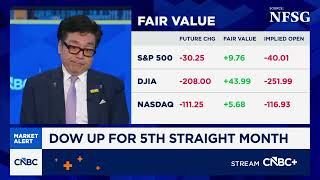
Tom Lee: Why the First 5 Trading Days of 2026 Matter So Much
Audio Brief
Show transcript
This episode covers the "Rule of first 5 days" market indicator and its historical validity for predicting annual S&P 500 performance.
There are three key takeaways. The "Rule of first 5 days" suggests early January trading signals the year's market trend. Positive performance in the first five days historically correlates with strong annual returns and a high win rate. A negative start, conversely, points to significantly lower average returns and increased market caution.
Historical S&P 500 data since 1950 validates this rule. When the first five days were positive, average full year returns stood at 16% with an 84% win rate.
In contrast, a negative start resulted in only a 3% average annual return and a 56% win rate. This notable performance difference underscores the indicator's utility.
Investors can leverage this "Rule of first 5 days" as an early directional guide for market sentiment and investment strategy.
Episode Overview
- The video announces an upcoming FS Insight "Macro Update & Top Ideas" webinar featuring Tom Lee and Mark Newton.
- It introduces the "Rule of first 5 days," a market theory suggesting that stock performance in the first week of January can predict the entire year's trend.
- The speaker presents historical S&P 500 data from 1950 to 2025 to validate this rule.
- The data shows a stark contrast in annual returns depending on whether the market was up or down in the first five days.
Key Concepts
- Rule of first 5 days: A market indicator suggesting that the direction of the stock market during the first five trading days of January often predicts the market's performance for the entire year.
- Historical S&P 500 Performance Analysis: The analysis uses data since 1950 to test the validity of the "Rule of first 5 days."
- Positive Correlation: In years where the first five days were positive (49 instances), the average full-year return was 16%, with an 84% win rate.
- Negative Correlation: In years where the first five days were negative (27 instances), the average full-year return was only 3%, with a 56% win rate.
Quotes
- At 00:11 - "I'd like to remind you that this coming Friday is our top macro update and top ideas webinar at 2:00 p.m. Eastern time." - Announcing an upcoming event for viewers.
- At 00:36 - "The rule of first five days is that how stocks trade in the first week of the year often is a good directional signal for how the rest of the year plays out." - Clearly defining the main concept of the video.
- At 01:44 - "Pretty sizable performance difference, 16% versus three." - Summarizing the key statistical finding from the historical data presented.
Takeaways
- Use the "Rule of first 5 days" as an early directional indicator to gauge potential market sentiment for the upcoming year.
- A positive market performance in the first week of January can historically justify a more optimistic or bullish investment outlook for the rest of the year.
- A negative start to the year should prompt caution, as historical data suggests significantly lower returns and a barely better than 50/50 chance of a positive year.