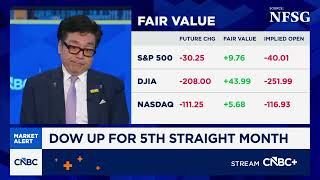
Tom Lee: Is Crypto Bottoming Right Now?
Audio Brief
Show transcript
This episode covers Fundstrat s Tom Lee and his analysis of early 2022 market volatility, focusing on why crypto assets have struggled alongside broader equity turbulence.
There are three key takeaways from the discussion regarding market indicators and asset rotation.
First, Lee attributes Bitcoin s recent underperformance to a capital rotation into precious metals. He argues that strong early-year momentum in gold and silver created a vortex that pulled risk appetite away from digital assets. This implies that the crypto sell-off was driven more by external capital flows than by internal structural failures, especially since the industry had already significantly deleveraged in late 2021.
Second, historical data highlights the critical importance of the first week of trading. Known as the First Five Days rule, statistics since 1950 show that when the S and P 500 rises during the first five sessions, the market averages an 18 percent gain for the year. Conversely, a negative start often signals a much weaker year, averaging a 5 percent loss, making January momentum a vital heuristic for annual forecasts.
Third, technical analysis suggests a bottom may be forming for Bitcoin based on the alignment of time and price. Lee references Tom DeMark s methodology, noting that market bottoms require not just a price drop, but also sufficient duration for negative sentiment to wash out. With both conditions now met, the technical setup points toward significant upside potential despite policy uncertainty coming from Washington.
In summary, investors should look beyond immediate price dips and consider whether enough time has passed for trends to exhaust themselves before deploying capital.
Episode Overview
- Market Turbulence and Crypto's Struggle: Tom Lee of Fundstrat joins CNBC to discuss the volatility seen in early 2022, specifically addressing why the crypto market has suffered more than expected compared to broader equities.
- The "First Five Days" Indicator: The discussion explores historical market data suggesting that a positive start to the year (first five days and first month) often correlates with strong annual returns, offering a bullish outlook despite current "speed bumps."
- Bitcoin Price Prediction: Lee provides a specific, contrarian forecast for Bitcoin, citing technical analysis that suggests a bottom is forming and significant upside potential exists based on market alignment.
- Political and Policy Impacts: The segment covers how Washington's policy decisions and the Federal Reserve's actions are creating uncertainty, influencing everything from sector performance to market psychology.
Key Concepts
- The "FOMO Vortex" of Precious Metals: Lee introduces the idea that strong early-year performance in gold and silver created a "vortex" that sucked risk appetite away from crypto. This suggests that crypto's price decline was less about its own fundamentals and more about capital rotation into safe-haven assets which were momentarily outperforming.
- Deleveraging vs. Leverage in Crypto: A crucial distinction is made regarding the state of the crypto market. Unlike previous crashes driven by excessive borrowing, the industry "de-levered" in late 2021. This implies that current price weakness is not a result of structural fragility or forced liquidations, but rather external market sentiment.
- The "First Five Days" Rule: Lee references a historical market statistic: when the S&P 500 is up in the first five days of the year, the market finishes the year up 18% on average (based on data since 1950). conversely, when this indicator fails, the market averages a 5% loss. This concept suggests early-year momentum is a critical predictor of annual health.
- Time and Price Alignment: This technical analysis concept, attributed to Tom DeMark, suggests that market bottoms aren't just about reaching a low price; enough time must also pass for sentiment to wash out. Lee argues that Bitcoin has now satisfied both the price drop and the duration requirements to form a durable bottom.
Quotes
- At 0:50 - "When we have gold and silver doing so well, especially at the start of the year, that created FOMO, and that was like a vortex sucking all risk appetite towards the precious metals trades." - explaining the mechanism behind crypto's underperformance relative to other assets.
- At 2:04 - "The White House is deliberately picking more winners and losers early, I think because of the midterms... I think that has caused some turmoil in markets." - highlighting the direct link between political strategy and market volatility.
- At 3:34 - "If you look at the non-36 instances [where the First 5 Days rule failed], the other 34 or so, the market on average is down 5% for the year. So it makes a huge difference to do well in the first week and the first month." - clarifying the statistical significance of early January market performance.
Takeaways
- Monitor "Time and Price" for Entry Points: When evaluating volatile assets like crypto, do not just buy the dip based on price alone; consider if enough time has passed for the negative trend to exhaust itself.
- Watch Early Year Indicators: Use the performance of the S&P 500 in the first five trading days and the month of January as a heuristic for gauging the likely direction of the market for the remainder of the year.
- Look for Divergence Between Price and Fundamentals: If an asset class (like crypto) has strong fundamental metrics (e.g., increasing active wallet addresses) but declining prices due to external factors (like a rotation into gold), this may signal a buying opportunity rather than a fundamental flaw.