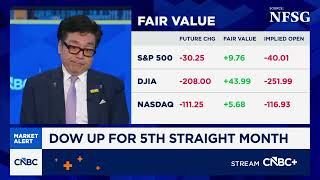
Tom Lee Warns of Volatility Ahead
Audio Brief
Show transcript
This episode features market strategists Tom Lee, Keith Lerner, and Malcolm Ethridge discussing a potential shift in market leadership away from mega-cap tech toward overlooked sectors amid critical earnings reports and Federal Reserve policy updates.
There are three key takeaways from the conversation. First, the market may be approaching a significant rotation into small-cap stocks, energy, and materials after years of underperformance. Second, while the tech sector remains crucial, its valuation premium has compressed significantly, making upcoming earnings reports a vital test for sustaining the broader rally. Third, despite a generally bullish long-term outlook through 2026, investors should brace for substantial volatility and potential drawdowns in the middle of 2024 due to election-year policy uncertainty.
Expanding on these points, Fundstrat's Tom Lee argues that the Russell 2000 is currently at a valuation turning point eerily similar to 2001. Based on price-to-sales and price-to-book metrics, small caps appear poised for a multi-year period of outperformance relative to the S&P 500. This thesis relies on mean reversion, suggesting that capital will flow into unloved areas like energy and materials as the market broadens beyond the Magnificent Seven. This shift is supported by what the panel identifies as a quiet Fed Put, where the Federal Reserve has pivoted from strictly fighting inflation to prioritizing the labor market, effectively placing a floor under asset prices.
However, the strategists caution against abandoning big tech entirely. Keith Lerner points out that the tech sector's premium relative to the S&P 500 has actually compressed from roughly 37 percent to 16 percent, making valuations more reasonable than many perceive. The critical variable will be upcoming guidance from giants like Apple, Amazon, Meta, and Microsoft, specifically regarding their capital expenditure. Strong spending would signal a healthy ecosystem for suppliers, while weak guidance could accelerate the rotation into value sectors.
Looking further ahead, while the earnings story remains robust, Tom Lee anticipates a possible bear market drawdown of up to 20 percent later this year. He attributes this risk not to economic failure, but to policy uncertainty surrounding the U.S. presidential election and potential tariff changes. The market may struggle to digest the combination of a shifting political landscape and the Federal Reserve navigating a soft landing. Additionally, the conversation highlights a divergence in safety assets, noting that gold is hitting record highs due to central bank buying, while Bitcoin struggles to act as digital gold during risk-off periods.
This discussion suggests investors should balance core tech exposure with incremental allocations to small caps and real assets to navigate the coming volatility.
Episode Overview
- This episode features market strategist Tom Lee of Fundstrat alongside Keith Lerner and Malcolm Ethridge, discussing market volatility during earnings season and the outlook for 2024 and beyond.
- The central narrative focuses on a potential shift in market leadership away from the "Magnificent Seven" tech stocks toward small caps (Russell 2000), energy, and materials, driven by a dovish Federal Reserve and historical valuation cycles.
- The discussion covers critical upcoming events, including major tech earnings and the Federal Reserve meeting, while also addressing risks like policy uncertainty, geopolitical tensions, and potential "bear market" drawdowns later in the year.
Key Concepts
- Small Cap and Sector Rotation Thesis: Tom Lee argues that small caps (Russell 2000) are at a historical turning point similar to 2001, poised for a multi-year period of outperformance relative to the S&P 500. He bases this on valuation metrics (Price-to-Sales and Price-to-Book) and a "mean reversion" theory after years of underperformance by energy and materials sectors.
- The "Fed Put" Shift: The panel suggests the Federal Reserve has pivoted from strictly fighting inflation to prioritizing the job market. This shift is interpreted as a "dovish tilt" or a "Fed put," which supports asset prices even if interest rate cuts aren't immediately forthcoming.
- 2026 Outlook and Intermediate Risks: While the long-term earnings story looks strong through 2026, Lee anticipates a potential "bear market" drawdown (possibly 20%) in mid-2024. He attributes this risk to two main factors: the market "testing" a new Fed chair (or policy shift) and heightened policy/tariff uncertainty from the U.S. presidential election.
- Tech Sector Positioning: Despite the rotation thesis, the strategists argue against abandoning big tech entirely. Keith Lerner notes that the tech sector's premium relative to the S&P 500 has compressed significantly (from ~37% to ~16%), making valuations more reasonable than perceived. The upcoming earnings from Apple, Microsoft, Meta, and Amazon are seen as critical tests for sustaining the current market rally.
- Gold vs. Bitcoin as a Safety Trade: The discussion highlights a divergence between gold and Bitcoin. Gold is hitting record highs due to central bank buying and global diversification away from the dollar. Conversely, Bitcoin is struggling due to massive deleveraging events and concerns over quantum computing security, failing to act as "digital gold" during recent periods of risk-off sentiment.
Quotes
- At 2:35 - "The last turning point for small caps and on a relative price to sales last year or price to book they were at the exact same point they were in 2001. That was a launch point for 12 years of relative outperformance." - Tom Lee explaining the historical valuation basis for his bullish stance on the Russell 2000.
- At 4:00 - "[The Fed] looking at the job market, that's a Fed put on the economy. To me that's a dovish tilt and as long as they're not fighting inflation to me that's a dovish Fed." - Tom Lee clarifying why the market perceives the Fed as supportive even without immediate rate cuts.
- At 9:44 - "The tech sector is now trading at a premium of just 16% relative to the S&P. That's the lowest since 2021 and it's well off the premium of about 36 or 37 percent that we saw just a few months ago." - Keith Lerner providing context on tech valuations to counter the narrative that the sector is universally overpriced.
Takeaways
- Balance portfolios by maintaining core tech exposure while incrementally rotating into "unloved" sectors like energy, materials, and small caps (Russell 2000) to capture potential mean reversion.
- Monitor next week's guidance from Apple, Amazon, Meta, and Microsoft specifically for capital expenditure (CapEx) spending; strong spending indicates a healthy ecosystem for semiconductor and material suppliers, while weak guidance could trigger a broader rotation.
- Prepare for potential mid-year volatility by acknowledging that election years often bring policy uncertainty (tariffs, regulation) that can trigger significant market drawdowns, regardless of the long-term bullish trend.