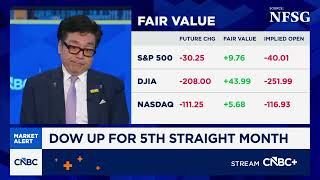
Tom Lee on Bitcoin, Crypto Adoption, and the Next Market Cycle
Audio Brief
Show transcript
Episode Overview
- Features market strategist Tom Lee presenting a comprehensive bullish thesis for the U.S. economy, predicting a decade-long expansion driven by demographics, wealth transfer, and technological innovation.
- Deconstructs the psychological pitfalls of investing, specifically explaining why trying to time market corrections is the "enemy of performance" and how to properly view volatility.
- Analyzes specific sector opportunities beyond Big Tech, including the "re-rating" of financial stocks due to AI efficiency and the rotation into Small Caps and Energy.
- Examines the hidden structural drivers behind Gold and Bitcoin, offering a roadmap for how these assets fit into a modern portfolio alongside traditional equities.
Key Concepts
-
The "Enemy of Performance" Principle: The primary reason individual investors underperform is the psychological compulsion to "buy the bottom and sell the top." In a secular bull market, significant pullbacks (10-20%) should be viewed as liquidity events to enter at better prices, not signals to exit. The "Double Decision" trap reveals that while selling is easy, the psychological conviction required to buy back in at higher prices is rarely present.
-
Secular Tailwinds vs. Cyclical Noise: The U.S. is in the early stages of a structural bull market supported by three pillars: a surge in the "prime-age" workforce (millennials/Gen Z), a massive wealth transfer from Boomers, and U.S. dominance in AI and blockchain. These long-term tailwinds outweigh short-term cyclical fears like inflation data, which is often artificially elevated by lagging housing metrics.
-
The "Re-Rating" of Traditional Sectors: AI offers a unique valuation shift for non-tech sectors, particularly Financials. Because a bank's largest expense is compensation, AI allows them to drastically reduce labor costs and stabilize earnings. This could cause banks to be "re-rated" with higher price-to-earnings multiples similar to technology firms, rather than traditional low-multiple value stocks.
-
The Power Law in Innovation: When investing in exponential growth themes like AI, the "hit rate" (percentage of winning stocks) is irrelevant compared to the magnitude of the winners. Historical data from the Dot-com bubble shows that holding a broad basket of stocks—where 98% might fail—still outperforms the S&P 500 because the returns from the surviving 2% are astronomical.
-
Hidden Market Mechanics (Tether & Gold): A sophisticated, invisible driver of gold prices is the stablecoin market. Tether (USDT) earns massive yields on Treasury bills and reportedly uses that excess capital to algorithmically buy gold as a diversification asset. This creates a structural, non-emotional buyer for gold that exists outside of traditional fear or inflation narratives.
Quotes
-
At 0:06 - "Trying to time the market makes you an enemy of your future performance... The only people who really make money are those who are investing for the long term." - Establishes the core philosophy that time in the market is statistically superior to timing of the market.
-
At 6:51 - "The US does have a favorable demographic tailwind... in contrast to other countries where the prime age workforce has gone into deficit." - Highlights the foundational macroeconomic advantage the U.S. holds over Europe and China.
-
At 16:09 - "Oil prices and energy stocks don't correlate... Energy stocks price the future levels of oil prices." - Clarifies a common error; investors can be bearish on spot oil prices but bullish on energy companies based on long-term cash flow and sustainability.
-
At 19:35 - "If you looked at a basket of stocks... in 2000, I think only 2% of all the universe of stocks actually survived, but the return generated by that 2%... [meant] you still outperformed meaningfully the S&P 500." - Explains the mathematical justification for buying a broad basket of risky innovation stocks rather than picking single winners.
-
At 21:38 - "Apple analysts... insisted Apple was a hardware company... I think people look at Nvidia as a cyclical hardware company... whereas Nvidia... has high visibility on future earnings and yet trades at half the multiple of Costco." - Illustrates how analysts often misclassify platform-shift companies as cyclical hardware makers, missing the valuation upside.
-
At 36:06 - "I believe Tether, which is the stablecoin... has become the largest private buyer of gold... They generate income and with that excess return, they're buying gold." - Reveals a critical, under-discussed structural mechanism linking the crypto market's success directly to gold demand.
Takeaways
-
Adopt a "Basket Approach" for AI Investing: Do not attempt to pick the single "winner" in the AI sector. Instead, buy a broad basket of companies. You should expect many to fail, but the mathematical "power law" ensures that the exponential gains of the few survivors will cover the losers and outperform the broader market.
-
Re-evaluate "Boring" Sectors for AI Upside: Look for industries with high labor costs (specifically Financials/Banks) that are heavily investing in technology. These companies are the primary beneficiaries of AI efficiency and are likely to see their profit margins expand permanently, justifying a higher stock valuation.
-
Utilize the "Fire, Ready, Aim" Opportunity: Recognize that markets historically overreact to threats of policy changes (like tariffs) before analyzing the details. When the market sells off on a headline threat, use that "panic selling" period as a liquidity event to acquire quality assets at a discount.
-
Monitor Generational Asset Shifts: Align your portfolio with the preferences of the "prime age" workforce. As Millennials and Gen Z enter their peak earning years, their preference for non-sovereign stores of value (Gold and Bitcoin) will drive long-term demand, creating a "Lindy Effect" where these assets gain value simply through sustained adoption over time.