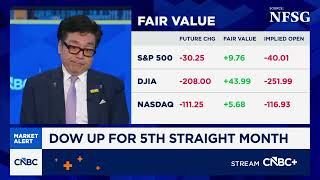
Tom Lee Flags 3 Risks for Stocks
Audio Brief
Show transcript
This episode covers the current state of the stock market. It focuses on whether the strong performance of artificial intelligence and tech equities represents an earnings driven surge or an overextended rally.
There are three key takeaways from this discussion. First, the current market rally appears to be fundamentally supported by strong corporate earnings rather than pure speculation. Second, data has become a critical fourth factor of production alongside land, labor, and capital. Third, the broader market faces immediate macroeconomic tests regarding inflation and Federal Reserve policy.
Expanding on these points, Ed Yardeni argues that the market is experiencing a fundamentals driven surge. He suggests that we have only begun to harness the economic value of data, making artificial intelligence a highly transformative growth engine for the future.
Tom Lee agrees with this secular trend but cautions investors about immediate volatility. He notes that rising bond yields, persistent inflation risks, and a growing pipeline of initial public offerings could temporarily pressure equities by increasing supply.
Interestingly, Lee suggests that certain aggressive growth investments, like memory components, might actually serve as defensive plays right now. Because severe shortages exist in global memory supply, these specific technology sectors may hold up well even in a challenging macroeconomic environment.
Ultimately, the long term structural tailwinds for technology remain incredibly strong. However, investors must still carefully navigate the upcoming inflation and monetary policy tests.
Episode Overview
- The episode features a discussion on the current state of the stock market, focusing on the strong performance of AI and tech stocks, and whether this constitutes an "earnings-led melt-up" or an overextended rally.
- Ed Yardeni argues that the market is experiencing a fundamentals-driven melt-up, supported by strong earnings and the transformative potential of AI, likening data to a new factor of production.
- Tom Lee agrees with the long-term potential of AI but outlines three key tests the market will face in the near term: Federal Reserve actions, inflation risks, and increased equity supply from IPOs.
- The conversation also touches on market breadth, with concerns raised about the underperformance of non-tech sectors and the impact of rising bond yields and inflation.
Key Concepts
- Earnings-Led Melt-Up: The idea that the current market rally is not solely driven by speculation but is underpinned by strong corporate earnings and reasonable valuation multiples relative to those earnings.
- Data as a Factor of Production: The concept that in the digital age, data has become a critical resource alongside land, labor, and capital, and AI is the key technology enabling the processing and monetization of this data.
- The "Three Tests" for the Market: The near-term challenges identified for the stock market: the Federal Reserve's response to inflation risks, the market's reaction to rising yields and inflation data, and the potential increase in equity supply from a growing IPO pipeline.
- Defensive Nature of Certain Tech Investments: The perspective that investing in specific tech sectors, like semiconductors and DRAM, might be defensive because memory shortages could compel purchases regardless of the broader macroeconomic environment.
Quotes
- At 1:42 - "I think data has become a fourth factor of production... and we really haven't squeezed it for all it's worth and that's what AI is doing." - Ed Yardeni explains his bullish view on AI, positioning data as a foundational economic resource that AI will unlock.
- At 2:32 - "I do think three tests are emerging for the stock market... How is the Fed going to react to the underlying inflation risks... The market doesn't really like when inflation is a concern and yields are rising... and the third of course is we have a lot of IPOs and that's a lot of supply." - Tom Lee outlines the near-term macroeconomic and structural risks that could challenge the current market rally.
- At 6:16 - "The move in DRAM in my opinion is actually somewhat defensive because we know that if you're worried about inflation and petroleum shortage, there's even bigger shortages in memory." - Tom Lee offers a counterintuitive view that investing in certain tech components can act as a defensive strategy against specific inflation and supply chain risks.
Takeaways
- When evaluating the sustainability of a market rally, look beyond price movements and assess the underlying earnings growth and valuation multiples to determine if it's fundamentally supported.
- Consider the long-term transformative impact of general-purpose technologies, like AI's ability to process data, when evaluating secular growth trends in the market.
- Be prepared for near-term volatility by monitoring macroeconomic indicators, such as inflation data and Federal Reserve policy, which can act as significant tests for market sentiment.
- Understand that in certain environments, traditionally aggressive growth sectors (like specific tech components) might offer defensive characteristics if they address critical shortages or bottlenecks.