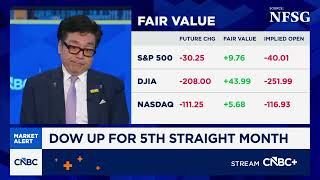
Tom Lee: Correction First. Rally Next?
Audio Brief
Show transcript
This episode covers Tom Lee's bullish market outlook through 2026, highlighting how persistent investor skepticism and AI's transformative impact signal future growth opportunities.
There are four key takeaways from this discussion. First, widespread market pessimism signals potential buying opportunities, as markets often climb a 'wall of worry.' Second, a diversified 'basket' approach is crucial when investing in high-risk, emerging sectors like artificial intelligence. Third, observing younger generations' technology adoption reveals future transformative market shifts. Finally, undervalued sectors, including small caps and financials, offer significant upside as the market broadens beyond mega-cap technology.
Lee argues years of economic shocks have suppressed the market, creating a 'wall of worry.' This widespread investor skepticism is historically bullish, as markets tend to climb on fear and peak on optimism. He views predicted future volatility as a healthy consolidation and a prime buying opportunity.
Investing in AI requires a diversified 'basket' approach, acknowledging most individual companies will likely fail. This strategy aims to capture the overall theme's potential rather than attempting to pick specific long-term winners. It mirrors early internet investment strategies where broad exposure proved more effective.
New technologies like AI are often dismissed by older demographics focused on wealth preservation. True adoption and market shifts are instead driven by younger generations, paralleling the historical embrace of cellular phones. Observing these early adopters helps identify transformative market trends.
Beyond the Magnificent 7, significant opportunities exist in overlooked areas. Small caps and financials are identified as currently undervalued sectors poised for growth. Financials, in particular, are expected to evolve into tech-centric companies, offering further upside potential.
This forward-looking perspective suggests navigating current anxieties with a strategic, diversified approach can unlock significant investment opportunities.
Episode Overview
- Tom Lee of Fundstrat presents his bullish case for the stock market through 2026, arguing that years of economic suppression from major shocks have created a "wall of worry" that is paradoxically a positive sign for future growth.
- The discussion explores the transformative impact of AI, drawing parallels to past technological shifts like the adoption of cell phones and the labor market disruption caused by frozen foods to frame current skepticism and opportunities.
- Lee predicts significant volatility ahead, including a potential "miniature bear market," but views it as a healthy consolidation and a prime buying opportunity before the market continues its upward climb.
- The conversation identifies specific investment opportunities, recommending a diversified "basket" approach for AI stocks and highlighting undervalued sectors like small caps and financials, while maintaining a positive outlook on Bitcoin.
Key Concepts
- The "Wall of Worry" Thesis: The market has been artificially suppressed by six "extinction events" (Covid, supply chain issues, inflation, rapid Fed hikes), leading to widespread investor skepticism. This environment is historically bullish, as markets tend to climb a "wall of worry" and peak on optimism, not fear.
- Technology Adoption Cycles: New, transformative technologies like AI are often dismissed by older, wealthier demographics focused on wealth preservation. True adoption and market shifts are driven by the younger generation, similar to the initial resistance and eventual embrace of cellular phones.
- AI's Labor Market Impact: The potential job displacement from AI is compared to the invention of frozen foods, which disrupted the agricultural workforce but ultimately led to repurposed labor and new industries, suggesting a similar evolution rather than a permanent labor crisis.
- Market Volatility as Opportunity: The bullish long-term forecast includes a prediction for a significant market drawdown (around 20%) in the near future. This is not seen as a crisis but as a healthy, temporary consolidation and a buying opportunity.
- Investment Strategy for AI: Acknowledging that most individual AI companies will likely fail, the recommended strategy is to invest in a "basket" of AI-related stocks to capture the theme's overall potential, similar to investing in the early internet.
- Undervalued Market Sectors: Beyond the Magnificent 7, opportunities exist in overlooked areas. Small caps and financials are identified as currently undervalued, with financials poised to evolve into tech-centric companies.
- Conviction vs. Stubbornness: A crucial skill for investors is to distinguish between having conviction in a well-researched thesis through volatility and being stubborn by clinging to an idea when the fundamental facts have changed.
Quotes
- At 0:21 - "I think the economy and stocks have been suppressed for the past few years." - Tom Lee giving the core thesis for his bullish outlook.
- At 1:03 - "I think all of these collectively have made investors very nervous about... investing in full risk because these are what, six black swans that happened in four years." - Tom Lee explaining how a series of major negative events have created a persistent "wall of worry."
- At 4:23 - "Markets actually peak on good news. You know, they don't peak when people are bearish. Markets peak when everyone is bullish and it no longer responds to good news. Just like markets bottom on bad news." - Tom Lee explaining the contrarian view that widespread skepticism is a positive indicator for future gains.
- At 7:18 - "Our outlook actually does call for a drawdown... next year... probably closer to 20%. So I think we are going to have another miniature bear market next year. But then we're going to recover." - Tom Lee predicting a significant but temporary market correction as part of his overall bullish forecast.
- At 12:47 - "I think AI is probably fair to say 90% of the stocks are going to do way worse than people expected... But I think as a basket, it's probably going to outperform." - Tom Lee on his strategy for investing in the AI sector, acknowledging high risk for individual companies but high potential for the theme itself.
- At 22:43 - "If you're using it through the lens of a 40-year-old, really wealthy person, no new technologies looks interesting to you because you're more interested in protecting your wealth and incumbency." - Tom Lee explains why established demographics are often slow to embrace disruptive innovation like AI.
- At 23:33 - "It was 70% of 20-year-olds had a cell phone and it was like 5% of 60-year-olds. So, of course, all my clients who were in their 50s and 60s said, 'You know, who needs a cell phone?'" - Tom Lee uses the historical adoption gap of cellular phones as an analogy for how different generations will adopt AI.
- At 26:18 - "We did at Fundstrat study another technological wave that wiped out at least 20% of the labor force… in the 20th century, which was frozen foods." - Tom Lee provides a historical parallel to show how major technological disruptions, while displacing jobs in one sector, can lead to positive economic evolution.
- At 33:32 - "You also need to know the difference between conviction and being stubborn. Because stubborn is riding something when all the facts have changed. Conviction is basically riding through the volatility." - Tom Lee describes the crucial judgment skills that make a great researcher irreplaceable in the age of AI.
Takeaways
- View significant market drawdowns and widespread pessimism not as signals to sell, but as potential buying opportunities, as markets historically perform well when climbing a "wall of worry."
- When investing in emerging, high-risk sectors like AI, mitigate risk by diversifying across a "basket" of companies rather than attempting to pick the single long-term winner.
- To identify future growth trends, analyze how younger generations are adopting new technologies, as they are the primary drivers of transformative and disruptive market shifts.
- Look for investment opportunities in undervalued sectors like small caps and financials, which may offer significant upside as the market rally broadens beyond mega-cap technology stocks.
- Regularly re-evaluate your investment theses to ensure you are operating with conviction based on solid fundamentals, rather than stubbornness that ignores changing facts.