Steven Strogatz: In and out of love with math | 3b1b podcast #3

Audio Brief
Show transcript
This episode covers applied mathematician Steven Strogatz's critique of traditional mathematics education, advocating for an approach that prioritizes intuition, narrative, and the love for a question over formal proofs.
There are three key takeaways from this discussion. First, effective mathematics education should prioritize fostering curiosity and building a narrative around the 'why' of a problem before presenting formal answers. Second, embracing intuitive and experimental approaches is crucial for discovery, laying the groundwork for later formal proofs. Third, a human-centric approach to mathematical communication, valuing clarity, motivation, and the story of discovery over mere concision, is essential for broader engagement.
Strogatz emphasizes that genuine engagement with mathematics begins with a deep curiosity about a problem. Traditional education often presents solutions or proofs without first building a sense of need or appreciation for the question itself. By sharing the human stories and the messy process of discovery, educators can make the subject relatable and inspiring, fostering a true love for inquiry.
The episode highlights the power of 'experimental math' where hands-on modeling and visualization lead to discovery before formalization. Building intuition for why a concept is true is more effective than rote memorization of definitions and theorems. This intuitive exploration makes the subsequent task of finding a formal proof significantly easier and more meaningful.
Modern academic culture often prizes terse, elegant proofs, inadvertently alienating many learners by hiding the human process of discovery. Strogatz argues for prioritizing the universal feeling of 'satisfaction' from solving a puzzle over the exclusionary concept of 'beauty.' Embracing the messy, intuitive side of mathematics and its compelling history creates more accessible entry points for diverse audiences.
Ultimately, the conversation advocates for a transformative shift in math education, moving towards an approach that celebrates curiosity, intuition, and the human element of discovery.
Episode Overview
- Applied mathematician Steven Strogatz shares his personal journey, from a high school geometry problem that sparked his passion to a discouraging undergraduate experience that shaped his philosophy on teaching.
- The conversation critiques traditional mathematics education, arguing for an approach that prioritizes building intuition, narrative, and a love for the question over formal, unmotivated proofs.
- Strogatz explores the power of "experimental math," using the story of his undergraduate thesis to show how hands-on, intuitive methods are crucial for discovery before formalization.
- The discussion contrasts historical mathematicians who shared their thought processes with the modern academic culture that often prizes terse, elegant proofs at the expense of human understanding.
Key Concepts
- Love the Question: The core principle of effective teaching is to make the audience care about the problem and build a sense of need before presenting the solution or formal proof.
- Intuition Over Formalism: The most reliable way to engage students and foster understanding is to build their intuition for why a concept is true, rather than asking them to memorize definitions and theorems.
- Experimental Mathematics: The practice of using hands-on modeling, visualization, and heuristic reasoning to discover an answer, which makes the subsequent task of finding a formal proof much easier.
- Beauty vs. Satisfaction: While mathematicians often speak of "beauty," this can be an exclusionary concept. The more universal feeling of "satisfaction"—the pleasure of solving a puzzle—is a more accessible motivator for many.
- Critique of Modern Exposition: Modern academic mathematics often presents polished, final proofs ("machine code") that hide the messy, intuitive process of discovery ("source code"), making the material unnecessarily difficult and alienating.
- The Human Side of Math: The history of mathematics is filled with compelling personalities, rivalries, and fables that, while not always factually perfect, serve as powerful tools for making the subject relatable and engaging.
Quotes
- At 12:57 - "I think all of these things can be summed up in one little phrase, which is: it helps to love the question." - Strogatz articulating his central philosophy of math education, emphasizing that motivation and curiosity must come before formal answers.
- At 26:12 - "And I was so overwhelmed, I started clapping in the middle of this lecture... Really clapping, out loud, hard." - Strogatz recounting his visceral, emotional reaction to the elegance of a proof by his professor, illustrating the profound aesthetic power of a masterful explanation.
- At 32:48 - "I think intuition is the most reliable way to get people to like math." - Strogatz stating his core belief about math education: focusing on intuitive understanding is the key to making the subject engaging.
- At 57:06 - "'Experimental math is to get you the answer. And then it's a lot easier to find proofs when you know what the answer's supposed to be.'" - Grant Sanderson summarizing the key relationship between experimental intuition and formal proof that Strogatz's story about his thesis illustrates.
- At 102:30 - "I think there is a culture that prizes elegance and concision... they treat a human being as something that is not what a human being is." - Strogatz critiques the culture of mathematical exposition for ignoring the human element of learning.
Takeaways
- Effective teaching and learning in mathematics should always begin with the "why," building curiosity and a narrative around a question before presenting the formal answer.
- Embrace intuitive and experimental approaches to problem-solving, as they are essential for discovering the solution that can later be formalized with a rigorous proof.
- Recognize that people connect with math for different reasons—from puzzle-solving satisfaction to historical context—and using diverse entry points is key to broader engagement.
- Advocate for a more human-centric approach to mathematical communication that values clarity, motivation, and the story of discovery over mere concision and formal elegance.
More from Grant Sanderson

Visualizing transformers and attention | Talk for TNG Big Tech Day '24
Nov 19, 2024

Ain't No Twin Primes (live) | Bill Withers parody by 3Blue1Brown and Acapella Science
Apr 20, 2024

Ego and Math | Stanford Math Department Commencement Speech 2023
Jun 19, 2023
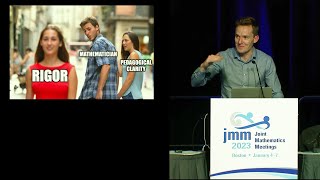
Math's pedagogical curse | Grant Sanderson JPBM Award Lecture, JMM 2023
Mar 30, 2023