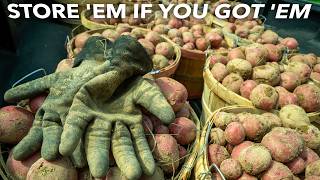
So You Want to Run a CSA Farm…
Audio Brief
Show transcript
This episode covers strategic management solutions for small-scale commercial growers, focusing on community-supported agriculture models, low-labor soil preservation, and organic crop disease control.
There are three key takeaways from this discussion. First, storage crops should serve as the operational foundation for community-supported agriculture to stabilize weekly share volumes. Second, resting vegetable beds can be maintained with minimal labor by combining organic mulch with silage tarps. Third, managing physical microclimates is far more effective at preventing tomato disease than relying on organic fungicidal treatments.
Relying on stable storage crops like potatoes, carrots, and onions allows growers to easily adjust weekly share volumes without wasting perishable greens. This prevents customer fatigue and the food waste anxiety that often discourages members from renewing their subscriptions. Strategically cycling heavy-yield crops like summer squash in and out of shares further improves long-term customer retention.
When labor constraints require growers to temporarily take beds out of production, passive soil management offers a highly efficient solution. Applying a thick layer of organic mulch under a silage tarp allows soil biology to break down organic matter in a weed-free environment. For dry climates, running drip tape beneath the tarp ensures sufficient moisture to sustain the decomposition process.
For sensitive outdoor crops like tomatoes, high environmental humidity and prolonged leaf moisture will override even the healthiest soil practices. Successful wet-climate production relies heavily on structural protection like high tunnels rather than expensive, preventative organic biofungicides. Without structures, growers must maximize airflow by spacing plants three to four feet apart with six feet between rows.
By balancing reliable storage crops, employing passive soil maintenance, and prioritizing physical microclimate control, growers can build more resilient and profitable farming systems.
Episode Overview
- This episode addresses common market-gardening and farming dilemmas submitted by growers, focusing on crop planning, soil management, and organic pest control.
- It explores the transition to a CSA-only (Community Supported Agriculture) farm model, focusing on crop selection, balancing excess yields, and managing customer retention.
- It details low-maintenance methods to "park" or rest vegetable beds for a season or two while preserving soil health, categorized by the level of labor required.
- It examines the harsh realities of growing field tomatoes in wet, humid climates and evaluates the effectiveness, risks, and application of organic biofungicides.
Key Concepts
- Storage Crops as the Foundation of a CSA: While fresh greens and summer crops draw interest, storage crops (such as potatoes, garlic, carrots, onions, and winter squash) act as the stabilizing core of a CSA share. They allow growers to easily adjust share volumes week-to-week without wasting perishable crops.
- The Psychology of CSA Customer Retention: Overwhelming customers with massive quantities of a single crop (like squash) or too much overall produce leads to food waste anxiety. When customers feel guilty about throwing away unused food, they are highly unlikely to sign up for the following season.
- Passive Soil Management (Parking Beds): When time constraints (such as raising young children) limit active farming, beds can be put on hold using passive organic matter digestion. Mulching heavily and covering with a silage tarp allows soil biology to break down organic matter in a weed-free, moisture-controlled environment without requiring active cultivation.
- Microclimate Control vs. Fungicidal Treatment: For sensitive crops like tomatoes, outdoor environmental conditions (prolonged leaf moisture and humidity) will override even the best soil health practices. Successful commercial tomato production in wet climates relies far more on structural protection (high tunnels) than on organic biofungicidal sprays, which are often costly, broad-spectrum, and difficult to apply preventatively.
Quotes
- At 4:47 - "Storage crops are the bass drum of the CSA. They help keep everything flowing forward... if you had too big of a share that week, you can easily take that storage crop away by keeping it in storage, and then you're not losing it." - explaining how stable, long-lasting crops act as the buffer for volatile crop yields.
- At 9:18 - "You could also add a mulch layer first and then tarp it, and that way the soil is consuming the mulch... it's not ideal, but it's a decent compromise." - clarifying how to use passive digestion to feed soil microbes while keeping beds weed-free.
- At 14:14 - "The best soil practices in the world are not really going to stop all foliar diseases when the leaves just stay wet all the time from heavy rains and heavy dews." - highlighting why physical environmental protection is superior to chemical or biological sprays for outdoor disease prevention.
Takeaways
- Implement a "Two-Weeks-On, Two-Weeks-Off" Succession Plan: When growing high-yielding summer squash or zucchini for a CSA, avoid continuous 8-week harvests. Instead, plant in successions that cycle these crops in and out of shares to prevent customer fatigue.
- Add Mulch Underneath Tarps to Resting Beds: If you need to rest beds with minimal labor, apply a thick layer of organic mulch (like straw or leaves) before laying down a silage tarp. If you live in a dry climate, run drip tape under the tarp to keep the environment moist enough for decomposition.
- Maximize Spacing for Field Tomatoes: If growing tomatoes outdoors without a high tunnel, space plants 3 to 4 feet apart within rows, and keep 6 feet of distance between rows. This maximizes airflow to dry out leaves quickly after rain and dew events, drastically reducing foliar disease spread.