Self-Directed, Organizational (Team) & Defensive Warfare - The 33 Strategies of War (Animated)

Audio Brief
Show transcript
This episode summarizes key principles from Robert Greene's "The 33 Strategies of War."
There are four key takeaways from this discussion. First, conquering your internal doubt and ego is crucial for external success. Second, effective strategy demands constant adaptation, not reliance on past victories. Third, wisely choosing your battles and understanding when to strategically retreat conserves vital resources. Fourth, inspiring your team by transforming your mission into a moral crusade fosters unity and high morale.
Success in any conflict begins with defeating your inner enemy. Conquer personal doubt, fear, and ego to maintain a clear presence of mind and focus your efforts. This self-directed warfare is foundational.
Never rely on past successes. Always adapt your tactics to the present situation to remain unpredictable and effective. This ensures agility and prevents opponents from anticipating your moves.
Conserve energy by carefully choosing your battles. Avoid conflicts you cannot win or those with an unacceptably high cost. Strategic retreat, trading space for time, is a powerful tactic to regroup and strengthen forces.
Finally, motivate your team by transforming your war into a crusade. Strong leadership and a noble cause inspire unity and high morale, turning a mission into a shared, values-driven effort.
This summary offers timeless insights into strategic thinking for personal and organizational triumph.
Episode Overview
- This episode provides a summary of key principles from Robert Greene's "The 33 Strategies of War," illustrating them with historical examples and animated visuals.
- It breaks down warfare into three categories: self-directed, organizational (team), and defensive warfare.
- The summary covers foundational strategies such as declaring war on internal enemies, adapting tactics, and maintaining composure under pressure.
- It explores leadership concepts like motivating a team, establishing a chain of command, and using psychological tactics to gain an advantage.
Key Concepts
- Self-Directed Warfare: This section focuses on the internal battle. It emphasizes the importance of conquering your own doubt, fear, and ego before facing external enemies. Strategies include adapting to new situations instead of repeating past successes, maintaining a clear presence of mind in chaotic moments, and creating a sense of urgency to focus your efforts.
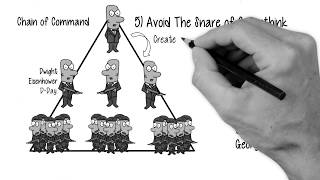
- Organizational (Team) Warfare: This covers strategies for leading a group. The key is to build a unified, motivated team by establishing a clear chain of command with shared values, transforming your mission into a moral crusade to boost morale, and knowing when to segment forces for speed or concentrate them for power.
- Defensive Warfare: This explores the idea that defense can be the strongest offense. It involves picking your battles wisely to conserve energy, turning an opponent's aggression against them by letting them make the first move, and creating a threatening presence to intimidate rivals into submission without a fight.
- Trading Resources: A recurring theme is the strategic trade-off. This is most clearly explained by the concept of "trading space for time," where a strategic retreat allows you to give up less valuable territory in exchange for the invaluable opportunity to regroup and strengthen your forces.
Quotes
- At 05:20 - "You will never reach your destination if you stop & throw stones at every dog that barks." - A quote attributed to Winston Churchill, used to illustrate the strategy of "Pick Your Battles" and the importance of conserving energy for meaningful conflicts.
- At 08:08 - "Space we can recover, time never." - A quote from Napoleon Bonaparte explaining the "Trade Space for Time" strategy, highlighting that time is the most valuable and non-recoverable resource in a conflict.
Takeaways
- To win any conflict, you must first defeat your "inner enemy"—your own doubt, emotions, and ego.
- Do not rely on past successes; always adapt your tactics to the present situation to remain unpredictable and effective.
- Conserve your energy by carefully choosing your battles. Avoid fights you cannot win and those where the cost of victory is too high.
- A strategic retreat is a powerful tool. Giving up ground can buy you the time needed to regroup, gather strength, and launch a more effective counter-attack.
- Motivate your team by transforming your war into a crusade. A noble cause and strong leadership inspire unity and high morale.

![The 48 Laws of Power [In-Depth Animation] #history #facts](https://img.youtube.com/vi/mYOq5Y9qqqs/mqdefault.jpg)