Sal Khan: Beyond Khan Academy | 3b1b Podcast #2

Audio Brief
Show transcript
This episode features an interview with Sal Khan, founder of Khan Academy, discussing his ambitious educational projects: Schoolhouse.world and the Khan Lab School.
There are four key takeaways from this conversation. First, mastery-based learning significantly accelerates student progress by ensuring foundational concepts are understood before advancing. Second, teaching a subject to someone else is the most effective way to deepen your own understanding. Third, when creating educational content, prioritize authenticity and a conversational tone over high production value to foster a human connection. Fourth, new forms of credentialing that require demonstrating and explaining knowledge offer more reliable signals of competence than traditional test scores.
Mastery-based learning ensures students achieve deep understanding in a topic before progressing. This contrasts with traditional models that often allow learning gaps to accumulate. Fully implementing this approach has shown students advancing multiple grade levels in a single year, highlighting its transformative potential.
Teaching a subject solidifies a learner's own grasp of material. Platforms like Schoolhouse.world leverage this by connecting students for peer tutoring. This creates a mutually beneficial learning environment where tutors gain deeper understanding and students receive personalized support.
Effective educational content thrives on authenticity and a conversational style. Overly polished or scripted explanations often lose the genuine thought process and human element crucial for learner engagement. Transparency and enthusiasm in delivery are more vital than production perfection.
Schoolhouse.world exemplifies a new approach to credentialing. Rather than relying solely on test scores, it enables applicants to record themselves demonstrating and explaining knowledge. This provides universities and employers with a richer, more reliable artifact of a candidate's actual understanding and competence.
This discussion underscores the power of innovative educational models to foster deep learning and provide credible pathways for demonstrating knowledge.
Episode Overview
- Grant Sanderson interviews Sal Khan, founder of Khan Academy, focusing on two of his ambitious projects: the peer-to-peer tutoring platform Schoolhouse.world and the physical K-12 Khan Lab School.
- The conversation explores the power of mastery-based learning, citing examples of students advancing multiple grade levels in a single year when the model is fully implemented.
- Khan discusses the creation of Schoolhouse.world as a platform for both scalable tutoring and a new, more authentic form of credentialing that some universities are beginning to recognize.
- The discussion concludes with Khan's philosophy on creating effective educational content, emphasizing authenticity, transparency, and a conversational tone over polished perfection.
Key Concepts
- Mastery-Based Learning: The core principle that students should achieve a high level of understanding in a topic before moving on, as opposed to the traditional model that accepts learning gaps and advances students based on "seat time."
- Peer-to-Peer Learning: The concept that teaching is one of the most effective ways to learn, benefiting both the tutor and the student being tutored.
- Authentic Credentialing: Using platforms like Schoolhouse.world to create "game-proof" credentials where applicants record themselves demonstrating knowledge, offering a richer artifact of understanding than a test score.
- Authenticity in Explanation: The most effective educational content is often not the most polished; a conversational tone, transparency in the thought process, and genuine enthusiasm are key to connecting with learners.
- Complexity of Education: Running a physical school revealed the immense challenges of teaching, which involves managing the complex needs and high emotional stakes of students, parents, and teachers.
- The Perfect as the Enemy of the Perfect: Over-scripting educational content in an attempt to make it flawless can strip it of the human element and authentic thought process that makes it truly effective for learning.
Quotes
- At 4:07 - "I think both you and I... we've almost been indulgent in how much fun it is to teach and how much more you learn when you have to learn to teach other folks." - Sal Khan on the personal benefits of teaching.
- At 20:25 - "'It was delusional when a one guy in a walk-in closet is writing 'free world-class education for anyone, anywhere.'" - Sal Khan reflects on how ambitious and seemingly impossible Khan Academy's mission statement felt in the very beginning.
- At 23:08 - "you got an 80%, too bad, you're a C student, let's move on to the next concept, somehow expecting you to master it." - Khan describes the flaw in the traditional education model, where learning gaps are allowed to accumulate, which mastery learning aims to solve.
- At 26:17 - "...his kids are gaining about three grade levels in a year... by the end of the year, 90% are a grade level ahead." - Khan shares a powerful anecdote about a teacher who fully implemented a mastery learning model, demonstrating its potential to dramatically accelerate student progress.
- At 28:44 - "...the perfect becomes the enemy of the good. Actually, the perfect becomes the enemy of the perfect." - Khan explains his philosophy that trying to create an overly polished, "perfect" video often removes the authentic, human thought process that makes for a truly great and effective learning experience.
Takeaways
- Mastery-based learning can significantly accelerate student progress by ensuring foundational concepts are understood before advancing.
- The most effective way to deepen your own understanding of a subject is to teach it to someone else.
- When creating educational content, prioritize authenticity and a conversational tone over high production value to build a more human connection with the audience.
- New forms of credentialing that require demonstrating and explaining knowledge can provide a more reliable signal of competence than traditional test scores.
More from Grant Sanderson

Visualizing transformers and attention | Talk for TNG Big Tech Day '24
Nov 19, 2024

Ain't No Twin Primes (live) | Bill Withers parody by 3Blue1Brown and Acapella Science
Apr 20, 2024

Ego and Math | Stanford Math Department Commencement Speech 2023
Jun 19, 2023
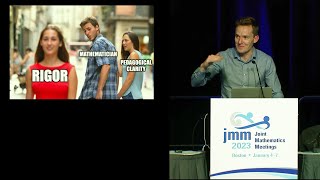
Math's pedagogical curse | Grant Sanderson JPBM Award Lecture, JMM 2023
Mar 30, 2023