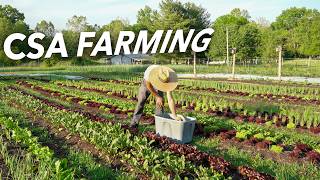
Recession Proofing the Farm + The Exciting World of Farm Taxes
Audio Brief
Show transcript
This episode covers practical farm management strategies, community sourced problem solving, and methods for recession proofing a small scale agricultural business.
There are three key takeaways from the discussion. First, collaborative learning drives practical problem solving on the farm. Second, farmers must critically assess crop profitability and environmental sustainability. Third, financial preparedness is crucial for weathering economic downturns.
The host highlights how shared community knowledge directly improves daily farm operations. Implementing a double dunk washing method for leafy greens is noted as an highly effective way to remove debris and pests. Growers are also reminded of weed management fundamentals, such as intervening early to prevent seed dispersal and flaming problem areas immediately after pulling. Simple equipment adjustments, like using short handled tools, are also recommended to prevent physical strain and improve efficiency.
Listeners are encouraged to evaluate the true economics of their harvests instead of growing strictly out of habit. Summer squash serves as a prime example of a crop that often saturates the local market to the point of losing all its retail value. Rather than wasting labor bringing low margin items to market, producers should focus their retail space on profitable crops while keeping the rest for personal use. The conversation also warns against the broader dangers of prioritizing short term profit over long term environmental health and the precautionary principle.
Building a resilient business model is essential for navigating uncertain economic times. This requires maintaining clear and organized financial records to simplify farm tax preparation and to accurately track operating expenses. Farmers must focus on building cash reserves and actively diversifying their revenue streams. Strategies like offering bulk items or adjusting product lines can help maintain steady cash flow even when consumer spending slows down.
Ultimately, combining disciplined financial management with adaptable community driven farming practices creates a much more resilient agricultural business.
Episode Overview
- The host, Farmer Jesse, reflects on the past week of content, discussing listener feedback on topics like summer squash, horse manure, pitchforks, weeds, and the various uses of garlic.
- A central portion of the episode is dedicated to "Feedback Friday," where the host highlights viewer comments and suggestions, fostering a sense of community engagement and shared learning.
- The episode also touches on the topic of "recession-proofing the farm," exploring strategies for financial resilience in uncertain economic times, including the importance of farm taxes and diversifying income streams.
- Viewers can gain insights into practical farming tips, community perspectives, and business management strategies relevant to small-scale agriculture.
Key Concepts
- Community Learning and Feedback: The host values and highlights listener feedback, demonstrating that learning in agriculture is a collaborative process where growers can benefit from each other's experiences and insights.
- Practical Problem-Solving: The episode showcases practical solutions to common farming challenges, such as using short-handled tools to avoid back strain and implementing a "double dunk" method for washing lettuce.
- Financial Preparedness: The host emphasizes the importance of financial preparedness for farmers, particularly in light of potential economic downturns. This includes understanding farm taxes, maintaining savings, and diversifying revenue streams to ensure business resilience.
Quotes
- At 1:58 - "Yeah, I love my zooks; and the flowers are great battered and fried, but people literally sell them for free during the summer so I’m only gonna grow some for myself this year and not bother bringing them to market." - Highlighting a viewer's perspective on the economics of growing summer squash and the value of focusing on profitable crops.
- At 3:40 - "A thing that will be found incomprehensible to future generations is that we allowed unchecked capitalism to ignore the precautionary principle that we say is the heart of our science. We say it is a fundamental principle but we don’t follow it because of profit to the few." - A thought-provoking comment on the long-term consequences of prioritizing short-term profit over environmental sustainability and the precautionary principle.
- At 5:32 - "1) Never walk past a weed. Pick that weed out! 2) Never let a weed go to seed. Pull it before. 3) if you skipped 1& 2 … flame the ever-living [we’ll say heck for the littles out there] out of the area immediately after pulling." - Practical advice on weed management, emphasizing the importance of early intervention and preventing seed dispersal.
Takeaways
- Implement a "double dunk" washing method for leafy greens to effectively remove bugs and debris.
- Consider offering bulk items or diversifying your product offerings to maintain cash flow during economic downturns.
- Prioritize clear and organized record-keeping for farm expenses and income to simplify tax preparation and financial management.