OS EUA ESTÃO REDESENHANDO O MUNDO, E NINGUÉM ESTÁ FALANDO DISSO
Audio Brief
Show transcript
Episode Overview
- Subject: Professor HOC analyzes the current geopolitical pressure on Venezuela, driven by US military positioning and legal actions against the Maduro regime.
- Narrative Arc: The discussion moves from the immediate military threats to the strategic goal of severing Venezuela's ties with enemies of the West, and finally to the risks and contradictions inherent in Donald Trump's "calculated madman" strategy.
- Relevance: This episode is essential for understanding how modern US foreign policy uses economic and military leverage to reshape alliances without necessarily committing to full-scale invasion, and the pitfalls of attempting nation-building in corrupt systems.
Key Concepts
-
Structural Decoupling as the Primary Goal: The immediate value of US intervention isn't necessarily instant democracy, but the geopolitical isolation of the Maduro regime. The US demands are focused on forcing Venezuela to sever ties with Russia, China, Iran, and groups like Hezbollah. By cutting these lifelines, the regime is structurally weakened, regardless of whether Maduro remains as a figurehead during a transition.
-
The "Norway Fallacy" in Reconstruction: Professor HOC critiques the optimistic view that Venezuela's oil wealth can simply pay for its reconstruction. He contrasts this with Norway, a country that combines oil wealth with high institutional trust and honesty. The concept highlights that resources alone cannot fix a failed state; without removing the corrupt human infrastructure governing the funds, money will simply be stolen rather than invested.
-
The Paradox of Cautious Belligerence: There is a distinct gap between Donald Trump's rhetoric and his actions. While his language suggests recklessness ("crazy"), his military and strategic moves are described as extremely cautious and "within the lines." This concept explains how a leader can use the appearance of instability as a leverage tool (a bluff) while actually avoiding the high risks associated with direct military conflict or extraction operations.
Quotes
- At 1:05 - "Isso vai enfraquecer... uma das coisas que os Estados Unidos vai exigir do regime é o desligamento e o afastamento com Rússia, com China, com Irã, com Hezbollah, com Hamas." - Explaining the strategic objective behind the US pressure, which prioritizes geopolitical alignment over internal Venezuelan politics.
- At 2:59 - "A Venezuela vai virar a Noruega simplesmente porque alguém de fora falou? Não, não vai. Você precisa ter fiscalização, você precisa ter um monte de coisas." - Illustrating the difficulty of economic recovery in corrupt states; external mandates cannot instantly create the institutional trust required for prosperity.
- At 4:44 - "O Trump andou assim bem na linha, no limite, mas dentro da linha. Ele não colocou um pezinho para fora." - Clarifying the difference between Trump's aggressive public persona and his actually risk-averse military strategy.
Takeaways
- Differentiate between rhetoric and operational reality: When analyzing geopolitical conflicts, ignore the "noise" of speeches and focus on the specific, cautious movements of assets. Leaders often project chaos to force compliance while acting conservatively to avoid casualties.
- Evaluate regime stability by external alliances: To determine if a government is close to collapsing or changing, look beyond domestic protests and watch their foreign relations. A regime is most vulnerable when it is forced to cut ties with its financial and military sponsors (e.g., Russia or China).
- Recognize the risks of the "Bluff Strategy": Understand that relying on threats to achieve policy goals creates a binary trap. If the opponent (like Maduro) calls the bluff, the aggressor is forced to either escalate to violence (which they wanted to avoid) or lose credibility.
More from Market Makers

EUA OU CHINA: QUEM VAI MANDAR NO MUNDO NO SÉCULO XXI?
Feb 13, 2026
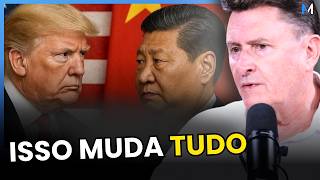
CHINA E EUA: QUEM TEM MAIS PODER GLOBAL HOJE?
Feb 12, 2026

A ELEIÇÃO NÃO ESTÁ NO PREÇO (E O MERCADO PODE QUEBRAR A CARA)
Feb 11, 2026

BOLSA NA MÁXIMA HISTÓRICA: O QUE ESTÁ ACONTECENDO E COMO SE POSICIONAR | Second Level #32
Feb 11, 2026