Organic Chemistry - MO Theory of Aromatic Compounds

Audio Brief
Show transcript
This episode explores the molecular orbital theory of aromatic compounds, detailing Hückel's rule and the critical criteria for their exceptional stability.
Three key takeaways emerge from this episode. First, aromatic compounds achieve exceptional stability through their electronic structure. Second, Hückel's rule provides a simple method to predict aromaticity. Third, planarity is non-negotiable for achieving aromaticity or avoiding antiaromatic instability.
Aromatic compounds are exceptionally stable because their pi electrons are fully paired within low-energy bonding molecular orbitals. This contrasts sharply with antiaromatic systems, which are unstable due to unpaired electrons in higher-energy orbitals.
Hückel's rule states that a cyclic, planar, and fully conjugated system is aromatic with 4N+2 pi electrons, and antiaromatic with 4N pi electrons. This rule helps quickly identify stable aromatic compounds like benzene versus unstable antiaromatic ones.
For a molecule to be aromatic, it must be planar, allowing continuous overlap of p-orbitals. Molecules that would otherwise be antiaromatic, such as cyclooctatetraene, often twist into a non-planar shape to break conjugation and avoid destabilization, becoming nonaromatic instead.
Understanding these principles is crucial for predicting the stability and reactivity of conjugated cyclic systems in organic chemistry.
Episode Overview
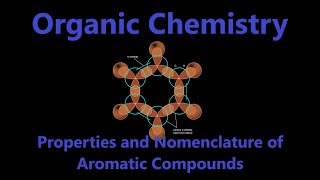
- This episode delves into the molecular orbital (MO) theory behind aromatic compounds, using benzene as a foundational example to illustrate bonding and antibonding orbitals.
- The video explains how to use MO energy diagrams and the "Polygon Rule" (Frost Circles) to visualize the electronic structure and stability of cyclic conjugated systems.
- It introduces Hückel's rule, a critical concept for predicting whether a compound is aromatic (4N+2 π electrons) or antiaromatic (4N π electrons).
- The discussion highlights the specific criteria for aromaticity and anti-aromaticity, emphasizing the crucial role of a planar structure for continuous p-orbital overlap.
- The limitations of Hückel's rule are explored, using cyclooctatetraene as an example of how a molecule can avoid anti-aromatic instability by adopting a non-planar conformation.
Key Concepts
- Molecular Orbital (MO) Theory: Aromatic compounds achieve exceptional stability by having a completely filled set of bonding molecular orbitals, with all electrons paired. In contrast, antiaromatic compounds are unstable because they have unpaired electrons in their highest occupied molecular orbitals (HOMOs).
- Aromaticity Criteria: For a compound to be aromatic, it must be cyclic, planar, fully conjugated (with a continuous ring of p-orbitals), and contain a specific number of π electrons that stabilizes the molecule.
- Antiaromaticity vs. Non-aromaticity: Antiaromatic compounds meet the structural requirements of being cyclic, planar, and conjugated but are destabilized by their electron count. Non-aromatic compounds fail one of the structural requirements (e.g., they are not planar), preventing the electronic effects of aromaticity or anti-aromaticity.
- Hückel's Rule: This rule provides a simple method to determine aromaticity. A cyclic, planar, and fully conjugated system is aromatic if it has (4N + 2) π electrons (where N is an integer 0, 1, 2...). It is antiaromatic if it has 4N π electrons.
- Polygon Rule (Frost Circles): A visual tool for predicting the relative energy levels of molecular orbitals in a cyclic system. The polygon of the molecule is inscribed within a circle with one vertex pointing down; each vertex represents the energy level of a molecular orbital.
Quotes
- At 02:50 - "We would expect that a stable system will have filled bonding MOs and empty antibonding MOs." - This explains the electronic basis for the exceptional stability of aromatic compounds.
- At 06:07 - "Hückel's Rule: If the number of π electrons in the cyclic system is (4N + 2) then the system is aromatic. If it's just (4N) then the system is antiaromatic." - The speaker states the core principle for quickly predicting aromaticity based on the number of π electrons.
- At 08:31 - "This happens when the orbitals are not lined up, such as with cyclooctatetraene, due to the molecule not being planar." - This quote addresses a key limitation of Hückel's rule, clarifying that a molecule must be planar for the rule to apply and that some molecules will distort to avoid the instability of anti-aromaticity.
Takeaways
- Aromaticity is a powerful stabilizing factor. Aromatic compounds have all their π electrons paired in low-energy bonding orbitals.
- Use Hückel's rule as a quick assessment: count the π electrons in a cyclic, planar, conjugated system. If the number is 2, 6, 10, or 14, it is likely aromatic. If it is 4, 8, or 12, it is potentially antiaromatic.
- Planarity is non-negotiable for aromaticity. A molecule that could be antiaromatic will often adopt a non-planar shape to break conjugation and avoid instability, thereby becoming nonaromatic.
- The stability order is generally: aromatic > nonaromatic > antiaromatic. Antiaromatic systems are particularly unstable due to having unpaired electrons in non-bonding or antibonding orbitals.