O COLAPSO DA DEMOCRACIA LIBERAL (O MODELO CHINÊS ESTÁ VENCENDO?)
Audio Brief
Show transcript
This episode examines the historical evolution of democracy, contrasting the struggles of modern liberal democracies with the perceived efficiency of autocratic states, and proposes an investment thesis favoring disciplined economies and hard assets.
There are three key takeaways from this discussion. First, strong, independent institutions are crucial for liberal democracies to counter populism and the tyranny of the majority. Second, long-term economic prosperity requires fiscal discipline, as unchecked spending leads to inflation and debt. Third, current global shifts suggest investments should favor disciplined economies and hard assets as a hedge against instability in some Western nations.
Historically, pure democracies faced the 'tyranny of the majority,' as seen in ancient Athens. Liberal democracy emerged as a sophisticated 'middle ground,' establishing strong representative governments and independent institutions like supreme courts and congresses. These serve as vital checks and balances, acting as the primary defense against modern populism, which threatens to undermine governance and representation by bypassing established norms.
A significant challenge for Western liberal democracies is the abandonment of fiscal responsibility. Both left and right-wing governments have increasingly resorted to populist spending, promising 'free money' to appease a 'pampered' populace. This leads to accumulating massive national debt, driving inflation, and ultimately weakening the very institutions meant to ensure long-term stability and economic prosperity.
In contrast, disciplined state-capitalist autocracies, like China, present a compelling alternative model. They focus on long-term strategic planning, productivity, and targeted investment in key sectors, often outperforming Western nations struggling with populist spending.
This global geopolitical shift suggests investors should seriously consider capital reallocation. Capital may increasingly flow towards fiscally disciplined economies, whether democratic or autocratic, and towards tangible 'hard assets' like commodities, as a crucial hedge against instability and fiscal irresponsibility in established markets.
The challenges facing liberal democracies today underscore the critical importance of institutional strength and fiscal prudence for both national stability and investment strategy.
Episode Overview
- The episode provides a historical analysis of democracy, tracing its evolution from ancient Athens to the modern challenges faced by liberal democracies.
- It contrasts the current economic and institutional struggles in Western liberal democracies with the perceived efficiency and success of autocratic states like China.
- The speaker argues that the abandonment of fiscal responsibility and the rise of populism have weakened the democratic model, leading to a crisis of representation and governance.
- Based on this geopolitical shift, an investment thesis is presented, favoring "hard assets" and disciplined economies (both democratic and autocratic) over struggling Western nations.
Key Concepts
- Athenian Democracy & Tyranny of the Majority: The discussion starts with the birth of democracy in Athens, highlighting its fundamental flaw: the "dictatorship of the majority," where popular vote could lead to disastrous decisions, such as the execution of Socrates.
- Rise of Liberal Democracy: After the Middle Ages, the Enlightenment and revolutions (American, French, Glorious) led to the creation of liberal democracy. This model is a "middle ground" that uses representative government and strong institutions (like a supreme court and congress) as checks and balances to protect against populism and the tyranny of the majority.
- The "End of History" and its Reversal: The idea that liberal democracy had "won" after the Cold War (as proposed by Fukuyama) is now being challenged. The last 20 years have seen this model erode due to a departure from its core principles.
- Populism and Fiscal Decay: The speaker identifies the current crisis in the West as a result of populist politics. Governments, both left and right, have abandoned fiscal discipline to appease a "pampered" populace, accumulating massive debt and weakening their own institutions.
- Autocracy as a Competing Model: Disciplined, state-capitalist autocracies (like China) are presented as a successful alternative model that is outperforming the West by focusing on long-term planning, productivity, and investment in key sectors, while avoiding the pitfalls of populist spending.
Quotes
- At 00:03 - "Os grandes países da democracia liberal tão ruins, e os grandes países autocratas tão muito bem." - Highlighting the central paradox that frames the entire discussion: the underperformance of democracies compared to autocracies.
- At 00:33 - "A ditadura da maioria é uma coisa que preocupava muito as pessoas." - Explaining the historical fear of pure democracy's main weakness, which led to the development of institutional checks and balances.
- At 02:22 - "A gente tem que fazer uma coisa que é o meio do caminho, que é a democracia representativa." - Describing the solution that formed the basis of liberal democracy: a system that avoids the extremes of pure majority rule by relying on elected representatives and institutions.
- At 04:42 - "A democracia só funciona até o dia que o Congresso perceber que ele pode comprar a votação com o dinheiro público." - Citing political thinker Alexis de Tocqueville to explain how democracies begin to fail when politicians realize they can use public funds to secure votes and power.
Takeaways
- Understand that strong, independent institutions are the primary defense of a liberal democracy against the inherent risks of populism and the "tyranny of the majority."
- Recognize that long-term economic prosperity is intrinsically linked to fiscal discipline. Promises of "free money" or endless government spending inevitably lead to inflation, debt, and societal decay.
- When investing, consider the underlying political and economic models. The current global shift suggests that capital may flow towards disciplined economies and "hard assets" (like commodities) as a hedge against the instability and fiscal irresponsibility plaguing many Western democracies.
More from Market Makers

EUA OU CHINA: QUEM VAI MANDAR NO MUNDO NO SÉCULO XXI?
Feb 13, 2026
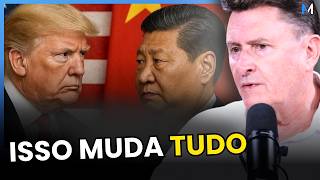
CHINA E EUA: QUEM TEM MAIS PODER GLOBAL HOJE?
Feb 12, 2026

A ELEIÇÃO NÃO ESTÁ NO PREÇO (E O MERCADO PODE QUEBRAR A CARA)
Feb 11, 2026

BOLSA NA MÁXIMA HISTÓRICA: O QUE ESTÁ ACONTECENDO E COMO SE POSICIONAR | Second Level #32
Feb 11, 2026