Mark Newton’s Best Buying Window of the 4-Year Cycle
Audio Brief
Show transcript
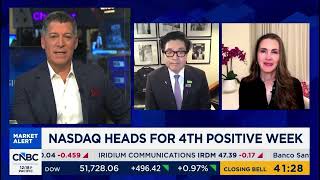
This episode covers the financial market outlook for the final quarter of the year with Mark Newton, Partner at Fundstrat, focusing on interest rates, tech sector resilience, and global macroeconomic trends.
There are three key takeaways for investors looking to navigate the current market cycle. First, the dominant technology sector continues to shield broader indices despite rising interest rates. Second, resilient consumer spending supports positive economic growth even as consumer confidence fluctuates. Finally, a projected cooling of the US dollar is expected to stimulate emerging markets, particularly those with heavy technology exposure.
Regarding interest rates, historical data shows that elevated rates do not trigger stock market declines when they are driven by economic growth. The information technology sector and mega-cap growth stocks continue to carry the S&P 500, proving that weak overall market breadth does not necessitate an index-level crash.
Looking at consumer dynamics, while political tension and inflation have weighed on consumer confidence, actual spending remains highly resilient. Investors can view any volatility in late October and November as a strategic buying window to build positions ahead of a historical market rally extending into next year.
On the global stage, a cooling US dollar and a stabilizing Japanese Yen are expected to boost international currencies and emerging markets. Portfolios can capitalize on this shift by increasing exposure to tech-heavy international regions, particularly Taiwan and South Korea.
Ultimately, focusing on actual price action and current trends rather than speculative risks remains the most reliable strategy for the quarters ahead.
Episode Overview
- This episode features Mark Newton, Partner at Fundstrat, discussing the financial market outlook for the final quarter of the year, focusing on interest rates, tech sector dominance, and global macroeconomic trends.
- Newton frames a narrative where rising interest rates do not automatically equal a market crash, showing how strong growth dynamics and tech sector resilience are shielding the broader indices.
- This content is highly relevant to investors, traders, and portfolio managers looking to navigate the market cycle, identify key entry points in October/November, and understand currency fluctuations.
Key Concepts
- Disconnect Between Interest Rates and Market Pullbacks: High interest rates (4-5%) do not inherently trigger stock market declines. Historically, markets have rallied under similar rate environments when driven by growth rather than rising term premiums.
- Technology's Role as a Market Shield: Market breadth can remain weak without causing index-level crashes if the dominant sector—Information Technology—maintains strong earnings and upward momentum. Tech and mega-cap growth stocks (the "Mag 7") continue to carry the S&P 500.
- The Divergence Between Consumer Confidence and Spending: While consumer confidence may decline due to political tension or inflation (gas/food), actual consumer spending remains resilient, supporting positive GDP growth.
- Global Macro Shifts and Dollar Depreciation: Anticipated stabilization of the Yen and a cooling US dollar index (DXY) are projected to boost international currencies (Euro, Sterling) and stimulate emerging markets (specifically Mexico, Taiwan, and South Korea).
Quotes
- At 1:17 - "Rates are moving higher because of growth, not necessarily because of term premium." - Explaining why the increase in long-term interest rates shouldn't panic equity investors, as it reflects economic strength.
- At 7:25 - "It already has bailed everything out. And that's the big lesson... the fact that breadth has been weak doesn't mean that the stock market has to fall." - Clarifying a common misconception about market breadth and highlighting technology's disproportionate impact on the S&P 500.
- At 11:28 - "We can never worry about what could happen. We need to worry about what is happening." - Emphasizing a technical analyst's focus on actual price action and current trends rather than getting paralyzed by speculative geopolitical risks.
Takeaways
- Use the projected choppy period in mid-to-late October and November as a key buying window, aiming to build positions ahead of a historical market rally extending into next April.
- Focus equity exposure heavily on technology (especially semiconductors, memory space, and mega-caps) and healthcare, while avoiding heavy dip-buying in weaker sectors like consumer discretionary, industrials, and financials.
- Capitalize on a weakening US dollar by increasing exposure to strong emerging markets that are heavily leveraged to technology, such as Taiwan and South Korea (EWY).