Mindscape Ask Me Anything, Sean Carroll | September 2026
Audio Brief
Show transcript
In this conversation, we explore the deep intersections of quantum mechanics, cosmology, and philosophy, tracing how physical laws shape everything from spacetime geometry to human consciousness.
There are three key takeaways from this discussion. First, quantum wave function collapse and time dilation are strictly governed by environmental decoherence and the hyperbolic geometry of Minkowski spacetime. Second, theoretical concepts like warp drives and gravity manipulation face immense physical hurdles due to the lack of negative gravitational charge and negative energy. Third, evaluating frontier science and human agency requires transitioning from binary thinking to probabilistic, Bayesian evaluations of reality.
Quantum entanglement demonstrates that observation does not require a conscious mind. When particles interact with their environment, decoherence naturally collapses the wave function, while the no-signaling theorem prevents any faster-than-light communication. Similarly, time dilation is a direct consequence of spacetime geometry, where moving through spatial dimensions mathematically decreases elapsed proper time due to the negative temporal coordinate.
Theoretical models like the Alcubierre warp drive remain highly speculative because they require unrealistic distributions of negative energy density. Furthermore, unlike electromagnetism which features positive and negative charges, gravity only has positive charges. This lack of negative mass-energy prevents us from shielding or finely manipulating gravitational fields for advanced engineering or communication.
To navigate frontier science, researchers must shift from asking if something is possible to calculating a probabilistic Bayesian credence based on indirect evidence. This analytical framework also applies to concepts of free will and agency. While microscopic physical laws are fundamentally deterministic, decision-making and consciousness remain highly robust, emergent macro-level descriptions of reality.
Ultimately, advancing our understanding of the universe relies on accepting the rigorous mathematical consequences of established physics while maintaining a probabilistic approach to the unknown.
Episode Overview
- This episode explores the deep intersections of theoretical physics, quantum mechanics, cosmology, and philosophy, ranging from the mathematical structures of spacetime and string theory to the nature of consciousness and emergence.
- The discussion spans a wide narrative arc, beginning with concrete physical phenomena like quantum entanglement and general relativity, transitioning into the philosophical implications of the multiverse, and concluding with a deep dive into the limits of technology, artificial intelligence, and human cognition.
- It addresses complex concepts like the Alcubierre warp drive, the string theory "swampland," the four faces of information, and the geometric nature of time dilation to build a coherent picture of how physical laws govern our universe.
- This content is highly relevant to students, physicists, and intellectually curious individuals seeking to transition from binary thinking (possible vs. impossible) to a probabilistic, Bayesian understanding of reality and science.
Key Concepts
- Wave-Particle Duality and Entanglement as Measurement: In quantum mechanics, particles behave as waves when unobserved, but interacting with external systems (decoherence) acts as an implicit measurement. This interaction collapses the wave function and destroys interference patterns without requiring a conscious observer, governed by the "no-signaling theorem" to prevent faster-than-light communication.
- The Physics and Geometry of Warp Drives: The Alcubierre metric theoretically allows superluminal travel by contracting spacetime in front of a craft and expanding it behind. However, this is not a violation of special relativity because the local speed of light remains constant; physically realizing this metric requires unrealistic initial conditions and a massive distribution of negative energy density (exotic matter).
- Anthropic Reasoning and the Multiverse: The "saturation effect" in anthropic reasoning resolves statistical paradoxes in infinitely large universes by calculating probabilities based on the likelihood of at least one observer existing, rather than the absolute number of observers.
- The String Theory Landscape vs. the Swampland: The landscape consists of low-energy vacuums compatible with string theory, whereas the "swampland" contains consistent-looking field theories that cannot couple to quantum gravity. If dark energy is dynamically evolving rather than static, it provides indirect support for string theory by aligning with these swampland constraints.
- The Four Faces of Information: Information in physical sciences operates across four distinct roles: Engineering (signal transmission/Shannon information), Statistical (probability distributions and data fitting), Thermodynamic (physical entropy and computational limits), and Ontological (the speculative "it from bit" paradigm).
- The Spacetime Interval Signature: Unlike Euclidean geometry where all spatial dimensions are positive in the distance formula ($x^2 + y^2 + z^2$), Minkowski spacetime features a negative sign for the time dimension (typically $-t^2 + x^2 + y^2 + z^2$). This hyperbolic geometry dictates that moving through space actually decreases elapsed proper time, explaining time dilation.
- Higgs Symmetry Breaking: Prior to electroweak symmetry breaking, particles like electrons and neutrinos are mathematically identical states of a single multi-dimensional field. The Higgs field acts as a potential energy landscape that establishes a preferred direction, giving the electron mass while leaving the neutrino nearly massless.
- Cognitive Convergence in AI: Large Language Models (LLMs) do not replicate human brain structures, but they may achieve cognitive convergence because both humans and LLMs are optimized to make accurate predictions based on the structural constraints of human language and culture.
Quotes
- At 0:03:20 - "If you try to look for which slit the electron went through... that means you've made a detection, you've made a measurement, and the wave function collapses... Once that happens, the electron only goes through one slit... and there's nothing to interfere with." - Explaining how physical detection collapses quantum superposition into localized particle behavior.
- At 0:06:26 - "As long as that entanglement is there, the electron is no longer in a pure state all by itself... and that's what destroys the interference pattern." - Demonstrating that quantum entanglement with external systems (decoherence) acts as an implicit measurement.
- At 0:07:37 - "If you could actually have an interference pattern and turn it on and off just by detecting particles at one of the detectors... you could send signals faster than the speed of light. And that is bad." - Illustrating how nature's quantum laws prevent faster-than-light communication despite non-local entanglement.
- At 0:11:11 - "For the wormhole idea, you're never traveling faster than the speed of light... What you're doing is making use of the flexibility of spacetime... to sort of trick yourself into thinking that the speed of light is different." - Explaining how general relativity permits apparent superluminal travel by altering spacetime topography rather than exceeding local light speed.
- At 0:14:02 - "The whole Earth, which is a lot of matter, exerts a really tiny gravitational force on you... So the amount of energy you need to warp spacetime in any noticeable way... is absolutely crazily enormous." - Highlighting the immense engineering challenges of spacetime manipulation due to the weakness of gravity.
- At 0:18:05 - "Very often in physics, what we'll do is look for what's called an 'initial value problem'... Tell me how it travels through the air before I can catch it... This is not what's very often done in general relativity." - Emphasizing the difference between proposing static geometries and solving dynamic equations of motion over time.
- At 0:27:33 - "We don't update our priors by how many observers are like you. We update our priors by the probability there would be at least one observer like you in this universe." - Showing how the "saturation effect" prevents infinitely large universes from dominating probability calculations.
- At 0:30:14 - "Their kinds of mechanisms are not down at the psychological level; they're at the network level of people bumping into each other... the entire rate of all processes is faster." - Explaining why human pacing speeds up in larger cities based on structural network dynamics.
- At 0:31:54 - "For the most part, a physicist will wait for the need for new math before actually diving on that bandwagon." - Detailing the pragmatic relationship between physics and mathematics.
- At 0:38:10 - "For gravity, there's essentially only positive charges... and what that means is that you can't cancel out the gravitational field and manipulate it in very fine ways like you can in an electromagnetic field." - Showing why gravitational waves cannot be easily engineered for precise communication like radio waves.
- At 0:41:02 - "Space-time through which strings travel has to obey the rules of General Relativity... but space-time is there as an ingredient. It's not that you construct the curvature of space-time out of the strings." - Clarifying the background-dependent nature of perturbative string theory.
- At 1:01:07 - "I would say that the discovery of the accelerating universe should lower your credence in string theory a little bit. I would also say that if we go on to discover that the dark energy is evolving with time rather than constant, then that should raise your credence in string theory a little bit." - Explaining the cosmological link between dynamic dark energy and string theory's swampland constraints.
- At 1:12:15 - "The courage comes in in accepting the implications of that theory, not in speculating about new theories... One easy way to make a mistake is to accept a theory but not its consequences." - Critiquing the scientific reluctance to accept the logical conclusions of validated physics equations.
- At 1:24:28 - "The existence of a non-zero, small, positive value for the cosmological constant is evidence for the multiverse in that Bayesian sense... because the non-zero positive number was likely under the multiverse scenario and unlikely under the others." - Demonstrating how anthropic selection functions as Bayesian evidence for a multiverse.
- At 1:37:34 - "Consciousness exists on one branch of the wave function at a time. It has nothing special to do with consciousness or with wave functions; it just has to do with how matter works." - Explaining that split awareness across quantum worlds is a natural physical consequence of decoherence.
- At 1:43:30 - "As far as a person is concerned, the world is not deterministic." - Pointing out that despite deterministic physics equations, human agency operates stochastically due to incomplete information.
- At 2:23:40 - "If you really, truly believe the naive picture of the multiverse, it's very hard to say what it predicts because everything happens an infinite number of times." - Identifying the core of the "measure problem" in eternal inflation.
- At 2:31:51 - "The brain is small enough, and the electrochemical signals inside are rapid enough, that the brain can act more or less coherently... Something like a large organization or a government, I don't think has that property." - Outlining the physical constraints on signal propagation speed that limit what systems can act as a single, coherent biological organism.
- At 2:49:33 - "Ordinary matter feels the force of electromagnetism... two particles can bump into each other and lose energy by emitting a photon... That is a source of dissipation... Dark matter doesn't have any dissipation." - Detailing why ordinary matter collapses into dense bodies while dark matter remains diffuse.
- At 3:25:08 - "Anil Seth and Ned Block have made cases against computational functionalism as a way of thinking about consciousness, without giving up on physicalism... there might be more to it than that, even if the 'more' is still 100% physical." - Highlighting that consciousness may rely on biological and chemical physical processes rather than pure computational algorithms.
Takeaways
- Use a Bayesian framework to update credences when direct observational evidence is impossible, treating structural and contextual likelihoods as valid mathematical clues.
- Distinguish between coordinate descriptions and physical hypotheses; mathematically equivalent formulations (such as shrinking matter vs. expanding space) represent the same physical reality.
- Recognize that the lack of negative mass-energy prevents the shielding or precise manipulation of gravity, limiting its utility for engineered communication systems.
- Understand that "free will" and "agency" are robust, emergent, macro-level descriptions that remain vital for decision-making even if the microscopic world is fundamentally deterministic.
- Evaluate the scientific viability of speculative models based on their logical consequences and their utility as edge cases to test observational limits.
- Shift focus from binary thinking ("is it possible?") to probabilistic evaluation ("what is the credence?") to navigate frontier science issues effectively.
- Filter information and seek trusted sources instead of relying on feed algorithms, as attention, rather than data access, is the primary scarce resource of the digital age.
- Prepare for diverse career paths in industry or national labs if pursuing a PhD, as the academic pipeline inherently produces more graduates than available tenure-track positions.
- Identify "crank" theories by their behavioral refusal to engage with objections, existing literature, or scientific consensus.
- Analyze the behavior of ordinary matter vs. dark matter by considering non-gravitational forces, specifically the role of electromagnetic dissipation in allowing matter to cool and collapse.
- Avoid over-extending copyright and intellectual property protections past a creator's lifetime to balance incentives for innovation with the preservation of a healthy public domain.
- Define "life" and "living systems" by their specific operational characteristics, such as internal communication speed and temporal coherence, rather than trying to construct rigid taxonomic boundaries.
More from Sean Carroll

Mindscape 331 | Solo: Fine-Tuning, God, and the Multiverse
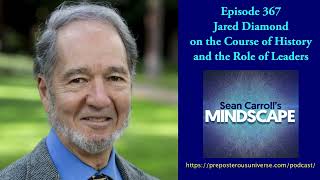
Jared Diamond on the Course of History and the Role of Leaders | Mindscape 367
Sep 07, 2026
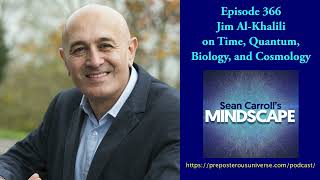
Jim Al-Khalili on Time, Quantum, Biology, and Cosmology | Mindscape 366
Aug 31, 2026
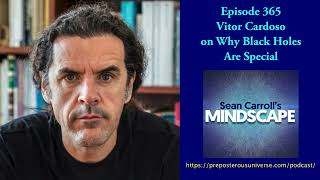
Vitor Cardoso on Why Black Holes Are Special (updated) | Mindscape 365
Aug 24, 2026