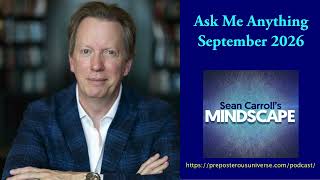
Mindscape Ask Me Anything, Sean Carroll | October 2026
Audio Brief
Show transcript
This episode covers the profound evolution of scientific inquiry in the age of artificial intelligence, the quantum origins of spacetime, and the philosophical superiority of empirical observation over rigid assumptions.
There are three key takeaways from this discussion. First, the rise of advanced artificial intelligence shifts the premium of human scientific labor away from rote calculation and toward conceptual interpretation. Second, space, gravity, and locality are not fundamental building blocks of the universe, but rather emergent phenomena arising from patterns of quantum entanglement. Third, scientific progress is best achieved through methodological empiricism, where worldviews are treated as Bayesian conclusions derived from data rather than initial assumptions.
Looking at the first takeaway, the automation of mathematical proofs by large language models is redefining the role of the researcher. While artificial intelligence exhibits a spiky form of intelligence that excels at formal calculation, it lacks the capacity for conceptual comprehension. This technological shift frees human scientists to focus entirely on framing the right questions, leaving the computational heavy lifting to digital systems.
On the second takeaway, modern quantum gravity suggests that the physical universe is fundamentally described by a quantum state vector in a high-dimensional Hilbert space. Spacetime and gravity emerge from the underlying patterns of quantum entanglement between subsystems. This shift requires a deeper understanding of quantum measurement as an actual physical interaction between systems rather than an abstract mathematical axiom.
Finally, the discussion highlights the importance of methodological empiricism over pre-established beliefs. Rather than assuming a naturalistic worldview from the outset, researchers should use a Bayesian framework to evaluate all hypotheses against empirical data. This open approach ensures that scientific conclusions are built on observed evidence rather than prior philosophical bias.
In summary, as technology automates the mechanics of calculation, the future of science relies on human creativity, rigorous empiricism, and a fundamental rethinking of physical reality.
Episode Overview
- The Evolution of Scientific Labor in the Age of AI: This episode explores how AI-generated mathematical proofs and large language models are shifting the role of human scientists from rote calculation and proof-generation toward conceptual interpretation, question-framing, and the pursuit of human comprehension.
- Demystifying Quantum Mechanics and Cosmology: The discussion breaks down foundational physics concepts—including what physically constitutes a "measurement," the static nature of quantum vacuum states, quantum tunneling in stellar fusion, and how spacetime emerges from quantum entanglement.
- Philosophical Foundations of Science and Naturalism: The narrative traces why methodological empiricism is superior to methodological naturalism, arguing that naturalism and the rejection of supernatural explanations should be treated as conclusions of rigorous Bayesian data comparison rather than initial assumptions.
- The Dynamics of Scientific Progress and Academic Structures: The episode examines how modern academic departments reify administrative boundaries to the detriment of interdisciplinary research, and how historical eras—rather than raw, isolated genius—dictate when revolutionary breakthroughs in physics occur.
Key Concepts
- AI-Generated Mathematical Proofs and Formal Verification: Large Language Models (LLMs) are increasingly capable of generating complex mathematical proofs. To ensure validity, mathematicians use computerized proof assistants like "Lean" to formally check the logic, establishing a collaborative workflow where machines calculate and verify while humans interpret.
- The Epistemology of "Shut Up and Calculate": Historically, physics and mathematics demanded immense computational labor. As LLMs automate calculation, the human role is freed from rote computation, shifting the scientific premium entirely toward framing the right questions, conceptualization, and creative interpretation.
- The "Etiological" Value of Content: The value of creative human outputs (such as art, writing, and podcasts) is deeply tied to their etiology—their historical origin and human intent. Even if AI can perfectly replicate an output, the absence of a lived human journey alters how the audience values and connects with the work.
- The Physics of Quantum Measurement: Standard quantum mechanics textbooks often treat "wave function collapse" as an axiomatic definition of measurement. In reality, measurement is a dynamical physical interaction between a quantum system and a macroscopic apparatus, transitioning a superposition of states into a specific eigenstate of the measured observable.
- Eigenstates and the Spectral Theorem: An eigenstate of an operator is a state that remains unchanged under the action of that operator (aside from scale). The spectral theorem guarantees that these eigenstates form a complete basis, meaning any quantum state can be expressed as a superposition of them.
- The Reification of Academic Departments: Academic departments are practical administrative divisions that universities often treat as absolute categories. This institutional rigidity penalizes interdisciplinary scholars whose work spans multiple fields, limiting academic innovation.
- The Misapplication of Gödel’s Incompleteness Theorems: Gödel's theorems are precise mathematical statements about formal axiomatic systems. They do not apply to physical systems, which are governed by states, dynamical laws, and empirical observations rather than formal mathematical proofs.
- The Spiky Nature of AI Intelligence: AI models exhibit a high-dimensional and uneven distribution of capabilities. They excel at highly formalized, checkable tasks (like mathematics and coding) but can fail spectacularly at simple, unrepresented tasks (such as counting letters in a word).
- Quantum Fluctuations as a Misnomer: In quantum mechanics, a system in its ground (vacuum) state is stationary and unchanging over time. The term "quantum fluctuation" is shorthand for the variance in potential measurement outcomes, not a description of physical motion or virtual particles constantly "boiling."
- Naturalism as a Reconstructive Framework: Naturalism is the worldview that only the natural world exists. Rather than just arguing against theism, a robust naturalistic framework must construct scientific, natural explanations for phenomena historically attributed to the supernatural, such as consciousness and objective morality.
- The Black Hole Information Paradox: This paradox concerns the fundamental predictability of the universe. Quantum mechanics dictates that microscopic information must be preserved to allow for past retrodiction and future prediction. If black holes truly destroy this microscopic state information, it violates a core principle of physics.
- Quantum Tunneling in Stellar Fusion: Quantum tunneling is the process where a particle passes through a potential energy barrier that it classically lacks the energy to surmount. In stellar cores, protons electromagnetically repel each other; quantum tunneling allows them to bypass this electrostatic barrier at lower temperatures, enabling nuclear fusion.
- The Cosmological Constant and the Multiverse: The cosmological constant ($\Lambda$) represents the energy density of empty space. The puzzle of its incredibly small, non-zero value is addressed by the anthropic principle: in a multiverse of varying energy densities, life can only emerge in regions where $\Lambda$ is small enough to allow galaxies and stars to form without rapidly tearing space apart.
- Spacetime as an Emergent Phenomenon: Modern quantum gravity suggest spacetime is not fundamental. Instead, the universe's deepest reality is a quantum state vector in a high-dimensional Hilbert space, and gravity, space, and locality emerge from the patterns of quantum entanglement between subsystems.
- Methodological Empiricism vs. Methodological Naturalism: Methodological naturalism assumes naturalism from the outset of scientific inquiry. Methodological empiricism is a more robust approach: it begins without assumptions, evaluates all hypotheses (including supernatural ones) against empirical data, and concludes that naturalism is true because supernatural hypotheses consistently fail to make accurate predictions.
- The Obsolescence of "Force" in Modern Physics: While "force" is central to Newtonian mechanics, modern physics (such as Hamiltonian mechanics, Lagrangian mechanics, and Quantum Field Theory) bypasses the concept entirely, prioritizing fields, energy, action, and quantum interactions.
Quotes
- At 0:05:39 - "From a physics point of view, it’s not all that interesting... the fluid mechanical description is supposed to be an approximation to a more true underlying particle description... and a singularity is a place where... you expect this approximation not to be that valid." - Explains why a mathematical "blow-up" in the Navier-Stokes equations doesn't translate to real physical fluids breaking down.
- At 0:07:04 - "Mathematicians have gotten to the point where they can formalize a proof and they can plug it into a program called Lean... which will check to see if your proof is valid." - Highlights the transition of mathematics into a digitally verifiable science.
- At 0:10:26 - "Even if you have in some sense proven something, it’s unclear whether or not you have increased the sum total of mathematical understanding in the world." - Pointing out that a raw, unreadable machine-generated proof does not equal human comprehension.
- At 0:12:15 - "LLMs could put an end to the 'shut up and calculate' philosophy... because there's no reason for you to shut up and calculate—the LLMs are better at calculating than you are. What is left to humans is thinking, being creative, and understanding." - Suggests that AI will free scientists from rote computation to focus entirely on conceptual interpretation.
- At 0:12:44 - "The underlying process of physics is very different than that of mathematics... proving theorems isn't the goal in physics; we're trying to understand what could be happening." - Differentiating the ultimate goals of physics from pure mathematics.
- At 0:15:52 - "An AI-generated version of a long-running podcast... will happen... but for me, the fact that it's me, even if I have a cold, saying the words... that's an important aspect of the show." - Addressing why human presence, vulnerability, and vocal authenticity remain central to audience connection.
- At 0:25:06 - "I don't know whether either Dirac or Sakurai meant it to be a definition of a measurement, but it certainly isn't. When you say 'a measurement always does X,' that's not defining what a measurement is; that's saying what a measurement does." - Distinguishing between the mathematical utility of a quantum postulate and a constructive definition of a physical process.
- At 0:25:24 - "In order to define what a measurement is, you have to tell me: what is the physical process that happens that has the consequence of the system jumping into an eigenstate of the dynamical variable that is being measured?" - Explaining why the standard textbook Copenhagen interpretation leaves a gap in our physical understanding of quantum mechanics.
- At 0:26:30 - "Every observable has a special set of states... with the property that if you measure it, the state doesn't change... That's called an eigenstate of the operator." - Outlining the mathematical definition of eigenstates in quantum mechanics.
- At 0:27:19 - "What it means to say that you measure that observable is you start with whatever state you start with, and you end up in one of those eigenstates. That is called collapse of the wave function." - Connecting the abstract math of operators to the physical phenomenon of measurement.
- At 0:28:20 - "Measurements are generally not defined in undergraduate quantum mechanics. That's one of the issues that I kind of like to harp about." - Highlighting the pedagogical gap where students are taught how to calculate quantum measurements without being taught what physically constitutes a measurement.
- At 0:56:08 - "That becomes problematic, because then you're saying, 'How do you fit into my box?' rather than, 'Are you good at what you do?' And I think that that is a major problem for modern academia, that they have reified their boxes." - Explains the bureaucratic friction that hinders interdisciplinary research in universities.
- At 0:58:38 - "Gödel's theorems are statements about mathematical systems; they're not statements about physics. And you know, they really are different things. Physics is a different thing than mathematics." - Highlights the conceptual boundary between abstract mathematical logic and empirical physical reality.
- At 1:04:41 - "I don't want to live forever at the cost of not enjoying the life I'm living. So, I don't drink too much, but I drink a little bit... I try to balance it all out." - Reflects a practical, Aristotelian approach to aging, health, and lifestyle choices.
- At 1:07:43 - "There are certain kinds of problems that are just naturally better suited to attack by computers... namely, those problems that are super well-defined and whose answers or solutions are easily checkable." - Explains why AI has made rapid, unexpected progress in mathematics and coding compared to other fields.
- At 1:19:53 - "Nothing is happening, because nothing is happening. The proton is a stationary state; nothing is changing over time." - Demystifying the common misconception that quantum vacuum states or subatomic particles are "boiling soups" of constant activity.
- At 1:23:24 - "Position is an observable in quantum mechanics; time is not... Time plays a different role; it's a parameter." - Clarifies why the "energy-time uncertainty relation" is fundamentally different from the position-momentum uncertainty principle.
- At 1:26:14 - "What if naturalism were true? How would things work if that were the case? What about all these questions that you might have, that might have been answered straightforwardly if you believed in God or in a supernatural realm? How would you answer them now?" - Explaining why a course on naturalism should focus on constructing a world view rather than simply arguing against theism.
- At 1:29:28 - "The information we're talking about for black holes is microscopic information. It's the information that specifies exactly what state the universe is in... if you tell me exactly all of the information needed to specify the universe's state at one moment of time, you can predict its future or retrodict its past." - Clarifying that the black hole information paradox is about the fundamental laws of physics, not human access to data.
- At 1:33:28 - "I'm entirely in favor of a multipolar global order. I don't think that there should be one boss, necessarily, of the world... It's fine to have different countries pursuing their own interests as long as they get along together." - Detailing a vision for international relations that moves away from US hegemony.
- At 1:43:21 - "AI is not superintelligent... That doesn't mean it's useless or dumb or incapable of doing great harm... there's a new box that we have to invent for what these things are. We can't just keep trying to put them into the old boxes of how we think about human beings." - Arguing that AI risks must be evaluated based on the unique, non-human nature of the technology rather than anthropomorphic fears.
- At 1:44:05 - "When a fire strikes and burns down a forest... I put the blame on the person, not on the concept of fire. And I think that this is absolutely a valid analogy for AI agents. If you don't give the agents instructions and set them out on the internet, they won't do anything bad." - Emphasizing that AI safety is fundamentally a human liability and regulatory issue rather than an autonomous software threat.
- At 1:51:34 - "The force of gravity holds together galaxies or clusters of galaxies... and once that happens, once you've turned around and your matter is now collapsing rather than expanding, the expansion of the background spacetime around you has zero impact on your life." - Explaining why the expansion of the universe does not affect localized, gravitationally bound systems.
- At 2:01:29 - "As a scientist, my inclination would be, of course, you want to understand what is going on inside the computer program that you're relying on, for all sorts of reasons... Gaining interpretive understanding of AI behavior helps researchers identify model reliability, predict failure modes, and learn new problem-solving methodologies." - Explains why AI interpretability is a fundamental scientific pursuit, not just an engineering task.
- At 2:01:45 - "We all know the famous examples of LLMs not being able to count the number of R's in the word 'strawberry' or whatever... That has to do with the spikiness of the notion of intelligence, the high dimensionality of it. You can be really good at some things, and really not so good at other things." - Explaining the concept of "spiky intelligence," where advanced cognitive systems can have surprising and basic blind spots.
- At 2:02:11 - "If you have a proof, but if no one understands the proof, have you really understood anything? ... Ultimately at the end of the day, human beings understanding things, I think, is the goal of the scientific part of this enterprise anyway." - Highlighting that the ultimate objective of scientific AI integration is advancing human understanding.
- At 2:27:16 - "Quantum tunneling is not anything weird... it's weird maybe from our classical intuition, but it's not something unusual. It happens all the time." - Demystifying quantum phenomena by showing they are foundational to everyday cosmic events.
- At 2:28:17 - "Pushing two protons together to fuse together is absolutely an example of quantum tunneling... Basically, any radioactive decay can be thought of as a quantum tunneling." - Connecting stellar physics and nuclear decay to show the ubiquity of quantum mechanics in the macro-world.
- At 2:29:12 - "If the cosmological constant is very large and positive, it basically pushes matter apart so quickly that you can't form galaxies or planets or life." - Explaining how fundamental physical constants dictate the viability of complexity and life in the universe.
- At 2:31:55 - "Making black holes is hard. It's hard because you have to squeeze a lot of matter into a very small region of space." - Correcting the misconception that black holes form easily from loose space debris or shockwaves.
- At 2:38:25 - "Anthropic reasoning certainly starts with the observation that certain universes or certain conditions or certain environments would be inhospitable to the existence of life... It only becomes interesting when you have these different environments, and then there's a pretty trivial statement that of course we will only exist where we can exist." - Clarifying the logical structure and limits of the anthropic principle in cosmology.
- At 2:42:25 - "In space, the shortest distance between two points is a straight line. In spacetime, it's the longest time between two events that is a straight line." - Highlighting a fundamental mathematical and conceptual difference between Euclidean space and relativistic Lorentzian spacetime.
- At 2:48:08 - "The universe is the universe. There's not a way of thinking about it as made of other stuff... The description of the universe might be in terms of a vector in Hilbert space, and in that case, the vector in Hilbert space is the stuff." - Challenging the reductionist urge to find physical "building blocks" within space, pointing instead to the abstract wave function as the ultimate reality.
- At 3:03:00 - "Naturalism is the idea that all that exists is the natural world... Methodological naturalism is the idea that when we do science, we should assume that naturalism is true... I think that's totally bogus... We should derive that naturalism is true by comparing it to other possibilities, being a good Bayesian, collecting data, the usual things." - Explains why naturalism should be a conclusion of scientific inquiry rather than an initial assumption.
- At 3:03:52 - "We learn about the world through empirical observation. We don't assume ahead of time that there are ways the world has to be just on the basis of pure reason... rather, we investigate all sorts of different hypotheses and we compare them to the data." - Outlines the core framework of methodological empiricism.
- At 3:08:27 - "If you really just want to be careful about it, forget about forces. Just talk about what fields do." - Explains how modern quantum field theory moves past the classical concept of force.
- At 3:11:03 - "I don't think that those folks were intrinsically more genius or talented than the people we have around now... physics is an area... that is a give-and-take between theory and experiment, and how much progress you can make as an individual physicist depends an enormous amount on where you are in history." - Contextualizes the achievements of early 20th-century physicists within their historical and experimental landscape.
Takeaways
- Focus on Question Framing and Interpretation: When integrating AI into scientific or analytical workflows, shift human labor away from calculation and routine execution, focusing instead on defining precise parameters, asking novel questions, and interpreting raw outputs.
- De-Reify Academic and Organizational Boundaries: To foster true innovation and solve interdisciplinary problems, build flexible collaboration structures that evaluate research on the basis of quality rather than how perfectly it fits into predefined, bureaucratic "departmental boxes."
- Separate Mathematical Theorems from Physical Realities: Avoid misapplying abstract mathematical theorems (such as Gödel's Incompleteness Theorems) to empirical physical systems, as physical systems are governed by states and laws of nature rather than mathematical axioms and proofs.
- Differentiate Microscopic and Macroscopic Information: When analyzing entropy or information loss, distinguish between human-accessible macroscopic information (such as readable text) and preserved microscopic quantum states (such as the exact arrangement of atoms in ash and smoke).
- Enforce Human Liability in AI Safety: Regulate AI systems and address safety risks by focusing on human and corporate liability for software deployment, treating AI as a complex tool rather than an autonomous agent with independent "will."
- Recognize and Predict AI Failure Modes: Assess AI capabilities through a lens of "spiky intelligence." Expect models to succeed in highly complex, high-dimensional spaces while simultaneously failing at basic, low-dimensional tasks that mismatch their processing structures.
- Address the Quantum Measurement Problem Dynamically: When studying or teaching quantum mechanics, move past axiomatic "wave function collapse" and analyze measurement as a standard physical interaction between a quantum system and a macroscopic apparatus governed by the Schrödinger equation.
- Acknowledge the Historical Context of Success: Recognize that breakthrough achievements are a joint product of individual talent and historical opportunity. Align your research or business focus with areas where theoretical frameworks and experimental/technological capabilities are currently converging.
- Understand the Emergent Nature of Spacetime: Approach modern gravity and quantum mechanics with the understanding that spacetime, gravity, and locality are not fundamental building blocks, but emergent properties generated by patterns of quantum entanglement.
- Apply Methodological Empiricism: Avoid assuming ideological positions (like naturalism or supernaturalism) ahead of time. Use a Bayesian framework to compare competing hypotheses against empirical data, allowing your worldview to be a conclusion derived from evidence.
- Abandon the Metaphor of "Quantum Boiling": When visualizing quantum vacuum states or stable subatomic particles, reject popular science imagery of "constant activity" and recognize that these states are mathematically static and stationary over time until an external measurement occurs.
- Adopt an Aristotelian Approach to Longevity: Balance health, diet, and lifespan interventions with personal enjoyment and present-moment quality of life, avoiding extreme optimization strategies that undermine current well-being.