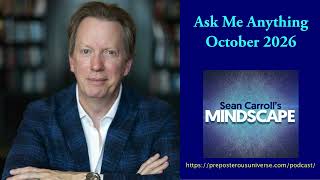
Mindscape Ask Me Anything, Sean Carroll | November 2026
Audio Brief
Show transcript
SUMMARY:
Why would a political party's attempt to over-optimize for slim majorities across many districts actually cause them to lose almost all of those vulnerable seats? On this episode of the podcast, host Sean Carroll talks with theoretical physicist Sean Carroll about the deepest laws of nature and society. You will learn about everything from the emergent nature of space and time to the civic buy-in required for the survival of democracy itself.
The hidden trap of rigging political districts. Manipulating voting maps to win can backfire spectacularly. When a political party redraws district boundaries to give itself slim majorities in many areas, they think they have guaranteed power. But if voter sentiment shifts even slightly, those paper thin majorities collapse all at once, leading to a massive loss of seats in what is known as dummy mandering.
Why physicists must trust bizarre equations. Sometimes, the math knows more than the scientist does. When validated mathematical theories predict seemingly impossible things like black holes or a multiverse, scientists are obligated to take those predictions seriously. As long as the mathematical model accurately reflects a realistic physical situation, the bizarre consequences cannot be ignored just because they feel strange.
Changing your mind without any new clues. Scientists often completely rewrite their beliefs without looking at a single new experiment. Researchers frequently update their views through pure logical analysis and math. For instance, the physics community ignored a major theory of weak and electromagnetic forces in 1967 because they believed it was mathematically broken. They embraced it five years later when a new proof showed it actually worked, all without any new physical discoveries. Deep thinking and conceptual analysis can drive progress just as much as new data.
The million dollar physics puzzle that computers cannot solve. Experimental physicists use certain equations every day to describe subatomic forces, but mathematicians still cannot prove they are mathematically sound. The Millennium Prize Problem demands a rigorous logical proof for the quantum Yang Mills theory and its non zero mass gap. While computers can verify that a proof is logically consistent, they cannot judge if the basic assumptions match the physical universe we care about.
Why space and time are just helpful illusions. Spacetime and cause and effect do not actually exist in the fundamental laws of the universe. In fundamental quantum mechanics, the starting point is a mathematical operator called the Hamiltonian, and physical space emerges from it. Cause and effect is simply a large scale, thermodynamic property that completely disappears when looking at the symmetric equations of the subatomic world.
The myth of the subatomic billiard ball. The particles that make up your body are not actually solid objects. Quantum Field Theory reveals that continuous, space filling fields are the only true building blocks of reality. What we call particles are actually just localized vibrations, or quantum states of mass and charge, rippling through these universal fields.
The physical nature of the human mind. Consciousness is completely compatible with the known laws of physics, requiring no magic or supernatural forces. Just like life itself, consciousness is not a single, mystical essence. Instead, it is an emergent property, a collection of physical and behavioral characteristics that naturally arise from highly complex physical systems.
Remember that no legal structure is mathematically foolproof against collapse. The survival of democratic systems relies entirely on continuous civic buy in and public education. If all of the people in a democracy decide to get rid of democracy, they can do it.
Episode Overview
- Theoretical physicist Sean Carroll discusses a wide range of fundamental questions with host Sean Carroll, spanning quantum mechanics, cosmology, the philosophy of science, and the societal implications of modern technology.
- The conversation moves from the nuances of political structures and mathematical modeling in physics to deep dives into quantum field theory, the Everett Many-Worlds interpretation, and the emergent nature of time and consciousness.
- This episode is ideal for anyone looking to build a rigorous, conceptually accurate framework for understanding modern physics and philosophy without getting bogged down in unscientific hype or overly simplified analogies.
Key Concepts
- Gerrymandering vs. Dummy-mandering: Gerrymandering manipulates district boundaries to favor a specific party. However, over-optimizing for slim majorities across many districts can result in "dummy-mandering," where a slight shift in voter sentiment (a wave election) causes the party to lose almost all of those vulnerable seats.
- The Ideal of "Accepting the Math" in Physics: Scientists must take the logical consequences of validated mathematical theories seriously, even when they predict bizarre phenomena like black holes or the multiverse, provided the mathematical model correctly represents a physically realistic scenario.
- Belief Revision without New Empirical Data: Scientists and philosophers frequently update their credences purely through conceptual analysis, deeper logical reasoning, or mathematical proofs (such as 't Hooft's proof of renormalizability for electroweak theory) rather than relying on new experimental observations.
- The Yang-Mills Existence and Mass Gap Problem: This Millennium Prize Problem seeks a rigorous mathematical proof that quantum Yang-Mills theory exists on $\mathbb{R}^4$ and features a non-zero mass gap. While experimental physicists comfortably use the theory because it matches data, mathematicians require absolute logical proof.
- The Emergence of Spacetime and Causality: Spacetime and causality are not fundamental ingredients of the universe's laws. In quantum mechanics, the fundamental starting point is the Hamiltonian, and spacetime emerges from it, while "cause and effect" is a macroscopic, thermodynamic property that does not exist in symmetric, fundamental differential equations.
- Particles as Field Vibrations: In Quantum Field Theory (QFT), continuous fields are the fundamental entities. "Particles" are merely localized vibrations within these fields, and their "particle-ness" refers to discrete quantum states (such as mass or charge) rather than localized, physical billiard balls.
- Consciousness as an Emergent, Physical Property: Completely compatible with the known laws of physics, consciousness is an emergent property of complex physical systems rather than a fundamental, non-physical force. Like the definition of "life," it is a collection of distinct physical and behavioral characteristics rather than a single, unified essence.
Quotes
- At 0:02:04 - "There's this idea called a gerrymander, which is when you have certain conditions in place... you can draw the maps however you want to decide what counts as a certain congressional district." - Explaining the structural vulnerability in geographic, winner-take-all voting systems.
- At 0:05:32 - "What you've done is arrange it so that your party has a majority usually in most districts, but that majority is small. So if there's sort of a wave election that pushes many people to the other party, suddenly you can actually have fewer seats than you think you deserve... This is called the dummy-mander." - Illustrating the high-risk, high-reward nature of aggressive redistricting.
- At 0:13:21 - "You should take seriously what the math about your theory is trying to tell you, to the extent that you think your theory is right and you've set up the mathematical formulation of the problem correctly." - Clarifying the nuanced relationship between mathematical models and physical reality.
- At 0:14:01 - "The black holes that we care about in our universe are created from stars... so they don't start with a white hole, they start with a star... The eternal Schwarzschild black hole is a mathematical solution, but not one of any physical relevance." - Explaining why physicists reject white holes despite their mathematical validity within general relativity.
- At 0:26:53 - "Have you ever significantly changed your mind about a scientific or philosophical question without encountering new evidence, simply because you came to understand the existing arguments differently? ... Oh sure, yeah, all the time." - Highlighting that cognitive progress often comes from better conceptual analysis rather than new observations.
- At 0:27:24 - "I used to think years ago that you could be scientific about morality and derive principles of morality... Now, just by thinking about it, no more data came in, but just by thinking about it, reading, and listening to other people, I understand that that was wishful thinking." - Showing the intellectual journey from moral realism to moral constructivism based purely on philosophical reflection.
- At 0:29:19 - "Steven Weinberg in 1967 wrote his famous paper, 'A Theory of Leptons'... and no one paid any attention... because there was a theoretical argument that said it can't work—namely, that the theory seemed to be non-renormalizable." - Illustrating how theoretical prejudices can suppress groundbreaking ideas before their mathematical consistency is fully understood.
- At 0:30:25 - "Five years later, it went from no one paying attention to hugely popular. No new data had appeared; all that had appeared was an improved understanding of what the theory was really about." - Emphasizing that conceptual breakthroughs are often driven by mathematical proofs rather than empirical discovery.
- At 0:57:40 - "Turns out that because quantum field theory is hard, and there's infinities everywhere, there's an infinite number of degrees of freedom, proving rigorous statements is just super duper hard." - Explaining why mathematically proving the existence of a quantum Yang-Mills theory is a million-dollar prize problem, whereas physicists usually just assume it works.
- At 0:59:39 - "What that means is, you can write down the proof step-by-step and have it checked by a computer so you don't think you've made any mistakes. That's what people mean when they say they have a Lean verification." - Demystifying the role of formal verification in mathematical logic.
- At 1:00:36 - "All the computer can check is that the conclusions follow from the assumptions. Are you sure that the assumptions you put in are the ones that we care about?" - Pointing out a fundamental limitation of AI-assisted proofs: a computer can verify logical consistency, but it cannot judge the physical relevance of starting axioms.
- At 1:33:07 - "A good Bayesian says the probability of a theory being true given some data is proportional to two things: the prior probability... and the likelihood that you would get that data if that theory were true." - Explaining how to evaluate bizarre occurrences systematically without abandoning rationality.
- At 1:34:42 - "The reason why the Earth goes around the Sun has a lot more to do with the curvature of time than the curvature of space." - Correcting the common misconception that gravity is purely about the warping of three-dimensional space.
- At 1:36:24 - "Nothing grows exponentially with an unbounded time horizon because there are bounds... every exponential in physical reality is probably going to be some kind of sigmoid curve." - Grounding speculative worries about runaway AI proliferation in physical resource constraints.
- At 2:02:06 - "The Hamiltonian is the laws of physics. It is defining the universe; it doesn't come from anywhere else. In anyone's version of the complete theory of physics, there has to be a starting point." - Explaining that in fundamental quantum theories, the Hamiltonian is the axiomatic starting point of physical law.
- At 2:36:12 - "When we talk about the cosmological multiverse... they're not really different universes. That's just bad language. They're different parts of our universe, parts that are far away." - Clarifying the physical reality of the multiverse, moving away from science-fiction interpretations toward standard cosmological models.
- At 3:04:21 - "Your goal is not to say true things; your goal is to improve other people’s understandings." - Explaining why effective science communication relies on pedagogically sound analogies rather than unyielding technical precision.
- At 3:11:17 - "We can now get through life in ways that things that were scarce to us before might be very plentiful, and that might take us away from the things that we need to work harder for but are actually more rewarding." - Reflecting on how modern technological abundance can paradoxically lead to social isolation.
- At 3:41:40 - "Boltzmann brains and Many-Worlds are consequences of equations that we have developed for other reasons. They are predictions of theories that have been very successful for describing data." - Explaining why controversial cosmological and quantum concepts deserve scientific consideration.
- At 4:08:44 - "It is basically impossible to design a democratic system that can't be overturned, for the very simple reason that if all of the people in a democracy decide to get rid of democracy, they can do it." - Outlines the core reality behind Gödel's constitutional loophole, emphasizing that civic buy-in matters more than legal structures.
Takeaways
- Apply Bayesian Reasoning to Strange Events: If you experience a seemingly supernatural event, weight the low prior probability of physical laws breaking against the much higher probability of human brain error, hallucination, or temporary neurological misfiring.
- Look Beyond 3D Space to Understand Gravity: To accurately conceptualize general relativity, look past the "rubber sheet" trampoline analogy and recognize that the warping of the temporal coordinate (how clocks tick differently at different altitudes) is the primary driver of gravitational orbits.
- Recognize the Limits of Evolutionary Morality: Do not conflate descriptive biological instincts shaped by evolution (like cooperation) with prescriptive, objective moral truths; evolution explains where our impulses come from, not what we ought to do.
- Treat AI as a Research Accelerator, Not a Creative Partner: Understand that in fields like theoretical physics, AI is highly efficient at processing well-formulated, highly structured calculations, but it lacks the creative intuition to define the foundational questions.
- Understand Cosmic Expansion as Self-Contained: Abandon the idea that the universe or the multiverse is expanding into an empty, pre-existing void; cosmic expansion simply means the actual amount of space within the self-contained system is increasing.
- Differentiate Between Particles and Fields: When learning or teaching quantum physics, frame particles as emergent, localized excitations of continuous, space-filling fields, which are the true fundamental building blocks.
- Evaluate Quantum Probability Subjectively in Many-Worlds: If adopting the Everett interpretation, treat quantum probabilities as an observer's subjective uncertainty about which branch of the split wave function they currently occupy, rather than objective physical frequencies.
- Adapt Education to AI Availability: Shift educational evaluations away from homework and unmonitored assignments, which AI tools can solve effortlessly, and place grading emphasis entirely on supervised, in-class, or oral exams.
- Prioritize Pedagogical Utility Over Absolute Accuracy: When communicating complex scientific concepts, use simplified analogies that actively elevate the audience's baseline understanding rather than overcomplicating the message with technical, pedantic details.
- Combat Modern Isolation with Active Connection: Recognize that technological efficiency can reduce meaningful human interaction; actively work to foster deep, offline connections to combat the structural loneliness of modern life.
- Accept the Irreversibility of Quantum Branching: Understand that once a quantum measurement occurs, the wave function branches irreversibly due to decoherence and environmental entanglement, preventing the split worlds from ever merging back together.
- Protect Democracy Through Civic Engagement, Not Just Legal Text: Realize that no constitution is mathematically foolproof against collapse; the preservation of democratic systems relies entirely on continuous public buy-in and civic education.