MERCADO EM ALERTA MÁXIMO: 2026 PODE SER UM ANO DESASTROSO | Risco Brasil #19
Audio Brief
Show transcript
This episode covers the central conflict facing investors in 2026: the powerful tailwind of synchronous global interest rate cuts clashing with a minefield of political risks, including crucial elections.
There are three key takeaways from this discussion.
First, the market faces a significant duality in 2026. This year combines a potent bullish force from coordinated interest rate cuts by major central banks with substantial political and economic headwinds. These include Brazil's presidential election, US midterm elections, and a change in Federal Reserve leadership. The central question for investors is which force will prevail.
Second, investors should scrutinize abstract investment narratives. The "US exceptionalism" thesis, often justifying high US valuations, is questioned. Instead, focus should be on quantifiable drivers like AI revenue or real interest rate levels. Furthermore, the idea of permanent US technological supremacy is challenged, as data shows China is rapidly closing the gap in key areas like Large Language Models.
Third, Brazil offers a compelling asymmetric opportunity. Anticipate significant capital flow from fixed income into Brazilian equities as real interest rates fall. The country presents cheap valuations, still-high interest rates, and the potential for a market-friendly political regime change, attracting substantial foreign investment. Even minor global capital reallocation can significantly impact Brazil's smaller market.
Ultimately, adopting a selectively aggressive portfolio stance, focused on future economic re-acceleration, may be the optimal strategy for this complex environment.
Episode Overview
- The podcast explores the central conflict facing investors in 2026: a powerful tailwind from synchronous global interest rate cuts clashing with a "minefield" of political risks, including elections in Brazil and the United States.
- The discussion critically examines high market valuations, particularly the narrative of "US exceptionalism," questioning whether it's a sound investment thesis or a justification for overpaying for assets.
- A deep dive into the Brazilian market ("Risco Brasil") analyzes how falling real interest rates, election uncertainty, and foreign capital flows will impact local equities.
- The episode provides insights on portfolio strategy for this complex environment, debating whether investors should adopt a defensive, selective, or aggressive posture.
Key Concepts
- The Duality of 2026: The year is framed as a rare period of tension, presenting both significant anxiety from political and economic risks and major opportunities driven by monetary policy.
- Synchronous Monetary Easing: A historically potent, bullish force where the U.S. Federal Reserve and the Brazilian Central Bank are expected to cut interest rates simultaneously, increasing market liquidity.
- Political and Economic Headwinds: Major sources of uncertainty include the 2026 Brazilian presidential election, U.S. midterm elections, and a change of leadership at the U.S. Federal Reserve.
- "US Exceptionalism" Narrative: A prevailing but questioned thesis used to justify high valuations in the U.S. market, contrasted with more quantifiable drivers like AI revenue or interest rate levels.
- Bubble Indicators and Historical Parallels: The current AI-driven market is compared to the dot-com bubble, noting that while valuations appear stretched, key downturn indicators (like equipment returns) are not yet present.
- The US-China Technology Gap: The idea of American technological dominance is challenged by data showing that China is rapidly closing the gap in key areas like Large Language Models (LLMs).
- Capital Reallocation in Brazil: The expected fall in real interest rates is predicted to trigger a significant shift of capital from Brazil's fixed-income markets into equities.
- Foreign Investor Appeal in Brazil: The country is presented as an asymmetric opportunity due to a combination of cheap valuations, high interest rates, and the potential for a market-friendly political regime change.
Quotes
- At 0:40 - "2026 se desenha como um daqueles anos raros que colocam o mercado em tensão permanente." - Henrique Esteter setting the theme of the episode, highlighting the unique and tense nature of the upcoming year for investors.
- At 0:54 - "Afinal teremos provavelmente desaceleração econômica em algumas regiões importantes, eleições no Brasil, midterms nos Estados Unidos e uma troca de comando no Federal Reserve que adiciona ruído e incerteza para a política monetária global." - Esteter detailing the "minefield" of negative factors and risks that could impact markets.
- At 1:13 - "Pela primeira vez em muito tempo, o Fed e o Banco Central brasileiro caminham para um ciclo de corte de juros ao mesmo tempo." - Esteter explaining the powerful and historically positive force of coordinated monetary easing by major central banks.
- At 1:31 - "O que vai pesar mais em 2026? O ruído político das urnas ou a força gravitacional dos juros caindo aqui e lá fora?" - Esteter posing the central question that the podcast aims to answer, framing the core conflict for investors.
- At 26:37 - "Que bizarro esse valuation, aí ele dobra na tua cara." - João Luiz Braga discusses the difficulty of identifying and betting against a market bubble, as stretched valuations can continue to rise.
- At 27:18 - "Cara, assim, eu não gosto dessa narrativa, porque a narrativa de AI a gente vai lá e faz conta... A narrativa do juro real zero, a gente faz conta." - João Luiz Braga explains his preference for quantifiable investment theses over abstract narratives like "US exceptionalism."
- At 27:29 - "Pô, narrativa de US exceptionalism... Parece aquela coisa pra pagar caro, né?" - João Luiz Braga concludes that the "US exceptionalism" narrative is often used to justify inflated asset prices.
- At 27:46 - "A diferença de eficiência dos modelos, LLM, chineses pros americanos, estava fechando o gap, tá?" - João Luiz Braga cites a report to argue that China is quickly catching up to the US in AI technology, challenging the idea of US dominance.
- At 27:54 - "O ponto de US exceptionalism e pagar valuations caros para surfar isso aí... pode ser que funcione, mas assim, longe de ser óbvio." - João Luiz Braga warns that investing in the "US exceptionalism" theme at current high valuations is a risky and uncertain bet.
- At 30:31 - "E o primeiro sinal que deu para pegar antes, foi quando começou a ter devolução." - João Luiz Braga recalls a key indicator from the dot-com bubble (returns of ordered equipment) that signaled a downturn, noting that this is not yet happening in the current AI boom.
- At 1:00:21 - "Esse ano de 2025 foi uma grande aula àqueles que... olham para juros altos e querem ficar na renda fixa." - Henrique Esteter commenting on how the stock market rallied in a high-interest-rate environment, teaching a lesson to investors who stayed in fixed income.
- At 1:02:08 - "Eu tô levemente mais agressivo... A galera tá bem defendida." - João Luiz Braga describing his fund's positioning as slightly more aggressive compared to his peers, who are positioned very defensively.
- At 1:03:32 - "A bolsa caiu para essa freada no ano passado, quando o juro estava subindo. Agora a gente tem que olhar o juro caindo para frente e a reaceleração." - João Luiz Braga arguing that the market has already priced in the economic slowdown and that the focus now is on the positive impact of future interest rate cuts.
- At 1:05:39 - "Você tem uma piscina olímpica, você tira cinco baldes de água da piscina olímpica, você olha para a piscina olímpica, não mudou nada... você pega esses cinco baldes e joga numa banheirinha chamada Brasil, meu irmão, joga água, voa água para todo lado." - João Luiz Braga using an analogy to explain how a small reallocation of capital from the massive U.S. market can have a huge impact on the smaller Brazilian market.
- At 1:12:06 - "Eu não sou pago para ter uma opinião, sou pago para mudar de opinião." - João Luiz Braga quoting a famous saying to explain his flexible approach as a fund manager, ready to change his portfolio's position quickly as new information arises.
- At 1:17:31 - "Eu tenho certeza que essa candidatura é pra valer. É ingenuidade achar que não é. É pra valer, e se não der, vira negociação." - João Luiz Braga expressing his conviction that Flávio Dino's potential presidential candidacy is a serious move, not just a political bluff.
Takeaways
- Prepare for a market environment where the powerful tailwind of coordinated global rate cuts will constantly battle the volatility from political uncertainty.
- Be skeptical of investment theses built on abstract narratives like "US exceptionalism"; instead, prioritize quantifiable factors when assessing high valuations.
- While AI-driven market valuations are high, the absence of key historical downturn signals suggests the current cycle may not be over.
- Anticipate a significant flow of capital from fixed income into Brazilian equities as real interest rates fall, which could provide a major boost to the local stock market.
- Recognize that Brazil offers an asymmetric risk-reward profile, where cheap valuations and the potential for a market-friendly election outcome could attract substantial foreign investment.
- Consider a selectively aggressive portfolio stance, focusing on the future economic re-acceleration driven by rate cuts rather than the slowdown that is already priced in.
- Challenge the assumption of permanent US technological supremacy, as the narrowing tech gap with China could have long-term implications for global asset allocation.
- Adopt a flexible investment philosophy, remaining ready to quickly change your portfolio's positioning in response to new information, particularly regarding political developments.
- Understand that even a minor reallocation of capital from massive global markets can have an outsized, positive impact on a smaller market like Brazil.
More from Market Makers

EUA OU CHINA: QUEM VAI MANDAR NO MUNDO NO SÉCULO XXI?
Feb 13, 2026
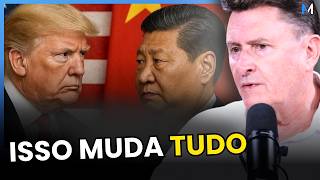
CHINA E EUA: QUEM TEM MAIS PODER GLOBAL HOJE?
Feb 12, 2026

A ELEIÇÃO NÃO ESTÁ NO PREÇO (E O MERCADO PODE QUEBRAR A CARA)
Feb 11, 2026

BOLSA NA MÁXIMA HISTÓRICA: O QUE ESTÁ ACONTECENDO E COMO SE POSICIONAR | Second Level #32
Feb 11, 2026