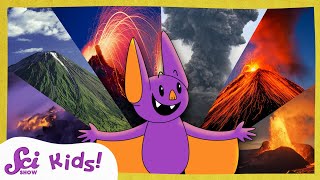
KABOOM! All About Volcanoes! | SciShow Kids Compilation

Audio Brief
Show transcript
This episode explores the science behind volcanoes, their role in shaping our planet, and how scientists monitor their activity.
There are four key takeaways from this discussion. First, volcanoes are a powerful natural force that create new landforms, exemplified by the entire state of Hawaii. Second, the Earth's crust comprises constantly moving tectonic plates, the primary driver of most volcanic activity. Third, while volcanic eruptions can be dangerous, scientific monitoring provides crucial warnings that help keep people safe. Finally, the same geological processes on Earth also occur on other planets, demonstrated by volcanoes found on Mars, including Olympus Mons, the largest known in our solar system.
The Hawaiian islands offer a prime example of volcanic land creation. They formed over a stationary "hot spot" in the Earth's mantle as the Pacific tectonic plate slowly moved above it. This continuous process created a chain of islands, with Hawaii currently home to six active volcanoes.
The Earth's crust is made of large, slowly moving tectonic plates. These plates move approximately 1.5 centimeters per year. Most of the world's volcanic and earthquake activity occurs along the edges of these plates, forming regions like the "Ring of Fire" that encircles the Pacific Ocean.
Scientists closely monitor volcanic activity to predict eruptions and ensure public safety. They use tools like seismographs to detect earthquakes, which often precede an eruption. Monitoring ground swelling and gas emissions also provides crucial data, allowing for timely warnings and evacuations.
The geological forces that create volcanoes are not unique to Earth. Evidence of volcanic activity has been found on other planets, including Mars. This includes Olympus Mons, the largest known volcano in our solar system, showcasing these powerful planetary processes beyond our world.
Understanding volcanic processes remains vital for both geological discovery and public safety.
Episode Overview
- Squeaks, the robot mouse, shares pictures from his vacation in Iceland and asks for suggestions for his next trip to a warm island.
- The host, Jessi, suggests Hawaii and explains that its islands were formed by volcanoes.
- The episode delves into the science behind volcanoes, including plate tectonics, the "Ring of Fire," and the difference between magma and lava.
- Jessi explains how scientists monitor volcanic activity to predict eruptions and ensure public safety, highlighting both slow and explosive types of eruptions.
Key Concepts
- Hawaii's Volcanic Origins: The Hawaiian islands are a chain formed by a "hot spot" in the Earth's mantle. As the Pacific tectonic plate moved over this stationary hot spot, a series of volcanoes formed, eventually creating the islands. Hawaii has 15 volcanoes on its eight main islands, with six being active.
- Plate Tectonics and the Ring of Fire: The Earth's crust is composed of large, slow-moving pieces called tectonic plates. Most of the world's volcanic and earthquake activity occurs along the edges of these plates, in a region nicknamed the "Ring of Fire" that circles the Pacific Ocean.
- How Volcanoes Erupt: An eruption occurs when magma (molten rock) from the Earth's mantle rises through a vent in the crust. Once it reaches the surface, it is called lava. Over many eruptions, cooled lava can build up to form mountains and islands.
- Types of Volcanic Activity: Volcanoes are classified based on their activity. Active volcanoes have erupted recently and may erupt again. Dormant volcanoes haven't erupted in a long time but could. Extinct volcanoes are unlikely to erupt ever again.
- Volcano Monitoring and Safety: Scientists use tools like seismographs to detect earthquakes, which often precede an eruption. They also monitor ground swelling and gas emissions to predict volcanic activity and issue warnings, allowing people to evacuate to safety.
Quotes
- At 01:21 - "Active means that they've erupted in the recent past and may erupt again." - Jessi explains the definition of an active volcano while discussing the six active volcanoes in Hawaii.
- At 02:06 - "There's so many that scientists nicknamed it the Ring of Fire." - The host introduces the concept of the Ring of Fire, an area around the Pacific Ocean with a high concentration of volcanoes and earthquakes.
- At 02:50 - "They only move about 1.5 cm per year, about the speed a person's toenails grow." - Jessi uses a relatable analogy to describe the extremely slow movement of the Earth's tectonic plates.
Takeaways
- Volcanoes are a powerful natural force that create new landforms, such as the entire state of Hawaii.
- The Earth's crust is made of constantly, albeit slowly, moving tectonic plates, which is the primary driver of volcanic activity.
- While volcanic eruptions can be dangerous, scientific monitoring provides crucial warnings that help keep people safe.
- The same geological processes on Earth also occur on other planets, as demonstrated by the existence of volcanoes on Mars, including the largest one known in our solar system, Olympus Mons.