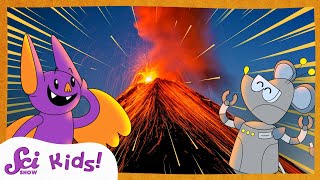
Every Kind of Volcano | SciShow Kids

Audio Brief
Show transcript
This episode covers the diverse nature of volcanoes, their types, classifications, and powerful impact on Earth.
There are four key takeaways from this discussion. First, volcanoes are incredibly varied geological features, extending beyond the classic explosive mountain. Second, iconic volcanic mountains form over hundreds of thousands of years from layers of hardened lava. Third, volcanic eruptions range from slow, land-building lava flows to massive, explosive events. Finally, volcanic activity continuously shapes our planet, creating new land while potentially impacting global climate, with scientists actively monitoring for predictions.
Volcanoes serve as vents in the Earth's crust, allowing molten rock to escape. These features include tall, cone-shaped stratovolcanoes, wide shield volcanoes, and even simple fissures or large calderas.
Their classifications are based on activity: active volcanoes erupt recently, dormant ones could erupt again, and extinct ones are unlikely to reactivate. The Volcanic Explosivity Index measures eruption intensity.
Eruptions create new landforms and islands. However, they can also release ash clouds that disrupt air travel and significantly alter global climate, as evidenced by historical events. Scientists continuously monitor seismic activity and ground changes to anticipate potential eruptions.
Understanding these powerful forces helps us appreciate Earth's dynamic and ever-changing geological processes.
Episode Overview
- The episode introduces the concept of volcanoes, explaining that they come in various shapes and sizes, not just the classic pointy mountain.
- It covers different types of volcanoes, such as stratovolcanoes, shield volcanoes, fissures, and calderas, and explains how they are formed.
- The hosts discuss the classifications of volcanoes as active, dormant, or extinct, based on their eruption history.
- The episode explores the different kinds of volcanic eruptions, from slow-moving lava flows to massive, explosive events, and how their intensity is measured.
Key Concepts
- Volcano Basics: A volcano is fundamentally a vent or opening in the Earth's crust that allows magma (molten rock) from inside the Earth to escape to the surface, where it becomes lava.
- Types of Volcanoes: Volcanoes are not one-size-fits-all. They include tall, cone-shaped stratovolcanoes (like Mount Fuji), wide and gently sloping shield volcanoes (like Mauna Loa), fissures (cracks in the ground), and calderas (large craters formed by collapsed volcanoes).
- Magma vs. Lava: Magma is the term for molten rock when it is beneath the Earth's surface. Once it erupts from a volcano, it is called lava.
- Volcano Classifications: Scientists categorize volcanoes based on their activity. Active volcanoes have erupted recently, dormant volcanoes have not erupted in a long time but could again, and extinct volcanoes are unlikely to ever erupt again.
- Volcanic Explosivity Index (VEI): This scale, ranging from 0 to 8, measures the explosiveness of a volcanic eruption. A higher number indicates a more powerful and destructive eruption.
- Impact of Eruptions: Volcanic eruptions can have significant effects, from creating new land and islands to releasing massive ash clouds that can disrupt air travel and even alter global climate, as seen after the Mount Tambora eruption.
Quotes
- At 00:33 - "That means it's a big, pointy, tall mountain that suddenly goes kaboom! And everyone runs away going, 'Ah! Ah! Save us from the hot lava! Ah!'" - The puppet, Sam, gives his dramatic and humorous initial understanding of what a volcano is.
- At 01:24 - "The Earth is always changing, building new pieces of itself. And volcanoes are part of that system." - The host explains that volcanoes are a natural and constructive part of the Earth's ongoing geological processes.
Takeaways
- Volcanoes are diverse geological features that are much more than just explosive mountains; they can be underwater vents, wide shields, or even simple cracks in the ground.
- The formation of iconic volcanic mountains like stratovolcanoes occurs over hundreds of thousands of years as layers of hardened lava build up from multiple eruptions.
- While some volcanic eruptions are dramatic and explosive, others involve slow-moving lava flows that gradually create new land.
- Volcanic activity is a powerful force that continuously shapes our planet, creating new islands and landforms while also having the potential to impact global climate.
- Scientists can monitor changes in the Earth, such as increased earthquake activity or ground heat, to help predict when a volcano might erupt.