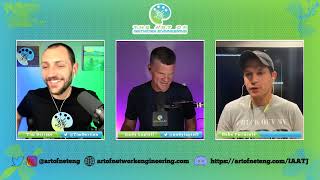
Interview with Adam Hill, a consulting network engineer with a focus on Cloud Networking! Ep 93

Audio Brief
Show transcript
In this conversation, guest Adam Hill details his inspiring career transition from military IT to Senior Network Engineer, sharing how he navigated significant financial hardship and professional setbacks. The episode explores critical distinctions in IT environments, the importance of foundational knowledge, and the power of a strong personal motivation.
There are four key takeaways from this episode. First, the crucial role of a powerful personal "why" in driving sustained career progression and resilience. Second, the essential difference between practical, hands-on skills and a deep, foundational understanding of core IT concepts. Third, understanding diverse IT environments and overcoming challenging workplace cultures, including "gatekeeping." Finally, the strategic value of certifications as a critical tool for career advancement.
Adam emphasizes that a strong personal motivation, such as providing family stability, is paramount for persevering through career setbacks, intense study, and financial hardship. This powerful "why" acts as the core driver for pursuing certifications, relocating for opportunities, and maintaining resilience in the volatile tech industry. It underscores that understanding your purpose is as vital as technical skills.
The discussion highlights the critical distinction between merely knowing which buttons to press and possessing a deep, foundational understanding of core concepts like TCP/IP. True career advancement and problem-solving ability require investing in theoretical knowledge. This allows professionals to evolve from a "button pusher" to a true engineer capable of understanding, designing, and troubleshooting complex architectures.
Adam's journey reveals the challenges posed by "gatekeeping" cultures, where senior engineers may hoard knowledge rather than mentor junior colleagues. He also contrasts enterprise IT, which is typically end-user and systems-focused, with the more network-centric and diverse service provider space. Navigating these environments often necessitates self-reliance and peer-based learning, while turning negative leadership experiences into a personal philosophy of mentorship.
Certifications like the CCNA are presented as vital tools for securing interviews and demonstrating a baseline of knowledge to potential employers. While they open doors, the episode clarifies that certifications are not a guarantee of employment. Instead, practical skills, problem-solving abilities, effective communication, and personal fit are what ultimately secure and advance a role.
Overall, Adam's story serves as a powerful testament to perseverance, strategic learning, and the transformative power of a clear personal purpose in building a successful and impactful IT career.
Episode Overview
- Guest Adam Hill shares his inspiring career journey, detailing his transition from military IT to becoming a Senior Network Engineer, overcoming significant financial hardship and professional setbacks along the way.
- The conversation explores the critical differences between enterprise IT and the service provider space, the challenges of a "gatekeeping" culture, and the importance of foundational knowledge over just practical skills.
- Adam emphasizes the power of having a strong "why"—his family's stability—as the core motivation that drove him to pursue certifications, relocate for opportunities, and persevere through layoffs.
- The episode provides practical advice on the role of certifications, the value of a "buddy system" for learning, and how to turn negative experiences with leadership into a personal philosophy of mentorship.
Key Concepts
- Enterprise IT vs. Service Provider: A comparison of the two environments, highlighting that enterprise IT is typically more end-user and systems-focused, while the service provider space is a network-centric "playground" with diverse architectures.
- The "Button Pusher" Problem: The distinction between having hands-on experience (knowing which buttons to press) and possessing a deep, foundational understanding of core concepts like TCP/IP, which is crucial for career advancement.
- Career Motivation: The central theme of finding a powerful, personal "why" (like family stability) to serve as the driving force to overcome financial struggles, career setbacks, and periods of intense study.
- Gatekeeping Culture in IT: Discussion of the challenge posed by senior engineers who hoard knowledge and are unwilling to mentor junior colleagues, forcing self-reliance and peer-based learning.
- Career Setbacks and Resilience: The narrative includes multiple instances of being laid off and taking temporary steps backward in career progression, demonstrating the resilience required to navigate the volatile tech industry.
- The Pivot to Networking: Adam's story highlights a pivotal career moment of discovering a passion for networking while working in a hybrid systems/network role, leading to a deliberate shift in his professional focus and studies.
- The Role of Certifications: Certifications like the CCNA are framed not as a guarantee of employment, but as a critical tool for "getting the interview" and proving a baseline of knowledge to potential employers.
Quotes
- At 2:57 - "What a change in the dynamic recording like in person around the same table versus, you know, how we do it normally... I don't know how we're going to do the show from now on." - AJ Murray reflects on how much better the recording experience was in person and jokes that it has spoiled him for their usual remote setup.
- At 8:25 - "It's like a network engineer's playground." - Guest Adam Hill describes his current role as a consultant in the service provider space, highlighting the opportunity to work on a diverse range of customer networks and technologies.
- At 8:52 - "I've worked in enterprise IT too... enterprise IT is more customer-focused, or end-user focused and a lot more systems focused, where I'm doing more work managing the servers and less work managing the networking." - Adam Hill explains the key differences he sees between working in enterprise IT versus the service provider sector.
- At 23:49 - "At that time, I'm really a button pusher. I didn't really understand what I was doing." - Hill describes his initial skill level after leaving the military, highlighting that he had practical experience but lacked foundational knowledge.
- At 25:04 - "Everything was starting to click... and at the same time, it sparked my love for IT." - Hill explains the "aha" moment at the bootcamp when he could finally correlate his military tasks with formal IT concepts, igniting his passion for the field.
- At 28:38 - "Those IT professionals... they were stuck in the mindset of, 'Oh, this guy's trying to take my job,' so they wouldn't really help or give any advice." - Describing the unhelpful, gatekeeping culture he encountered from senior engineers at his early jobs.
- At 32:24 - "At that moment, that moment was life-changing for me." - Referring to a call from his wife about their water being shut off due to financial struggles, which became a powerful motivator for him to advance his career.
- At 52:03 - "I will do anything to get the break into this field and get my family to stability." - Adam Hill explains that his powerful motivation, or "why," was the driving force that helped him persevere through difficult career challenges.
- At 52:21 - "I'm not going to do the people behind me as some of these leadership has done to me." - Hill reflects on how negative experiences with leadership early in his career shaped his own philosophy on how to treat others.
- At 65:51 - "I was like, 'You know what? Networking is actually more fun than systems.'" - Hill describes the moment he realized his true passion lay in networking while working in a hybrid systems and network administrator role.
- At 72:26 - "The very next day, they laid me off." - Hill recounts the shocking turn of events where he was laid off due to budget cuts just one day after passing his CCNA exam.
- At 75:06 - "I was only out of work for a week, and I got a $20,000 raise and a $4,000 severance pay." - Hill details the rapid and positive outcome after being laid off, where his new CCNA certification quickly led to a much better job opportunity.
- At 78:24 - "A certification does not get you a job. It just gets you to the interview." - Hill shares his perspective on the value of certifications, comparing them to a tool that gets you noticed, while your experience seals the deal.
- At 81:26 - "Always making sure that I always kept my 'why' at the forefront of everything I do." - Hill explains that remembering his core motivation is crucial for maintaining his drive and mental health through professional challenges.
Takeaways
- Identify and constantly keep your "why" at the forefront of your mind to maintain motivation and resilience through the inevitable challenges of a tech career.
- Form a "buddy system" with a like-minded colleague when studying for certifications to create accountability and mutual support, increasing your chances of success.
- Bridge the gap between hands-on skills and theoretical knowledge; invest time in learning the fundamentals to evolve from a "button pusher" into a true engineer.
- Don't be afraid to relocate to a new city or region if local opportunities are limited, as moving can be a necessary catalyst for significant career advancement.
- Use negative experiences with poor leadership or a gatekeeping culture as a lesson in what not to do, and commit to being a helpful mentor for others.
- Understand that a temporary career step-back to ensure financial stability is a strategic move, not a failure, and can provide the foundation for your next big leap forward.
- View certifications as a key to open doors and secure interviews, but remember that your practical skills, problem-solving abilities, and personality are what will ultimately land you the job.
- Actively seek out roles that expose you to different areas of IT, as you may discover a passion for a specialization you hadn't previously considered.
More from The Art of Network Engineering

We tour the world's fastest super computer at Oak Ridge National Laboratory!
Apr 18, 2024

Exploring Tech Certification Challenges with Brent Morris
Sep 26, 2023

Navigating the CCIE Landscape with help from 3 CCIEs!
Sep 12, 2023
This week we interview a 3x CCIE and discuss Data Center Network Design! Ep 106 of AONE
Nov 22, 2022