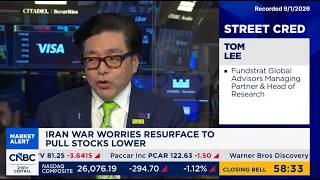
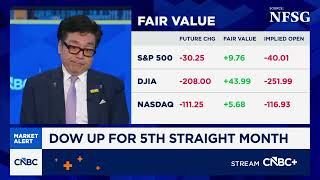
Fundstrat’s Tom Lee: AI Trade Still Strong = Year-End Rally?
Audio Brief
Show transcript
This episode covers the stock market's rebound, driven by technology sector strength amid ongoing debates on AI stock valuations and market concentration.
There are three key takeaways from this discussion. First, AI stock valuations demand individual assessment. Second, the market's narrow leadership presents concentration risks. Third, long-term strategy should outweigh short-term market noise.
Regarding AI stocks, while the sector has seen massive gains, not all players are in a bubble. Leading companies like Nvidia may still trade at reasonable forward earnings ratios compared to their growth. However, other names in the space are considered more speculative and potentially overvalued.
The market rally in 2023 has been largely driven by a handful of mega-cap tech stocks, often called the Magnificent Seven. The cap-weighted S&P 500 significantly outperforms its equal-weighted version, indicating a lack of broad market participation and highlighting concentration risk.
Finally, market sentiment is easily swayed by specific events like CEO announcements or investor reports, creating short-term volatility. A robust long-term investment strategy should prioritize fundamental analysis over sentiment-driven swings.
In conclusion, prudent investing in this dynamic market requires discerning individual stock values, managing concentration, and maintaining a long-term perspective.
Episode Overview
- The episode analyzes the stock market's rebound, attributing it to relief from the potential government shutdown and ongoing strength in the technology sector.
- Panelists debate the valuation of the "AI trade," discussing whether stocks like Nvidia are reasonably priced while others like Palantir might be overextended.
- The discussion touches on the narrowness of the market rally, highlighting the outperformance of a few large-cap tech stocks (the "Magnificent 7") compared to the broader market.
- The role of retail investor sentiment, the correlation between Bitcoin and the Nasdaq, and the influence of high-profile company announcements on market volatility are also explored.
Key Concepts
- AI Stock Valuation: The panel discusses that while the AI sector has seen massive gains, not all stocks are in a bubble. Tom Lee argues that key players like Nvidia still trade at reasonable forward P/E ratios compared to their growth, making them cheaper than some consumer staples. However, other names in the space are considered more speculative and potentially overvalued.
- Market Concentration: The rally in 2023 has been largely driven by a handful of mega-cap tech stocks. The performance of the cap-weighted S&P 500 is significantly better than the equal-weighted version, indicating a lack of broad market participation and raising concerns about concentration risk.
- Influence of News and Sentiment: The conversation highlights how market sentiment can be easily swayed by specific events, such as announcements from major tech CEOs (like OpenAI's Sam Altman) or reports of short positions by well-known investors (like Michael Burry). This can lead to short-term volatility, especially in popular retail stocks.
- Bitcoin and Nasdaq Correlation: The historical correlation between Bitcoin and the Nasdaq is revisited. As both are considered risk-on assets sensitive to monetary liquidity, their recent price movements have once again aligned, suggesting that factors affecting tech stocks may also impact crypto markets.
Quotes
- At 01:05 - "Nvidia still only trades at 29 times forward earnings. I mean, it's still cheaper than Costco. So it's hardly a bubble valuation." - Tom Lee argues that the premier AI chipmaker is not overvalued despite its massive run-up.
- At 10:29 - "Tech moves the market. Tech is the market right now. I know that everyone's out there calling for this broadening trade right now and it's just not happening." - Malcolm Ethridge emphasizes the continued dominance of the tech sector and the narrowness of the current market rally.
- At 13:25 - "Most of it is really just focused on the tech sector. There isn't a broader concern outside of that. So if anything, it was this desire and it was this question around, 'How do I diversify outside of this but still stay invested broadly in the market?'" - Kevin Gordon describes the primary concern of retail investors as being overly concentrated in tech and seeking ways to diversify.
Takeaways
- Evaluate AI stocks individually rather than as a single group. Leading companies with strong earnings and reasonable valuations may still present opportunities, while more speculative names carry higher risk.
- Recognize and manage the risks of a narrowly-led market. Since a few mega-cap stocks are driving most of the index gains, consider diversifying with equal-weight ETFs or by looking for opportunities in underperforming sectors like healthcare and utilities.
- Avoid making investment decisions based on short-term market noise. High-profile headlines and CEO comments can create temporary volatility, but a long-term strategy should be based on fundamental analysis rather than sentiment-driven swings.