Carrots Without Weeds
Audio Brief
Show transcript
This episode covers organic weed management strategies for high-risk carrot crops and the diagnosis of common garlic pathogens.
There are three key takeaways from this discussion. First, successful organic carrot production relies on the stale seedbed technique and pre-emergent flame weeding. Second, the no seed rain principle is foundational to long-term weed suppression across all cultivation areas. Third, managing garlic pathogens like Fusarium requires strict crop rotation and gentle harvesting practices.
For slow-germinating crops like carrots, growers can establish a clean planting environment using stale seedbeds and compost mulching. Preparing and watering beds weeks ahead of sowing flushes out weed seeds, which are then terminated. Flame weeding can also be safely applied just days after sowing, targeting surfaced weeds before the carrot crops emerge.
The bedrock of long-term weed suppression is preventing existing weeds from reproducing anywhere on the farm. Halting seed production in pathways, beds, and borders exponentially depletes the soil weed seed bank over time. Because soil acts as an excellent insulator, flame weeding only destroys emerged weeds without harming buried seeds, making prevention critical.
Addressing crop health, rust-colored spots on garlic bulb papers often point to soil-borne fungal infections like Fusarium. Controlling these outbreaks requires treating harvested bulbs with extreme care to prevent entry points for pathogens. Growers should implement strict crop rotations, avoid replanting cloves from infected crops, and ensure proper curing.
Implementing these preventative weed and disease management strategies helps organic growers maximize crop yields and maintain long-term soil health.
Episode Overview
- This episode of Growers Daily focuses on organic weed management strategies for carrot crops, addressing the high-risk, high-reward nature of growing carrots without heavy weed pressure.
- Host Jesse Frost explores various techniques, including the use of compost mulch, stale seedbeds, tarping, and flame weeding, to maintain clean planting beds.
- The episode addresses a grower's question about rust-colored spots on harvested garlic bulbs, identifying likely causes such as Fusarium and explaining how to manage infected crops.
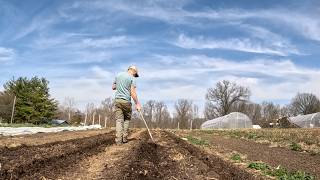
- A practical field demonstration of flame weeding illustrates the timing, technique, and safety considerations necessary for successful pre-emergence weed control.
Key Concepts
- The "No Seed Rain" Principle: The foundation of long-term weed control is preventing existing weeds from going to seed anywhere in the garden, pathways, or borders. Consistently stopping weed reproduction exponentially reduces the weed seed bank over time.
- Compost Mulching: Applying a weed-free and herbicide-free compost layer (from a few inches to several inches deep) serves as a clean planting medium that smothers underlying weed seeds while allowing directly seeded crops like carrots to germinate cleanly.
- The Stale Seedbed Technique: This method involves preparing a planting bed entirely, watering it, and covering it to induce weed germination before sowing the actual crop. Once weeds emerge, they are terminated via light cultivation or flame weeding, leaving a clean bed for the subsequent crop.
- Pre-Emergent Flame Weeding: Because carrots are slow to germinate, a flame weeder can be run over the bed after carrot seeds are sown but before they emerge. This kills fast-germinating weeds without harming the carrot crop, giving the carrots a head start in a weed-free environment.
- Garlic Pathogen Management (Fusarium): Rust-colored spots on garlic bulb papers often indicate fungal infections like Fusarium. Managing these soil-borne diseases requires strict crop rotation (avoiding alliums in the affected bed for several years), careful curing, and avoiding replanting any cloves from affected bulbs.
Quotes
- At 2:14 - "It starts, of course, with 'no seed rain.' I.e., don't ever let weeds go to seed in your gardens—not in your pathways, not in the beds, not along the edges if you can help it." - Emphasizing the most critical preventative rule of organic weed management.
- At 3:41 - "As your mulch layer goes down, your weed pressure goes up. It's got to be one of the worst ratios in the world, but that's kind of just how it works." - Explaining the direct relationship between soil exposure and weed germination.
- At 19:04 - "Soil is such a good insulator, it's going to protect everything below it." - Highlighting why flame weeding only kills surfaced, germinated weeds and will not eradicate weed seeds or roots buried in the soil.
Takeaways
- Implement the stale seedbed method by fully preparing, amending, and watering your carrot beds 1–2 weeks before planting to flush out and terminate weed flushes prior to sowing.
- When flame weeding pre-emergent carrots, carefully monitor soil moisture and germinating seeds; draft a schedule to flame the bed approximately 5 days after sowing, just before the carrot cotyledons break the soil surface.
- Handle harvested garlic with extreme care, treating bulbs "like eggs" to prevent bruising, which serves as an entry point for fungal pathogens like Fusarium during the curing process.