Beyond the Mag 7: Where Fundstrat Sees Opportunity
Audio Brief
Show transcript
Episode Overview
- This episode features Mark Newton, Global Head of Technical Strategy at Fundstrat, discussing recent market volatility amidst geopolitical tensions and unexpected news events.
- The conversation frames the current market pullback not as the start of a bear market, but as a temporary consolidation within a broader bullish trend, drawing parallels to April 2024.
- This content is relevant for investors looking to understand sector rotation away from "Mag 7" technology stocks and identifying emerging opportunities in small caps, industrials, and international markets like Latin America and South Korea.
Key Concepts
-
Market Resilience and Investor Psychology: Despite geopolitical shocks (such as tensions over Greenland involving NATO, or issues with Iran and Venezuela), investor sentiment has remained surprisingly optimistic. The market's reaction—a sharp but potentially short-lived dip—is characterized as a "negotiation tool" rather than a fundamental collapse. The current dip is viewed as a buying opportunity because market breadth (participation of many stocks in the rally) has actually improved recently.
-
The Rotation Out of "Mag 7" Tech: The major technology stocks (Magnificent 7) are undergoing a period of consolidation after becoming overextended. This is a healthy market function known as "mean reversion." While these tech giants stall or correct, capital is rotating into other sectors like transports, industrials, and healthcare, which suggests the overall market health is better than the headline indices might imply.
-
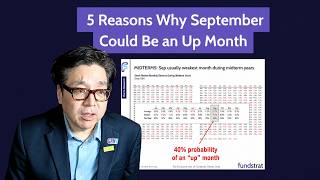
Mid-Term Election Year Seasonality: Historical data for mid-term election years often points to choppy performance in the early quarters, described as the "weak spot of the four-year cycle." Newton predicts a year of consolidation rather than a straight line up, forecasting a pullback in late February/early March, followed by a summer bounce, a Q3 drawdown, and a strong rally into year-end.
-
Emerging Markets Decoupling: As the U.S. dollar begins to roll over, emerging markets are becoming more attractive. Specifically, there is a focus on "Ex-China" opportunities. Latin American markets (Brazil, Mexico, Argentina) are breaking long-term downtrends, and South Korea is highlighted for having exceptional earnings setups, offering alternatives to the crowded U.S. tech trade.
Quotes
-
At 0:13 - "Deja vu to April of 2025 [likely meant 2024]. And I think that's the key message. Unexpected news happens all of a sudden, stocks get shocked to the downside. But we don't really know what's going to happen... For me, it's more of a negotiation tool yet again, and it's likely a reason for investors to take a dip in and buy stocks." - This quote contextualizes the market's reaction to geopolitical news as a temporary shock rather than a systemic failure.
-
At 1:34 - "The only thing that's not [working], of course, is Mag 7. So we need to see some stabilization in these large-cap companies... These things go through patterns of rampant acceleration followed by meaningful consolidation. And we're in one of that time now." - Newton explains the technical necessity of the current tech pullback, framing it as a normal part of the market cycle rather than a permanent decline.
-
At 3:21 - "Tech got too extended... It's going to be a broadening out and we're seeing that already. That's a good sign. It's not going to be an earnings-led recession so to speak. It's going to be just tech falling from very overbought levels." - This distinguishes between a recessionary bear market and a technical correction caused by valuation and overbuying, suggesting the broader economy remains intact.
Takeaways
- Look for entry points in sectors outside of big tech, specifically targeting transports, industrials, and small caps which have recently shown relative strength and improved market breadth.
- Prepare for volatility in late Q1 and Q3 of this election year; consider using the projected late February/early March pullback as a strategic buying opportunity for a year-end rally.
- diverse portfolios by exploring "Ex-China" emerging market ETFs, with a specific focus on the Latin American 40 (ILF) and South Korean markets, which are showing technical breakouts and strong earnings potential.