Alex Kontorovich: Improving math | 3b1b podcast #1

Audio Brief
Show transcript
This episode features mathematician Alex Kontorovich, exploring his philosophy on math education, experimental mathematics, and the evolving role of technology in mathematical discovery.
There are four key takeaways from this conversation. First, effective mathematics education balances creative problem-solving, conceptual understanding, and computational fluency. Second, cutting-edge mathematical research often relies on experimental work for problems lacking formal proof methods. Third, while technology automates verification, the essential human role in mathematics remains the pursuit of deep understanding, intuition, and narrative. And fourth, interdisciplinary collaboration between pure mathematics and other sciences is a powerful engine for innovation.
Kontorovich advocates a three-pronged approach to math education. This involves engaging with interesting problems, developing fluency through practice to free up mental resources, and building deep conceptual understanding. Mastering basic skills to automaticity is crucial for tackling more complex, creative challenges.
Experimental mathematics focuses on discovering patterns and conjectures using empirical methods like computation, especially when formal proof techniques are not yet available. This approach is vital for exploring problems at the mathematical frontier, where existing tools are insufficient for immediate formal proof.
The discussion weighs the impact of new technologies, particularly formal theorem provers like Lean. These tools can formally verify proofs, potentially accelerating research, but pose a risk of diminishing human intuition. The ultimate goal of mathematics is human understanding and explanation, not merely automated verification. While tools can verify, humans provide the narrative and context.
Mathematical innovation is greatly enriched by interdisciplinary collaboration. Interaction with fields like physics and computer science provides novel problems and fresh perspectives, driving new discoveries within mathematics itself.
This episode underscores the dynamic evolution of mathematics, balancing foundational education with cutting-edge research and technological advancements.
Episode Overview
- Mathematician Alex Kontorovich discusses his philosophy on math education, advocating for a balanced approach that integrates problem-solving, computational fluency, and deep conceptual understanding.
- The conversation explores the role of experimental mathematics in modern research, highlighting its importance in tackling problems where formal proof techniques do not yet exist.
- The potential impact of new technologies, particularly formal theorem provers like Lean, is examined, weighing their ability to accelerate research against the risk of diminishing human intuition.
- The discussion emphasizes that the ultimate goal of mathematics is not just verification but human understanding, and that interdisciplinary collaboration is a key driver of mathematical innovation.
Key Concepts
- Three-Pronged Math Education: A balanced approach to learning that combines engaging with interesting problems, developing fluency through practice, and gaining a deep conceptual understanding.
- Cognitive Fluency: The idea that mastering basic skills to the point of automaticity frees up mental resources to tackle more complex, creative problems.
- Experimental Mathematics: A field focused on discovering mathematical patterns and conjectures through empirical methods, like computation, before formal proofs are available.
- Problems Without Tools: Describes the frontier of mathematical research where the techniques required for a formal proof may not yet exist, creating a space for experimental work.
- Interactive Theorem Provers (Lean): Tools that can formally verify mathematical proofs, potentially revolutionizing research, publishing standards, and education.
- Automation vs. Intuition: The tension between using tools to automate tedious calculations and the risk of losing the deep intuition that comes from struggling with the details.
- Verification vs. Understanding: A core theme that the human role in mathematics is to understand and explain why a statement is true, not merely to verify its correctness.
- Interdisciplinary Innovation: The concept that mathematics is greatly enriched when it interacts with other fields like physics and computer science, which provide novel problems and perspectives.
Quotes
- At 5:57 - "The whole purpose of those skills is to make thinking obsolete." - Kontorovich explains his counterintuitive view that drilling basic skills is essential to achieve fluency, which frees the brain to focus on higher-level problem-solving.
- At 22:56 - "So these are problems that don't yet have tools." - Kontorovich succinctly describes the niche of Experimental Mathematics, focusing on areas where proof techniques are not yet developed.
- At 59:35 - "I'm no longer actually thinking about the mathematics. I'm just playing the video game." - Kontorovich describes the feeling of using Lean to formally prove a theorem, highlighting the risk that the process can become a mechanical game rather than deep engagement.
- At 1:06:51 - "What we want as mathematicians isn't just the answer. We want, we want a discussion, we want to understand." - Kontorovich explains that even with automated proofs, the human role will be to provide the narrative, context, and high-level understanding that a formal proof lacks.
- At 1:23:11 - "I give it 50-50." - When asked for his personal probability that the Collatz conjecture is actually false, Kontorovich gives this surprising answer, indicating significant uncertainty about one of math's most famously stubborn problems.
Takeaways
- Effective mathematics education requires a balance between creative problem-solving, conceptual understanding, and computational fluency.
- The frontiers of mathematical research are often advanced through experimental work on problems for which formal proof methods have not yet been invented.
- While technology will increasingly automate verification, the essential human contribution to mathematics will remain the pursuit of deep understanding, intuition, and narrative.
- Collaboration between pure mathematics and other scientific disciplines is a powerful engine for discovery and innovation within math itself.
More from Grant Sanderson

Visualizing transformers and attention | Talk for TNG Big Tech Day '24
Nov 19, 2024

Ain't No Twin Primes (live) | Bill Withers parody by 3Blue1Brown and Acapella Science
Apr 20, 2024

Ego and Math | Stanford Math Department Commencement Speech 2023
Jun 19, 2023
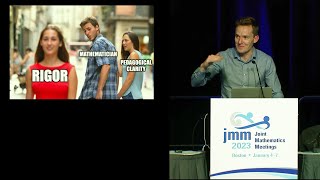
Math's pedagogical curse | Grant Sanderson JPBM Award Lecture, JMM 2023
Mar 30, 2023