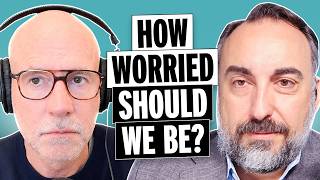
3 Rules for Men Who Can’t Get a Date
Audio Brief
Show transcript
In this conversation, we explore the rise of the anti-social century, examining how digital convenience and physical-world costs have structurally incentivized isolation, and how this shift affects mental health and risk-taking.
There are three key takeaways from this discussion on modern social isolation. First, physical socialization faces a major economic headwind as digital entertainment becomes virtually free while real-world connection becomes expensive and high-effort. Second, a new phenomenon termed monks in the casino reveals how young men are shifting risk-taking behaviors from the physical world into highly stimulating, online environments. Third, prioritizing rigid wellness metrics can lead to over-optimization, where individuals avoid real-world connections to protect their health scores, missing the critical benefits of social fitness.
The economic friction of the physical world acts as a powerful structural driver for isolation. While digital platforms like streaming services and social media provide cheap, instant gratification, going out or traveling has become costly. This economic imbalance makes staying home the default choice, even though studies consistently show that real-world interaction dramatically improves daily well-being.
This digital migration has also reshaped how young people, particularly young men, handle risk. While offline risks like dating, driving, and physical entrepreneurship are declining, high-risk online behaviors are soaring. Many now live monastic, isolated lives while actively engaging in highly stimulating digital casinos, such as speculative cryptocurrency day trading and sports betting.
Finally, modern health culture often hyper-focuses on trackable data like sleep scores and heart rate metrics. This can lead to suboptimal choices where people decline spontaneous gatherings with close friends just to preserve their daily data. In reality, maintaining deep social relationships acts as a vital vaccine against psychological decline, and the long-term cognitive damage of isolation far outweighs minor physical health risks.
Ultimately, reclaiming our mental and cognitive fitness requires us to embrace the natural friction of the physical world and prioritize active, real-world connection over digital convenience.
Episode Overview
- The Anti-Social Century: This episode explores how real-world socialization, dating, and community participation have collapsed over the past few decades, ushering in a highly isolated modern lifestyle.
- The Economic Incentives of Isolation: The discussion frames the rise of isolation as a structural and economic issue, where digital entertainment has become virtually free and frictionless while physical socialization has become expensive and high-effort.
- The "Monks in the Casino" Phenomenon: The conversation highlights a worrying trend among young men who live socially withdrawn, monastic lives while engaging in highly stimulating, high-risk digital behaviors like crypto trading and online sports betting.
- Rethinking Risk and Optimization: The episode challenges modern hyper-optimization and health culture, arguing that avoiding all physical-world risks and social friction often leads to much greater harms like chronic loneliness and cognitive decline.
Key Concepts
- The Anti-Social Century: In contrast to the first half of the 20th century, which saw rising indicators of social capital, the latter half of the 20th century and the first decades of the 21st century have seen a dramatic decline in real-world socialization. This is marked by declines in dating, coupling, marriage, and general time spent in public spaces.
- The Illusion of Digital Socialization: While early internet advocates argued that online networks would replace declining real-world interactions, data shows that every indicator of socialization continues to decline, even with widespread internet and social media adoption.
- Over-Demanding Solitude: Humans have a psychological tendency to "over-demand" introversion, frequently choosing to avoid strangers or real-world interactions. However, randomized studies consistently show that people who engage in brief social interactions report feeling happier afterward.
- Baumol's Cost Disease in the Social Sphere: Digital entertainment (TikTok, Netflix) has become virtually free, highly engaging, and incredibly convenient, while physical-world socialization (going out to a bar, traveling to meet friends) has become comparatively expensive and high-effort. This economic pressure acts as a powerful structural incentive for isolation.
- "Monks in the Casino": A metaphor describing modern young men who live highly solitary, monastic lives in their rooms. Unlike traditional monks, their solitary environment is a "casino"—they are heavily engaged in highly stimulating, high-risk digital behaviors, such as online sports betting and speculative day trading, rather than quiet contemplation.
- The Transference of Risk: The human drive for risk and thrill has not disappeared; rather, it has been transferred from the offline world to the online world. While young men are taking fewer real-world risks (such as driving, dating, or starting physical businesses), they are concentrating their risk-taking behavior online in speculative and highly addictive virtual environments.
- The Illusion of Optimization: Modern health and wellness culture places an immense emphasis on trackable metrics (heart rate variability, sleep scores, daily steps). Treating these metrics as absolute truths can lead to "suboptimal optimization," where individuals decline real-world social connections (like late-night drinks with a close friend) because it would temporarily damage their data scores.
- Democratic Socialism vs. Social Safety Nets: Modern political movements among young people often self-identify as "socialist" primarily as a critique of current economic systems and a desire for stronger social safety nets (like affordable housing and healthcare), rather than wanting state control over private industries.
- The Power of Curiosity in Human Connection: Good conversation is less about self-promotion and more about active curiosity. Approaching social interactions with a "reporting" mindset—asking questions and being genuinely interested—facilitates deep and comfortable connections.
Quotes
- At 0:00:22 - "We are disconnecting ourselves from happiness when we disconnect ourselves from other people. I think we’re locking ourselves out of real joy in a very finite life." – Derek Thompson explaining how choosing isolation over social friction actively reduces our daily well-being.
- At 0:03:38 - "Our crisis is not quite loneliness... In many ways, the crisis is the opposite of loneliness. It’s that we don’t feel the social cue to be lonely enough." – Derek Thompson arguing that because solitude has become so comfortable and entertaining, we no longer feel the biological signal (loneliness) that should push us to seek human connection.
- At 0:05:31 - "Americans under 25, Gen Z, spend 70% less time at parties than they did just 26 years ago—the year that Bowling Alone was published." – Derek Thompson highlighting the massive generational shift away from real-world, group-based social activities.
- At 0:07:37 - "In many cases you could say that the anti-social century is about the triumph of individualism. But the triumph of individualism has its own costs." – Derek Thompson explaining that while breaking free from traditional social structures offers freedom, it also strips away the social safety nets that protect mental health.
- At 0:11:28 - "I worry that isolation is directly correlated to... going crazy. If you isolate any mammal—an orca, a dog—it starts to go crazy. Other people and relationships create guardrails and checkpoints." – Scott Galloway explaining how real-world social relationships serve as an essential reality-check and stabilizer for the human mind.
- At 0:14:27 - "You can almost think of socialization as a kind of vaccine against a certain kind of isolating misery... You don't get a vaccine to help you when you're at your healthiest. You get a vaccine so that in the worst case, you don't get sick." – Derek Thompson arguing that the deepest value of friendship is not the fun moments, but the protective buffer it provides during life's inevitable tragedies.
- At 0:17:41 - "As our phones and digital entertainment have gotten dirt cheap, the physical world has gotten relatively expensive... It is cheap to stay at home on your couch and watch Netflix, and cheaper still to scroll through TikTok." – Derek Thompson applying the logic of Baumol's Cost Disease to explain why staying isolated has become the default economic choice.
- At 0:21:03 - "Today's monks are not religious; they are secular monks. And rather than hold traditional scriptures in their hands, they hold, of course, a smartphone... A lot of young men today are essentially behaving like monks. But what makes this particularly strange is... to imagine a monk in a casino." — Scott Galloway explaining the core juxtaposition of high-risk financial behavior occurring within highly isolated, monastic environments.
- At 0:22:08 - "Everything that requires some amount of gumption outside of one's room, that is declining. But everything that involves risk that you can do inside of your room, that is rising." — Scott Galloway highlighting the stark divergence between physical risk aversion and digital risk-seeking behavior.
- At 0:24:37 - "Socializing might be just as important as going to the gym... Social fitness isn't just a metaphor. Socializing makes our brains fit." — Derek Thompson emphasizing that social interaction is a physiological necessity for brain health and longevity, on par with physical exercise.
- At 0:44:42 - "The risks to a 25-year-old liver of alcohol are dwarfed by the risks of social isolation." – Derek Thompson highlighting the relative severity of mental and social health compared to minor physical health risks.
- At 0:49:17 - "Rather than delude ourselves with the idea that there exists a door behind which is the riskless life, we should have the more rational idea that every door... has risks behind it. You choose your own risks." – Derek Thompson articulating a mature philosophy on risk management in daily life.
Takeaways
- Overcome the "Introvert Trap": Actively push yourself to engage in casual, real-world social interactions—such as talking to a stranger during a commute—even if you feel an initial preference to remain alone.
- Build Your Friendship Vaccine: Cultivate and maintain deep, real-world relationships during stable times, treating socialization as a necessary buffer that will protect your mental health during future life crises.
- Balance Offline and Online Risk: Shift risk-taking behaviors away from digital platforms (like speculative trading or online betting) and redirect that energy toward offline risks, such as starting a business, dating, or joining physical clubs.
- Avoid Over-Optimization of Health Metrics: Do not let wearable health metrics and "perfect" sleep or fitness scores prevent you from participating in spontaneous, late-night, or messy social connections that bring joy.
- Practice the "Reporter Mindset": Lower dating and social anxiety by framing conversations around active curiosity and asking thoughtful questions rather than focusing on self-promotion.
- Acknowledge the True Cost of Solitude: Evaluate lifestyle choices by comparing physical micro-risks (like having a drink with friends) against the much larger, proven long-term macro-risks of social isolation.
- Fight Digital Frictionlessness: Intentionally create barriers to passive digital consumption (like deleting highly addictive apps) to make the physical world more appealing and competitive.