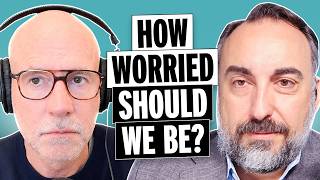
What’s the Right Investment Strategy for 2026? | Prof G Markets
Audio Brief
Show transcript
This episode analyzes the 2026 market outlook, focusing on AI's dual impact, the risk of market correction, high concentration in major tech stocks, and the importance of de-risking portfolios.
Four core insights emerge from this discussion: the importance of time in the market over timing, the necessity of actively rebalancing portfolios away from concentrated tech, understanding AI's societal ownership implications, and preparing for potential market corrections while discerning ego-driven corporate actions.
Wealth creation is primarily driven by consistent long-term market investment, not by attempting to time market highs and lows. Expert commentary emphasizes that staying invested over time is a more reliable path to financial success.
Investors must actively de-risk portfolios, rebalancing away from over-concentration in a few large-cap tech names. Diversification strategies include allocating to non-tech sectors, non-U.S. equities, or equal-weight S&P 500 funds.
AI's economic impact is framed as an ownership problem, not solely a technological one. While AI drives productivity, it also displaces jobs, raising crucial questions about who controls and profits from these advancements.
A 10 to 15 percent market correction is anticipated, viewed more as profit-taking than a deep crash. Yet, market concentration in a few tech names presents systemic risk, with a downturn potentially rippling widely. Investors should also scrutinize ego-driven corporate bidding wars, which often destroy shareholder value.
These insights underscore the critical need for disciplined, diversified, and long-term investment strategies amidst evolving market dynamics.
Episode Overview
- The episode analyzes the 2026 market outlook, featuring expert opinions on the dual impact of AI, the risk of a market correction, and the dangers of high concentration in major tech stocks.
- Scott Galloway shares his personal investment philosophy, emphasizing that his wealth came from staying invested in the market long-term, not from attempting to time it.
- The hosts advocate for "de-risking" as a primary strategy for the current market, suggesting investors rebalance portfolios away from an over-concentration in Big Tech.
- The ongoing bidding war for Warner Bros. Discovery is dissected as a case study in ego-driven corporate strategy that is likely to destroy shareholder value for the winning company.
Key Concepts
- 2026 Market Outlook: Experts predict a potential market correction on the order of 10-15%, more akin to the 1999 dot-com bubble than a major depression, driven by overvaluation and euphoria.
- AI's Economic Impact: AI is presented as both a major productivity driver and a significant job displacer. The core societal issue is framed not as a technology problem, but as an "ownership problem"—who controls and profits from AI.
- Systemic Market Risk: The heavy concentration of the market in a few large-cap tech stocks creates systemic risk, meaning a downturn in these few names could trigger widespread panic with no safe havens in equities.
- Long-Term Investing Philosophy: The majority of wealth is built by consistently investing capital in the market over the long term, rather than through entrepreneurial exits or attempting to time market highs and lows.
- The "Year of De-Risking": Due to the massive run-up in Big Tech, most investor portfolios are imbalanced and overexposed. The recommended strategy is to de-risk and rebalance.
- Portfolio Rebalancing Strategies: Methods for diversification include paying down debt, investing in private companies, using equal-weight S&P 500 funds, and allocating to non-tech sectors (e.g., healthcare, consumer staples) and non-U.S. equities.
- Ego-Driven Mergers & Acquisitions: The bidding war for Warner Bros. Discovery serves as an example of how testosterone and ego, rather than financial discipline, can drive corporate acquisitions, often leading to overpayment and poor outcomes for shareholders.
Quotes
- At 2:19 - "Ed has not had his review and bonus conversation yet, so he's laughing and being nice to me. Claire's like, 'Fuck you, old man, let's get on.' She had her review yesterday. So she's done. The money has already been wired." - Scott Galloway humorously explains the dynamic between himself and his production team.
- At 3:22 - "I invent a robot, but I sell the robot to your boss. You're out of a job, brother... What we have here is not a robot problem or an AI problem, but an ownership problem." - Economist Justin Wolfers explains the societal challenge of AI, framing it as an issue of who owns the technology.
- At 3:53 - "I'm more convinced that there'll be a destruction of value in the markets, but probably more akin to something like 1999 than 1929." - Journalist Andrew Ross Sorkin predicts a market correction similar to the dot-com bubble rather than a full-scale depression.
- At 4:51 - "To the extent that there's going to be a correction, there's no place to hide in stocks... The panic that that's going to create is going to ripple through stocks." - Professor Aswath Damodaran warns that a downturn in the largest tech stocks would have a widespread negative impact on the entire market.
- At 24:47 - "I've made more money in stocks than I've made buying and selling businesses, and I've made a lot of money buying and selling businesses." - Scott Galloway explains that the majority of his net worth has come from market investments, not his entrepreneurial ventures.
- At 25:14 - "I have never once been able to say, 'Oh, I'm selling now,' and then a year later, the market's down and I go back in... and buy stuff on the cheap. I've never been able to figure that out." - Galloway on the futility and difficulty of timing the market.
- At 26:44 - "I think it's more important to say, what are you doing with your actual fucking money? What are you doing? That is what you really believe, right?" - Galloway transitions from theory to practice, emphasizing that an investor's true beliefs are reflected in their own portfolio moves.
- At 27:23 - "One of my tenets that I still hold on to is I am always in the market." - Galloway shares a core principle of his investment philosophy, emphasizing the importance of staying invested.
- At 34:02 - "This is the year of de-risking... almost everyone's portfolio is completely imbalanced right now." - Ed Elson on why 2026 should be focused on de-risking and rebalancing away from an over-concentration in Big Tech.
- At 53:27 - "Basically, this whole process is going to create the wealthiest man who destroyed the most shareholder value, and that is David Zaslav." - Scott Galloway critiques the Warner Bros. Discovery CEO, suggesting he will be handsomely rewarded regardless of the outcome for investors.
Takeaways
- Prioritize "time in the market" over "timing the market," as consistently staying invested is a more reliable path to wealth creation.
- Actively rebalance your portfolio to reduce overexposure to a handful of large-cap tech stocks and diversify into other sectors and geographies.
- When evaluating the impact of new technologies like AI, focus on the implications of ownership and control, not just the technology itself.
- Prepare for a potential 10-15% market correction, but view it as a likely profit-taking event rather than a sign of a deep, systemic crash.
- In a market with subdued return expectations, investing in your own education, skills, and health can provide the most significant long-term ROI.
- Be a skeptical investor when companies engage in high-profile, ego-driven bidding wars, as they often result in overpayment and the destruction of shareholder value.