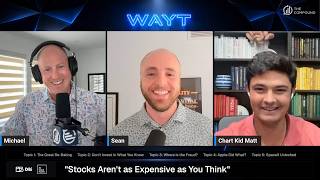
WAYT? 7-21-2026
Audio Brief
Show transcript
In this conversation, the focus is on a critical transition phase in the stock market as capital rotates out of concentrated technology sectors into undervalued defensive and cyclical industries.
There are three key takeaways from this market analysis. First, the recent technology sell-off represents a healthy broadening of the market rather than an impending crash. Second, the rapid de-leveraging of speculative retail funds is flushing out short-term froth while leaving core corporate spending intact. Third, hard transaction data shows that consumer financial health remains resilient despite persistent headlines of systemic distress.
While major technology indices have experienced sharp corrections, the broader market has held remarkably steady. Capital is not fleeing equities altogether, but is instead rotating into lagging areas like financials, healthcare, and industrials. This internal rotation prevents dangerous asset bubbles and provides structural stability to the entire index.
The market is also undergoing a necessary clearing of speculative leverage, highlighted by a nearly forty percent reduction in assets within leveraged semiconductor funds. This volatility provides institutional investors with a healthier environment to build positions in highly profitable mega-caps. Moving forward, corporate capital expenditure from hyperscalers like Alphabet will serve as the primary gauge for the longevity of the artificial intelligence infrastructure cycle.
Finally, despite downbeat corporate commentary from fast-food chains, hard banking data contradicts the narrative of lower-income consumer insolvency. Wage growth in lower-income brackets has actually re-accelerated, credit card delinquencies remain historically low, and absolute transaction demand is holding firm. While consumers are price-sensitive and trading down to cheaper alternatives, their underlying balance sheets remain intact.
Ultimately, this market transition suggests that sector rotation and leverage reduction are paving the way for a healthier, more diversified economic expansion.
Episode Overview
- This episode analyzes a critical transition phase in the stock market, focusing on how a massive rotation of capital out of heavily concentrated technology and AI sectors into undervalued, defensive, and cyclical sectors is stabilizing the broader indexes.
- It explores the mechanics of market "de-risking" by tracking the liquidation of highly leveraged retail ETFs and evaluating how corporate capital expenditure (particularly at Alphabet/Google) acts as a structural proxy for the entire AI infrastructure thesis.
- The narrative challenges popular, pessimistic macroeconomic theories, such as the imminent "catch-down" market crash and the overblown narrative of systemic lower-income consumer insolvency, by contrasting media headlines with hard bank transaction and wage growth data.
- This episode is essential for investors, traders, and market strategists trying to determine whether the recent volatility in technology stocks signals a major market peak or a healthy, necessary consolidation that paves the way for a broader bull run.
Key Concepts
- Market Rotation and Broadening: A critical process where capital exits overextended, highly concentrated sectors (like technology and AI hardware) and flows into lagging sectors (such as healthcare, financials, consumer staples, and small-caps). Rather than indicating a market top, this broadening of participation prevents dangerous asset bubbles and provides structural stability to the broader indexes.
- Leveraged ETF De-risking: The rapid liquidation and decline in assets under management (AUM) within speculative, leveraged semiconductor and tech ETFs. This painful but necessary "clearing of the brush" flushes out volatile, short-term retail and algorithmic leverage, allowing institutional investors with high conviction to rebuild long-term positions at attractive valuations.
- The "Clean" AI Narrative: The concept that certain mega-cap tech giants, particularly Alphabet (Google), serve as the foundational pillars of the artificial intelligence trend because their core businesses are highly profitable and self-funding. Tracking their capital expenditure (CapEx) offers a concrete metric of actual corporate commitment to physical AI infrastructure.
- The "Catch-Down" vs. "Catch-Up" Debate: A classic market dilemma regarding extreme divergence where major indexes trade near highs while the majority of underlying stocks lag. Bears argue the index must drop to meet the weaker stocks ("catch-down"), while bulls argue that strong economic fundamentals allow the lagging stocks to rally and support the index during a leadership consolidation ("catch-up").
- Deconstructing the "K-Shaped" Consumer Narrative: The popular belief that the lower-income consumer is in financial ruin is often contradicted by hard data. While price sensitivity has led consumers to "trade down" to discount brands, bank transaction data shows that lower-income wage growth has re-accelerated, credit card delinquencies remain historically low, and absolute demand remains intact.
- The Structural Bull Case for Insurance: Property & Casualty (P&C) insurance companies act as highly effective investment vehicles during inflationary, higher-rate environments. They benefit from the structural tailwinds of rising premiums, increased yields on their massive investment floats (premiums collected but not yet paid), and periods of relatively low catastrophe losses.
Quotes
- At 0:03:02 - "We have one earnings report that will be more meaningful to the market than any other... Google's earnings are the key to the market. I think this is the most determinative moment of earnings season." - Explaining why Alphabet's financial performance and CapEx guidance are treated as the ultimate bellwether for the AI infrastructure thesis.
- At 0:05:07 - "The float's going to quadruple... we're talking about an unbelievable amount of money... $123 billion worth of potential supply potentially coming to market." - Illustrating how scheduled shareholder lock-up expirations can introduce artificial downward price pressure on high-quality equities regardless of fundamentals.
- At 0:08:14 - "If we're going to put on another 10-15% in the S&P from here to finish out the year... the only way that's happening is if the AI trade gets back on track, and the most important player is Google." - Emphasizing that while the market can rotate, long-term broad index growth ultimately relies on mega-cap tech leadership.
- At 0:11:11 - "What on earth is more bullish than a situation where the leadership group... gets absolutely taken to the cleaners, and the S&P 500 index doesn't budge? Because there's so much buying in almost all of the other sectors." - Describing how powerful sector rotation shields the overall index from sharp corrections in its largest components.
- At 0:11:54 - "The AUM of leveraged ETFs has dropped by over $100 billion... 39% of levered semi ETF AUM has been reduced. This decrease is one of the healthiest things that can happen for the market." - Highlighting how systemic risk is mitigated when speculative retail and algorithmic leverage is washed out.
- At 0:24:48 - "39% of levered semi ETF AUM has been reduced... This decrease is one of the healthiest things that can happen for the market." - Reiterating that flushing out excessive retail leverage is a mandatory prerequisite for establishing a sustainable, long-term market bottom.
- At 0:26:46 - "The S&P 500 index doesn't budge because there's so much buying in almost all of the other sectors... that the market holds up, the internals blow out in terms of broadening, and we go through a margin wipeout and then come out of the other side." - Explaining the mechanics of a constructive market consolidation where broad demand offsets targeted sector selling.
- At 0:29:14 - "[Apple] had its best three-week stretch relative to the index since 2009... The AI trade unwound, and this is the anti-AI tech stock." - Showing how mature mega-cap stocks with stable, non-speculative cash flows act as safe havens during rapid thematic unwinds.
- At 0:29:58 - "I don't think the narrative is there yet, I think you were very early." - Noting how long-term structural changes in a company's business model are often recognized by savvy investors well before mainstream financial media codifies them.
- At 0:34:33 - "Money left these names and went into the rest of the index. I don't buy that it's going to be a delayed catch-down." - Expressing confidence that capital redistribution within the stock market indicates fundamental economic strength rather than a looming systemic crash.
- At 0:41:14 - "The conventional K-shaped narrative is probably roughly half reality and half overstatement. It accurately captures wealth inequality and affordability frustrations, but frequently exaggerates the degree of deterioration in current cash flows." - Distinguishing consumer frustration over elevated prices from actual, systemic household balance sheet insolvency.
- At 0:42:07 - "The companies blaming the lower consumer are fast-food companies... The banks are saying people are paying their bills." - Demonstrating why hard bank transaction and credit data is a far more reliable indicator of consumer health than specific corporate earnings reports.
Takeaways
- Monitor Capital Rotation Rather Than Total Market Exits: Do not mistake a sharp sell-off in leading high-beta technology stocks for an impending market crash; analyze whether that capital is leaving equities entirely or simply rotating into defensive and value-oriented sectors.
- Leverage Volatility to Buy Clean Fundamentals: Use periods of violent de-leveraging (such as spikes in semiconductor volatility and massive outflows from leveraged ETFs) to build or expand long-term positions in highly profitable mega-caps that have strong balance sheets.
- Track Corporate CapEx as a Leading Indicator: Look at the Capital Expenditure (CapEx) trends of hyperscalers like Alphabet to gauge the true, multi-billion-dollar health and longevity of hardware supply chains and the broader artificial intelligence cycle.
- Differentiate Consumer Sentiment From Hard Financial Data: Avoid making investment decisions based solely on retail consumer frustration headlines; instead, monitor hard metrics like wage growth, credit card delinquency rates, and bank transaction data to assess consumer health.
- Invest in Quiet Compounders with High Float: Look beyond volatile, headline-grabbing sectors and allocate capital to boring, defensive industries like Property & Casualty (P&C) insurance, which quietly compound at all-time highs by earning elevated yields on their float in a high-rate environment.
- Identify "Anti-Thematic" Safe Havens: Identify high-quality, cash-rich companies that can act as defensive havens and capture liquidity during periods when highly speculative, thematic market trades unwind rapidly.