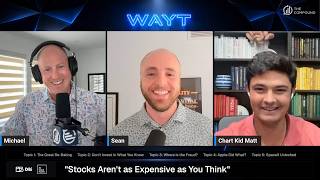
WAYT? 3-17-2026
Audio Brief
Show transcript
This episode covers the artificial intelligence industry transition from capital intensive training to operational inference, the structural moats of dominant tech platforms, and the hidden systemic risks brewing in private credit markets.
There are three key takeaways from this discussion. First, the economics of artificial intelligence are changing as the industry moves toward continuous usage and agentic workflows. Second, structural advantages in technology are increasingly defined by software ecosystems and distribution networks rather than physical hardware. Third, severe valuation disconnects and asset liability mismatches are creating dangerous liquidity risks in the private markets.
The artificial intelligence ecosystem is moving past the phase of building massive models and into the deployment phase known as inference. This transforms the technology into an always on utility where energy efficient computing becomes the new critical bottleneck. The technology is also evolving past simple synchronous chatbots into asynchronous agents capable of performing multi step tasks independently. This shift allows businesses to fundamentally reduce labor costs by automating complex daily routines and overnight customer interactions.
When evaluating technology leadership, software ecosystems provide the ultimate competitive defense. Nvidia maintains its dominant market share not just through superior chips, but through its twenty year old proprietary software platform that serves as the essential operating system for developers. This creates immense switching costs that protect the company from hardware only competitors. Similarly, Uber is cementing its future through a capital light distribution strategy for autonomous vehicles, acting as an indispensable tollbridge that forces manufacturers to compete for its massive rider base.
Beyond technology, significant systemic risks are quietly building within the financial sector. Private credit and equity funds are frequently failing to mark down their portfolios to reflect the valuation haircuts seen in comparable public companies. This creates an illusion of stability that masks a classic asset liability mismatch, where funds offer liquid redemption terms while holding highly illiquid loans. If an economic downturn triggers mass redemptions, these private funds could face a severe liquidity crisis echoing historical financial panics.
Ultimately, navigating this complex environment requires prioritizing energy efficient infrastructure and capital light platforms while applying extreme skepticism to private market valuations.
Episode Overview
- Explores the critical transition of the AI industry from the capital-intensive "training" phase to the continuous, operational "inference" phase, including the rise of autonomous agents and robotics.
- Analyzes the structural moats and market valuations of dominant technology companies, specifically detailing Nvidia's software advantage and Uber's capital-light autonomous vehicle strategy.
- Examines hidden systemic risks in the financial sector, focusing on the massive valuation disconnects and asset-liability mismatches currently building in private credit and private equity markets.
- Essential listening for investors, business leaders, and technologists seeking to understand how AI will be practically monetized and where the next major liquidity risks lie in private markets.
Key Concepts
- The Inference Inflection: The AI ecosystem is shifting from building massive models (training) to deploying them for continuous daily usage (inference). This matters because the economic model of AI is changing into an "always-on" utility, making energy-efficient computing the new critical bottleneck.
- Agentic AI and Robotics: AI is evolving past synchronous chatbots into asynchronous agents capable of performing multi-step tasks independently, and manifesting physically through robotics. This paradigm shift allows AI to fundamentally reduce B2B labor costs rather than just serving as a consumer novelty.
- The Software Moat in Hardware: Nvidia's true competitive advantage is its 20-year-old proprietary CUDA software platform, which serves as the de facto operating system for AI developers. This matters because it creates immense switching costs, protecting Nvidia from hardware-only competitors.
- The Private Credit Valuation Disconnect: Private credit and equity funds are failing to mark down their portfolios to reflect the massive valuation haircuts seen in public software companies. This lack of transparency creates a dangerous illusion of stability in private markets that ignores the underlying stress on equity.
- Asset-Liability Mismatch in Private Funds: Many private credit funds offer liquid redemption terms to investors while holding highly illiquid private loans. If a downturn triggers mass redemptions, these funds face a severe liquidity crisis, echoing historical financial panics.
- Uber's Autonomous Tollbridge Strategy: Uber is partnering with autonomous vehicle manufacturers rather than building its own cars. This allows Uber to act as the indispensable, capital-light distribution network, monetizing the autonomous transition while forcing manufacturers to compete for access to its rider base.
Quotes
- At 0:10:20 - "We have reached the inference inflection. So inference in distinction to training... most of what's gone on the last three years since the advent of ChatGPT had to do with training models... now inference is the ongoing usage." - Explaining the critical shift in how AI compute is being utilized and monetized.
- At 0:12:31 - "AI can now do productive work. Once that happens, the demand picture changes... that all moves into production where the meter never stops running." - Describing the economic shift from R&D spending to continuous operational expenditure in AI.
- At 0:16:18 - "The biggest moat that Nvidia has and has always had is the CUDA software platform, which celebrated 20 years today. Because CUDA runs in every cloud... everyone working in AI is familiar with CUDA, it's like the operating system of AI." - Identifying the core structural advantage that protects Nvidia's market share.
- At 0:17:48 - "Deal with my customers from 7:00 PM until 7:00 AM when my employees come back to work... now we're getting into a realm where companies are going to be able to program their customer interaction." - Illustrating the practical, high-ROI business applications of the new wave of AI agents.
- At 0:20:30 - "these aren't two distinct technological waves these are highly overlapping things that are happening all at once and they're reinforcing each other." - Explaining the interconnected and rapid nature of software and hardware advancements in AI and robotics.
- At 0:25:34 - "everyone that watched it at 180 for six months goes ah no no no no no no I'm doing this 30 years I'm 49 years old that's I'm not saying it has to happen I'm just telling you that's how it does happen." - Illustrating market psychology and investor regret when missing out on a tech stock's upward momentum.
- At 0:34:00 - "I think the charitable interpretation is that coming public sucks and it does and it's expensive and it's annoying and one of the most annoying things is having to report earnings quarterly." - Explaining the rationale behind proposals to reduce earnings reporting frequency, despite the inherent risks to transparency.
- At 0:46:16 - "I literally think all the marks are wrong." - Highlighting the core argument that private equity and private credit valuations are currently disconnected from public market realities.
- At 0:52:21 - "The worst loans are made in the best of times." - Quoting Howard Marks to explain the latent risk embedded in private credit portfolios built during periods of easy money and low interest rates.
- At 0:55:12 - "This is the classic asset liability mismatch." - Identifying the systemic risk created when funds offer liquid redemption terms while holding highly illiquid private loans.
- At 1:03:55 - "Is there anyone you would rather have as a partner for the autonomous driving future than Nvidia? Because Nvidia is going to be the provider to every OEM." - Detailing the strategic significance of Uber's partnership network to dominate the software-driven robotaxi market.
Takeaways
- Prioritize investments in energy-efficient computing and infrastructure, as electricity consumption will be the primary bottleneck in the AI inference phase.
- Implement asynchronous AI agents in your business workflows to handle routine, overnight customer interactions and significantly reduce operational labor costs.
- Evaluate technology investments by analyzing their software ecosystems and developer lock-in, rather than solely comparing hardware specifications.
- Defend against reduced corporate reporting frequency (like semi-annual earnings) to ensure you maintain the transparency required to accurately assess public market investments.
- Apply extreme skepticism to the reported valuations of private credit and private equity portfolios, especially if they heavily feature software companies that have seen public market multiples collapse.
- Monitor private credit funds for the implementation of redemption gates, using them as an early warning signal for broader liquidity stress in the private markets.
- When analyzing platform companies, look for business models that position the company as a capital-light distribution network (like Uber) rather than a capital-intensive manufacturer.