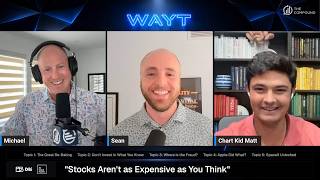
WAYT? 12-2-2025
Audio Brief
Show transcript
This episode delves into the perils of buying the dip on high quality stocks that crash, while also examining specific investment opportunities in AI and energy.
There are three key takeaways from this discussion. First, avoid the impulse to buy the dip on former market darlings after they crash significantly, as data suggests continued underperformance is likely. Second, look for investment opportunities where market fear over a specific threat, like AI, has already compressed a strong company's valuation to historically low levels. Third, for contrarian bets in historically underperforming sectors such as energy, a broad market ETF can be more prudent than stock picking, while recognizing that even dominant tech companies must rapidly adapt to competitive threats.
Adam Parker's research defines a broken compounder as a stock that has risen over one hundred percent in five years, then crashes thirty percent or more in a single month. Data suggests buying the dip on these names is statistically a losing strategy. On average, they continue to underperform industry peers for six to twelve months post crash. The worst performers typically have the highest forecasted earnings growth, as any disappointment leads to a severe and prolonged reset of expectations.
The discussion highlights Adobe as a contrarian opportunity, where market fears about AI's impact have already compressed its valuation multiple significantly. This can create a buying opportunity if the company remains fundamentally sound. Additionally, large scale authorized share repurchase programs can serve as a major bullish catalyst, signaling management's confidence when a stock is trading at multi year lows.
In sectors with low dispersion and high correlation, such as energy, individual stocks tend to move together. This makes a broad sector ETF a logical investment vehicle, as picking individual winners is less likely to yield significant outperformance. Furthermore, the AI industry exemplifies intense competition; a new launch by Google's Gemini, for instance, forced OpenAI to declare a code red to quickly improve its core product.
These insights underscore the importance of data driven decisions and careful analysis in navigating today's dynamic markets.
Episode Overview
- The episode features a deep dive into "Broken Compounders"—high-quality stocks that crash over 30%—with guest Adam Parker, whose research suggests that "buying the dip" on these names is statistically a losing strategy.
- The discussion transitions to analyzing specific investment opportunities, including the contrarian case for Adobe (ADBE) despite AI threats and the potential for a rebound in the underperforming energy sector.
- The hosts explore the competitive dynamics in the AI industry, highlighting OpenAI's "code red" response to Google's Gemini launch.
- The conversation also touches on market history, contrarian investing strategies, and the logic of using sector ETFs versus individual stock picking.
Key Concepts
- Broken Compounders: A quantitative framework for identifying formerly high-performing stocks (up 100%+ in 5 years) that have "broken" by falling 30% or more in a single month.
- "Buy the Dip" Fallacy: Research and data indicate that, on average, the basket of "broken compounders" continues to underperform their industry peers for 6-12 months following the crash.
- Risk Factors for Underperformance: Fallen stocks with the highest forecasted earnings growth are most likely to continue underperforming, as any future disappointment leads to a severe and prolonged reset of expectations.
- Valuation Compression: The market can price in existential threats (like AI's impact on Adobe) by significantly lowering a stock's valuation multiple, which can create a buying opportunity if the company is fundamentally sound.
- Stock Buybacks: Large-scale, authorized share repurchase programs can serve as a major bullish catalyst for a company's stock, especially when it is trading at multi-year lows.
- Sector Dispersion and Correlation: In sectors with low dispersion and high correlation (like energy), individual stocks tend to move together. This makes a broad sector ETF a logical investment vehicle, as picking individual winners is less likely to yield significant outperformance.
- AI Competitive Landscape: The artificial intelligence space is marked by intense competition, where advances by one company (e.g., Google's Gemini) can force market leaders (e.g., OpenAI) to immediately shift resources and declare a "code red" to improve their core product.
Quotes
- At 4:48 - "Tell us about this piece that you did about broken compounders... It's one of my favorite topics. Like, when do you buy the dip in some of the most popular stocks once they stumble?" - Josh Brown frames the central investment question they are exploring based on Adam Parker's research.
- At 6:30 - "We decided it's got to be up 100% at least in five years... and then it has to go down by a certain amount that it hurts. So we studied what we thought makes sense, and it was 30% in a month." - Adam Parker explains the quantitative methodology used to define a "broken compounder" for his study.
- At 9:43 - "The attributes of the worst ones are highest forecasted earnings growth... And so when you get really high forecasted earnings growth and you disappoint, that's when there's a longer tail to the underperformance." - Adam Parker details the specific traits of the worst-performing broken compounders.
- At 19:43 - "When you see a stock that had previously been a compounder... when you see it break, like really break, 30% or worse, that is not in and of itself a quote-unquote opportunity." - Josh Brown summarizes the primary, counterintuitive takeaway from Adam Parker's research on fallen market leaders.
- At 20:28 - "If you have a one-week horizon, maybe you'll catch the dead cat bounce. But if you're 6 or 12 months, the distribution is pretty negative." - Adam Parker clarifies that while short-term trading might yield a profit, the statistical odds are against long-term investors in these specific situations.
- At 21:02 - "I know guys who shorted UnitedHealth after they were long it... went down 30 and they were like, I don't know what this thing's going to earn and I'm gonna short it." - Adam Parker provides an anecdote illustrating how professional traders will flip their positions once a stock's fundamental story breaks down.
- At 43:01 - "If you think you're the first genius to be like, 'Oh, Adobe's threatened by AI,' dude, everybody understands that. Not just the stock price, but the valuation. It's crazy." - Josh Brown explains that the market has already priced in the AI threat, leading to a significant compression in Adobe's valuation multiple.
- At 44:15 - "Is this like buying Alphabet last summer? Or is that a bad comparison? Because people were saying a lot of the same things, that Google is existentially endangered by AI." - Josh Brown draws a parallel between the current sentiment on Adobe and the past pessimism surrounding Google.
- At 53:21 - "OpenAI Chief Executive Sam Altman told employees Monday that the company was declaring a 'code red' effort to improve the quality of ChatGPT and delaying other products as a result." - Josh Brown discusses the competitive pressure OpenAI is facing from Google's new Gemini model.
- At 59:22 - "It is so far underperforming. It's the worst sector over the last five and 10 years... Just massive, massive, massive lag." - Michael Batnick makes the case for energy stocks by highlighting their extreme, long-term underperformance relative to the S&P 500.
- At 60:52 - "But energy, no dispersion, high correlation... So yeah, you could pick winners if you want, Josh, I know you like to, but if I'm gonna wade here, I'm just buying the index." - Michael Batnick argues that a sector ETF is the most logical way to invest in energy.
Takeaways
- Avoid the impulse to "buy the dip" on former market darlings after they crash 30% or more; data suggests they are more likely to continue underperforming.
- Be most cautious with fallen stocks that still have very high earnings growth expectations, as they have the farthest to fall if they disappoint again.
- When a leading stock in a sector breaks down, consider reallocating capital to a healthier competitor in the same group rather than betting on a recovery of the fallen name.
- Look for investment opportunities where market fear over a specific threat (like AI) has already compressed a strong company's valuation to a historically low level.
- A significant stock buyback authorization can be a powerful catalyst and a signal of management's confidence, especially when a stock is out of favor.
- For contrarian bets in historically underperforming sectors like energy, using a broad market ETF can be a more prudent strategy than trying to pick individual stocks.
- Recognize that even the most dominant tech companies are vulnerable to rapid innovation and must be prepared to pivot strategy in response to competitive threats.