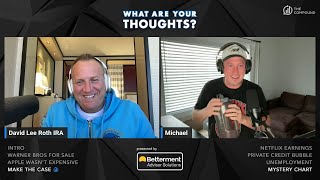
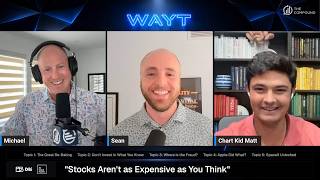
WAYT? 11-25-2025
Audio Brief
Show transcript
This episode covers recent market volatility, long-term historical optimism, investor psychology, and emerging investment opportunities.
There are four key takeaways from this discussion. First, the market’s extreme volatility, with sharp intraday sell-offs quickly reversed by powerful rallies, underscores the futility of short-term predictions and the importance of humility in market commentary.
Second, economist Ed Yardeni presented his optimistic "Roaring 2020s" thesis. He argues that powerful, multi-hundred-percent decadal market gains are historically normal, not anomalous, challenging modern market pessimism with a long-term perspective.
Third, the discussion explored investor psychology, particularly managing Fear of Missing Out, or FOMO. The cure for FOMO is often just time, as investor interest frequently ties to recent performance rather than underlying fundamentals. The conversation also differentiated between shallow non-recessionary corrections and deep, recession-driven bear markets.
Finally, the episode analyzed emerging investment opportunities. This includes a significant sector rotation into healthcare stocks, led by companies like Eli Lilly achieving trillion-dollar valuations. Attention was also drawn to potential turnarounds in previously out-of-favor names, identifying opportunities where the market may have prematurely written off a company.
These insights offer a nuanced perspective on current market dynamics, emphasizing long-term historical context and disciplined investor behavior.
Episode Overview
- The hosts discuss the market's recent extreme volatility, highlighting a sharp intraday sell-off that was completely erased by a powerful three-day rally, underscoring the futility of short-term predictions.
- Economist Ed Yardeni joins the show to present his optimistic "Roaring 2020s" thesis, arguing that powerful, multi-hundred-percent decadal market gains are historically normal, not anomalous.
- The conversation explores investor psychology, focusing on how to handle FOMO (Fear of Missing Out) and the critical distinction between shallow, non-recessionary corrections and deep, recession-driven bear markets.
- The episode concludes by analyzing emerging investment opportunities, including a significant sector rotation into healthcare stocks, led by Eli Lilly, and potential turnarounds in previously out-of-favor names like Zoom.
Key Concepts
- Market Unpredictability: The market's capacity to deliver stunning reversals that defy short-term expectations, as seen in the recent gap-up, crash, and immediate sharp recovery.
- The "Roaring 2020s" Thesis: The idea that powerful, decadal bull markets are historically common, providing a counter-narrative to modern-day market pessimism.
- Investor Psychology and FOMO: The concept that the cure for FOMO is often just time, as investor interest is typically tied to an asset's recent performance rather than its underlying fundamentals.
- Types of Market Drawdowns: A framework for distinguishing between two types of market declines: more frequent, non-recessionary corrections (averaging -17%) and rarer, deeper, recession-driven bear markets.
- Sector Rotation into Healthcare: A notable shift in market leadership with broad-based strength emerging in healthcare and instrument companies, highlighted by Eli Lilly becoming a trillion-dollar company.
- Corporate Turnaround Stories: Identifying investment opportunities in companies previously written off by the market, such as the incredible resurgence of Eli Lilly and a potential bullish setup for Zoom.
- Optimism vs. Pessimism: The contrast between an optimistic, long-term outlook grounded in historical progress and the more pessimistic view often adopted by experienced market veterans who feel the "golden era" is over.
Quotes
- At 0:39 - "I got to say, I think we're doing some of our best work. Like this really is the best show in the world. I said it." - Michael Batnick humorously hypes the show at the beginning of the episode.
- At 3:05 - "If you're not humbled by this market, you're a psycho." - Michael Batnick commenting on the stock market's recent unpredictable and counterintuitive behavior.
- At 3:24 - "We're talking with Warren Pies on Thursday morning, the show is going to air... Friday, and we have no way of knowing that we're going to have a gap up, a crash, and then the following day we're going to gain... most of it back." - Josh Brown highlighting the challenges of producing timely market commentary in such a volatile environment.
- At 19:10 - "The bottom line is that there's nothing unusual about a roaring stock market. We've had it before." - Ed Yardeni makes his central point that strong decadal market performance is not a historical anomaly.
- At 19:35 - "I think there's sort of like a disconnect sometimes when you're talking to people who have seen a lot of history and you would expect them to be more optimistic given everything that they've witnessed in their lifetime, but it goes the other way." - Josh Brown elaborates on his observation that many older investors become more pessimistic despite having lived through decades of progress.
- At 43:51 - "There is a cure for FOMO, and it's simpler than you think. A lot of times the cure is just time. Just letting things play out." - Josh explains that the intense fear of missing out on a hot stock often resolves itself as the hype fades and fundamentals reassert themselves over time.
- At 44:43 - "We don't really want the asset that badly, we want the performance of the asset. And when the perception of that performance continuing goes away... well, who the hell wants to buy this thing?" - Josh makes a point about investor psychology, suggesting that demand for speculative assets is driven by momentum.
- At 50:21 - "There are two types of equity drawdowns... There is the non-recessionary equity drawdowns, which on average are a 17% drawdown... And then there is the recessionary equity drawdowns... the knockout punch." - Michael distinguishes between typical market corrections and severe, recession-linked bear markets.
- At 55:44 - "That effectively makes Google into a combination of OpenAI and Microsoft with a bit of Nvidia thrown in." - Michael quotes a Wall Street Journal article to describe Google's comprehensive, vertically integrated AI strategy.
- At 56:02 - "We're delighted by Google's success—they've made great advances in AI and we continue to supply to Google." - Michael reads a tweet from NVIDIA's official newsroom, highlighting the passive-aggressive nature of corporate messaging.
- At 63:38 - "10 years ago, people were saying this thing should just go private, it's just worthless. They have nothing. And out of nowhere, they found this metabolic market and they ran with it." - Josh marvels at the incredible turnaround story of Eli Lilly, a 150-year-old company that went from being written off to becoming a trillion-dollar market leader.
Takeaways
- Remain humble and avoid making bold short-term predictions, as the market can reverse course violently and without warning.
- Ground your long-term investment outlook in historical precedent, which shows that powerful, decade-long bull markets are a recurring feature.
- Combat the fear of missing out (FOMO) by practicing patience, recognizing that speculative manias eventually fade as performance-chasing behavior subsides.
- Use historical data to differentiate between a standard market correction and a major recessionary bear market to better calibrate your risk management.
- Monitor sector rotations for emerging investment themes, such as the current strength and potential leadership from the healthcare sector.
- Look for opportunities in "left for dead" stocks, as powerful turnaround stories can emerge from companies the market has completely written off.
- Understand that speculative bubbles are fueled by a desire for performance, not a fundamental love for the underlying asset, which helps in identifying and avoiding them.